
We read your photo as:
Find the equation of the line of the below a) gradient 2 passes through (0,8) b) gradient 4 passes through (0,3) 5. Divide a) (2x³4x² + 6x - 3) ÷ (x+4) b) (6x³ - 4x² + 3x + 2) ÷ (2x + 2)
ScanSolve AI Answer
Step-by-step solution
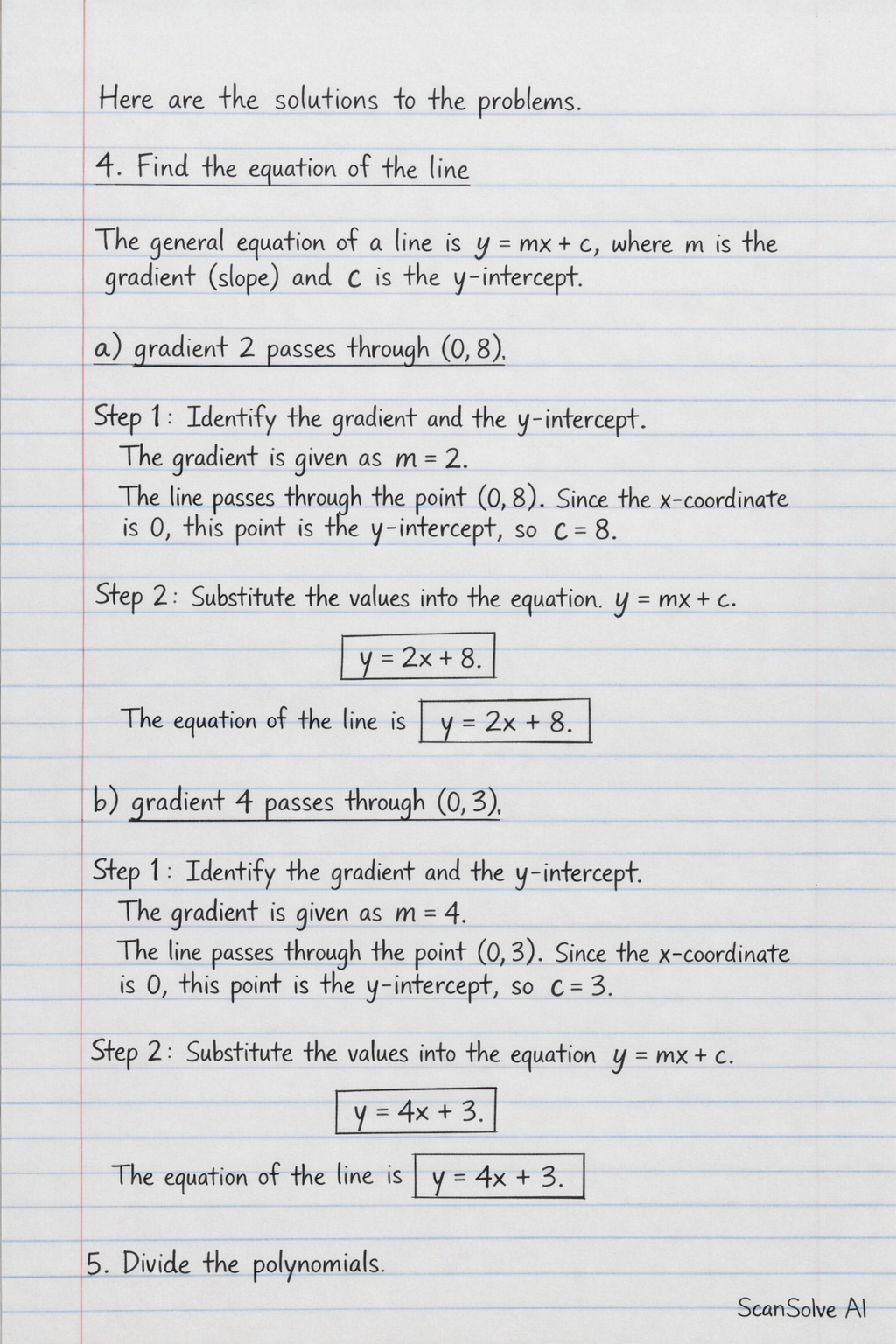
10 stepsHere are the solutions to the problems.
4. Find the equation of the line
The general equation of a line is , where is the gradient (slope) and is the y-intercept.
a) gradient 2 passes through
Identify the gradient and the y-intercept.
The gradient is given as .
The line passes through the point . Since the x-coordinate is 0, this point is the y-intercept, so .Substitute the values into the equation .
The equation of the line is .
b) gradient 4 passes through
Identify the gradient and the y-intercept.
The gradient is given as .
The line passes through the point . Since the x-coordinate is 0, this point is the y-intercept, so .Substitute the values into the equation .
The equation of the line is .
5. Divide the polynomials
a)
Assumption: The term is interpreted as . If it was intended as a product, the problem would be significantly more complex and usually written with a multiplication symbol.
We will perform polynomial long division for .Divide by .
Divide by .
Divide by .
The quotient is and the remainder is .
Therefore, .The result of the division is .
b)
We will perform polynomial long division for .Divide by .
Divide by .
Divide $13x$ by $2x$.
The quotient is and the remainder is .
Therefore, .The result of the division is .
Still stuck on this one?
Ask a follow-up, and the answer starts from this question.
More Mathematics Questions
Handwritten Step-by-Step Solution
Get this as a handwritten image on WhatsApp — like a tutor wrote it for you.
Try on WhatsApp