
A bar magnet is freely suspended by a thread at its midpoint. A small piece of iron is brought near the north pole (N-pole) of the magnet. At the same time, a small compass is placed near the south pole (S-pole). Which of the following statements is correct? A. The iron is repelled by the N-pole, and the compass needle points randomly near the S-pole B. The iron is attracted by the N-pole, and the compass needle aligns with the S-pole facing north C. The iron is repelled by the N-pole, and the compass needle aligns with the S-pole facing south D. The iron is attracted by the N-pole, and the compass needle aligns with the S-pole facing south
Computer Science
ScanSolve AI Answer
Answer
B
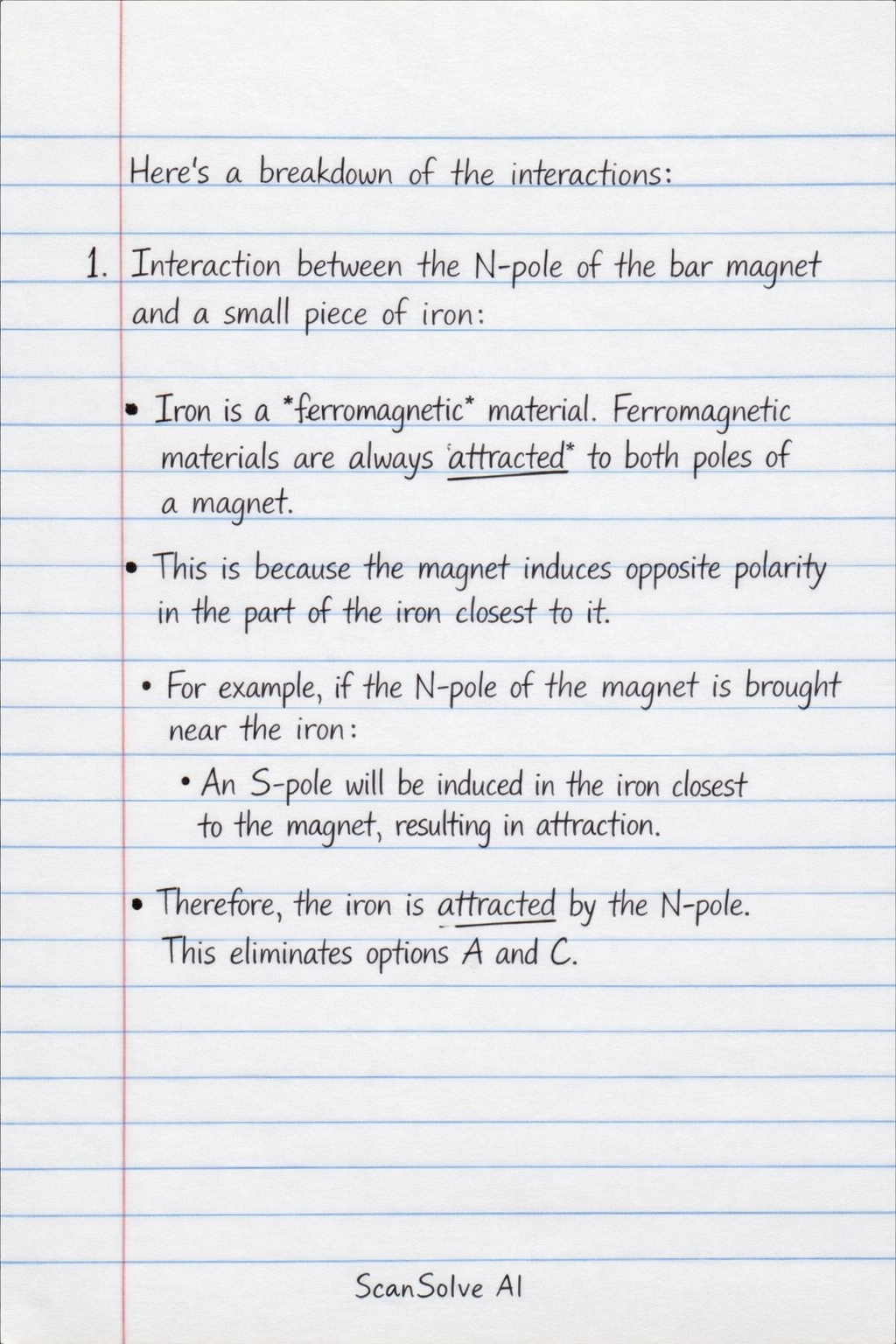
Here's a breakdown of the interactions:
-
Interaction between the N-pole of the bar magnet and a small piece of iron:
- Iron is a ferromagnetic material. Ferromagnetic materials are always attracted to both poles of a magnet. This is because the magnet induces opposite polarity in the part of the iron closest to it. For example, if the N-pole of the magnet is brought near the iron, an S-pole will be induced in the iron closest to the magnet, resulting in attraction.
- Therefore, the iron is attracted by the N-pole. This eliminates options A and C.
-
Alignment of a small compass near the S-pole of the bar magnet:
- A compass needle is itself a small magnet, with a North-seeking pole (N) and a South-seeking pole (S).
- Magnetic field lines emerge from the North pole of a magnet and enter its South pole.
- When a compass is placed near the S-pole of the bar magnet, the N-pole of the compass needle will be attracted to the S-pole of the bar magnet.
- This means the N-pole of the compass needle will point towards the S-pole of the bar magnet.
- Consequently, the S-pole of the compass needle will point away from the S-pole of the bar magnet, which is in the direction of the bar magnet's N-pole (or generally towards the "north" direction relative to the bar magnet's field).
- Therefore, the compass needle aligns with its S-pole facing north.
Combining both correct parts:
- The iron is attracted by the N-pole.
- The compass needle aligns with the S-pole facing north.
This matches option B.
The final answer is .
Was this helpful?
Try one yourself
A new problem that tests the same skill.
Still stuck on this one?
Ask a follow-up, and the answer starts from this question.
Got a different question?Ask your own question
More Computer Science Questions
QMAGNETIC FORCE Magnetic materials such as iron, steel, cobalt and nickel. A magnet has a north and a…QExplain how the plotting compasses show that bar AB is a magnet.QA) Explain how the plotting compasses show that bar AB is a magnet. b) Draw the magnetic field lines…QA south magnetic monopole is placed near a bar magnet. Describe the forces acting on the monopole in…QWhat will happen when the north pole of the bar magnet and the north pole of another bar magnet are…
Handwritten Step-by-Step Solution
Get this as a handwritten image on WhatsApp — like a tutor wrote it for you.
Try on WhatsApp