
We read your photo as:
What is a primary key? Explain two importances of a primary key. Give a chronological order which dry-run testing is performed when developing a program.
ScanSolve AI Answer
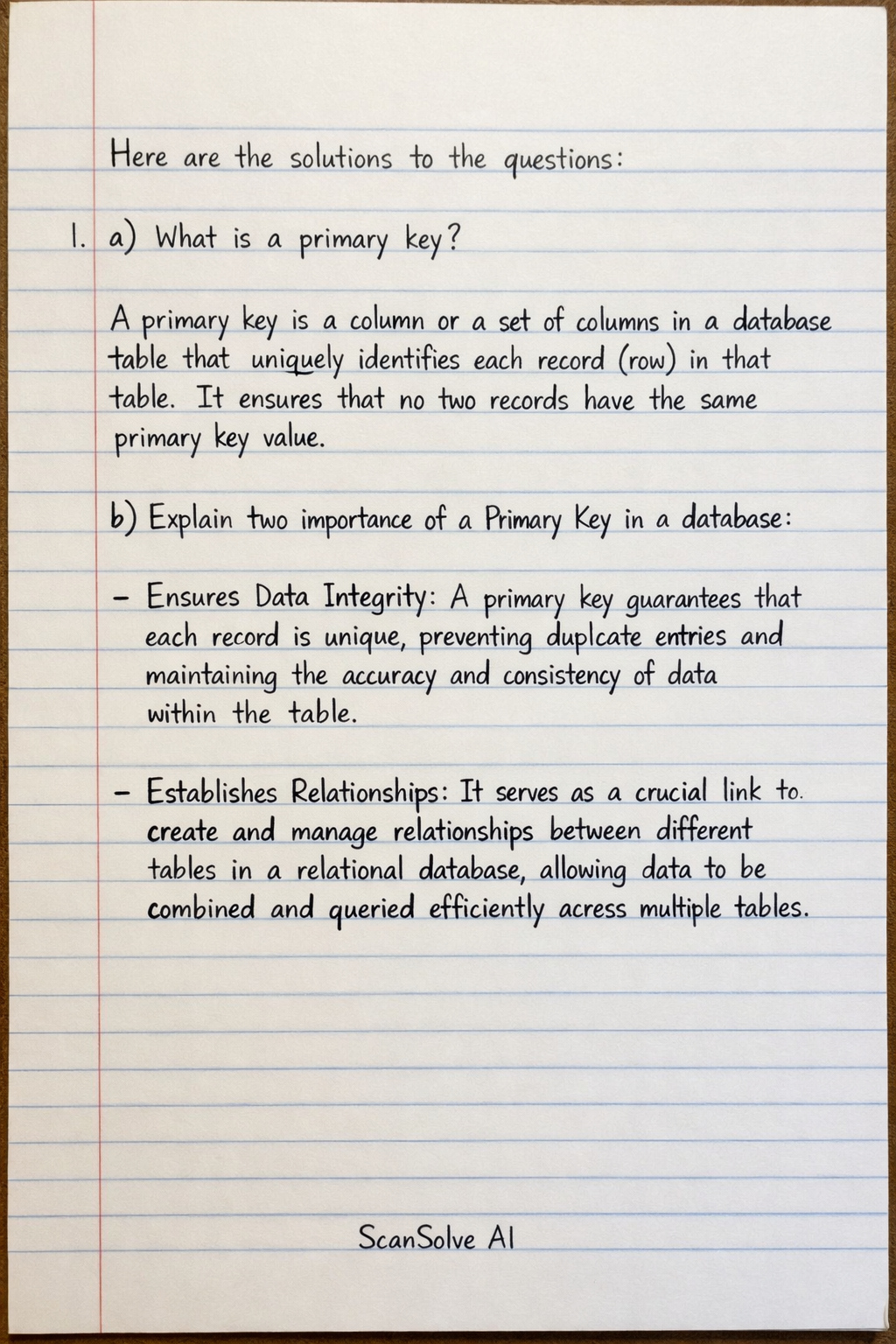
Here are the solutions to the questions:
-
a) What is a primary key? A primary key is a column or a set of columns in a database table that uniquely identifies each record (row) in that table. It ensures that no two records have the same primary key value.
b) Explain two importance of a Primary Key in a database:
- Ensures Data Integrity: A primary key guarantees that each record is unique, preventing duplicate entries and maintaining the accuracy and consistency of data within the table.
- Establishes Relationships: It serves as a crucial link to create and manage relationships between different tables in a relational database, allowing data to be combined and queried efficiently across multiple tables.
-
Give a chronological order which dry-run testing is performed when developing a program: Dry-run testing is typically performed in the following chronological order:
- After Algorithm Design: It is done once the program's logic or algorithm has been designed, often represented by flowcharts or pseudocode.
- During/After Code Writing: It is performed manually by tracing the code line-by-line with sample data before the program is compiled or executed on a computer.
- Before Formal Testing: It serves as an initial check to identify logical errors and design flaws early, reducing the need for extensive debugging during later stages of formal testing.
-
State three situations where processing modes can be categorized: Processing modes can be categorized based on how and when data is handled. Three common categories are:
- Batch Processing: Data is collected over a period and processed together in large groups or "batches" at a scheduled time.
- Real-time Processing: Data is processed immediately as it is input, providing instant feedback or updates, often critical for time-sensitive applications.
- Online Processing: Data is processed interactively as it is entered by a user, typically through a network connection, allowing for immediate interaction with the system.
-
Given the binary number 101011011011, determine the number of: The given binary number is 101011011011. First, count the total number of bits: There are 12 bits in the number.
a) nibbles
A nibble is a group of 4 bits.
Number of nibbles =
Number of nibbles =
The number of nibbles is .b) bytes
A byte is a group of 8 bits.
Number of bytes =
Number of bytes =
The number of bytes is .
Still stuck on this one?
Ask a follow-up, and the answer starts from this question.
More Computer Science Questions
Handwritten Step-by-Step Solution
Get this as a handwritten image on WhatsApp — like a tutor wrote it for you.
Try on WhatsApp