
We read your photo as:
Explain the primary functions of a Bank. Explain the secondary functions of a Bank.
ScanSolve AI Answer
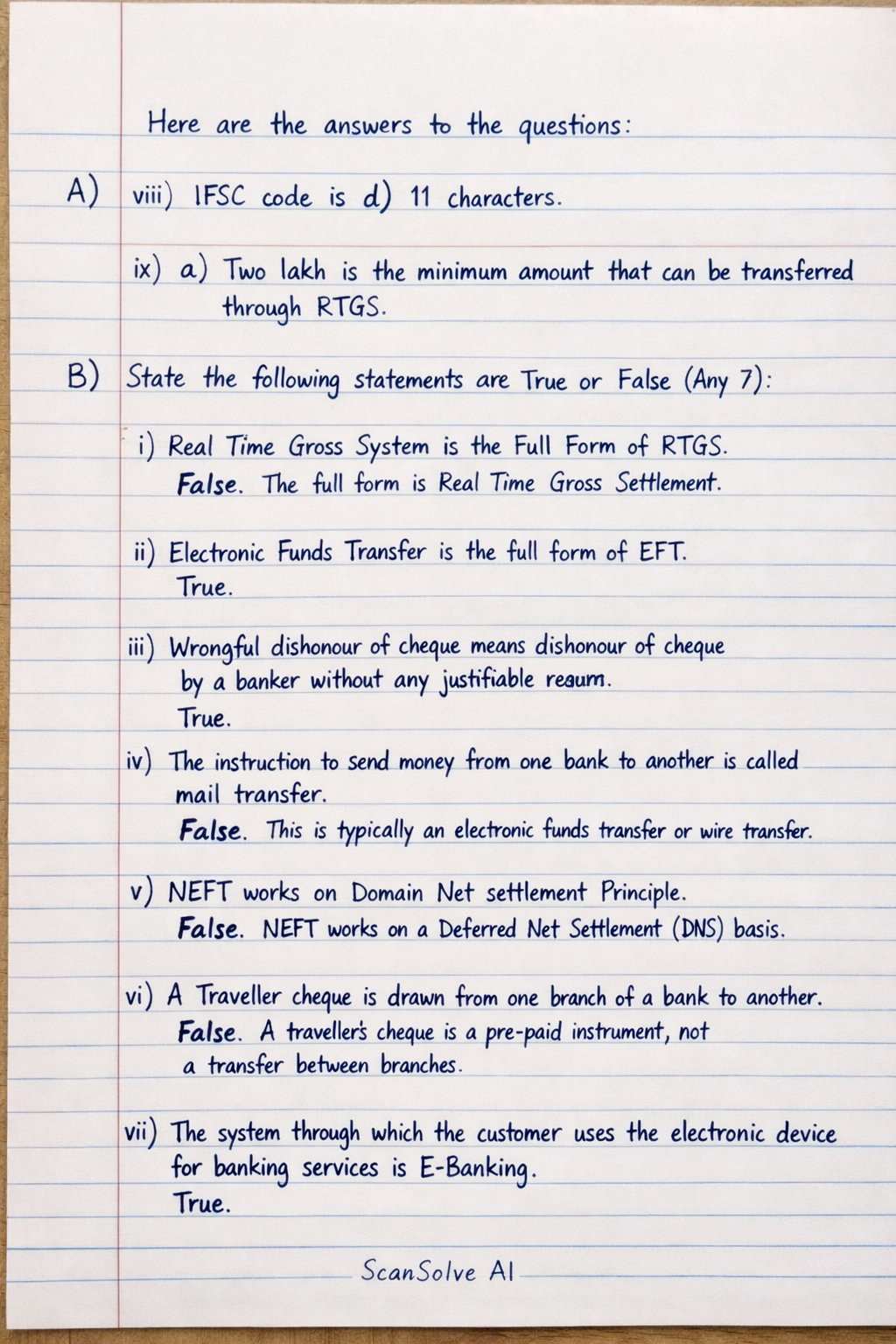
Here are the answers to the questions:
A)
viii) IFSC code is d) 11 (characters).
ix) a) Two lakh is the minimum amount that can be transferred through RTGS.
B) State the following statements are True or False (Any 7):
i) Real Time Gross System is the Full Form of RTGS.
False. The full form is Real Time Gross Settlement.
ii) Electronic Funds Transfer is the full form of EFT.
True.
iii) Wrongful dishonour of cheque means dishonour of cheque by a banker without any justifiable reason.
True.
iv) The instruction to send money from one bank to another is called mail transfer.
False. This is typically an electronic funds transfer or wire transfer.
v) NEFT works on Domain Net settlement Principle.
False. NEFT works on a Deferred Net Settlement (DNS) basis.
vi) A Traveller cheque is drawn from one branch of a bank to another.
False. A traveller's cheque is a pre-paid instrument, not a transfer between branches.
vii) The system through which the customer uses the electronic device for banking services is E-Banking.
True.
viii) Rs. 1 Crore is the amount limit for filling in the cheque.
False. There is generally no legal upper limit for the amount on a cheque.
ix) Private sector banks started to serve customers electronically in 1994.
True.
Q2 a) Explain the meaning of Bank.
A bank is a financial institution that accepts deposits from the public and creates credit. It provides various financial services such as lending money, facilitating payments, and offering investment products.
Q2 b) Explain the structure of Indian Banking System.
The Indian banking system is primarily regulated by the Reserve Bank of India (RBI). It is broadly structured into Scheduled Commercial Banks (including Public Sector Banks, Private Sector Banks, Foreign Banks, and Regional Rural Banks) and Co-operative Banks. Non-scheduled banks also exist but form a smaller part.
Q3 a) Explain the primary functions of a Bank.
The primary functions of a bank are accepting deposits from the public (e.g., savings, current, fixed deposits) and advancing loans (e.g., cash credit, overdrafts, term loans) to individuals and businesses. These core activities facilitate capital formation and economic growth.
Q3 b) Explain the secondary functions of a Bank.
Secondary functions of a bank include agency functions (e.g., collecting cheques, paying bills, acting as executor) and utility functions (e.g., locker facilities, issuing letters of credit, underwriting securities, foreign exchange services). These services enhance customer convenience and generate additional income for the bank.
Q4 a) Explain the procedure for opening of Deposit Account in a bank.
To open a deposit account, an applicant must fill an account opening form, provide identity proof (e.g., Aadhaar, PAN), address proof (e.g., utility bill), and recent photographs. The bank verifies these documents, conducts a KYC check, and upon satisfaction, opens the account, providing a passbook, chequebook, and debit card.
Q4 b) State the Needs and Norms of Know Your Customer (KYC).
KYC (Know Your Customer) is a process by which banks obtain information about the identity and address of their customers. Its need arises from the necessity to prevent financial crimes like money laundering and terrorist financing. The norms require customers to submit valid proof of identity (e.g., PAN card, passport) and proof of address (e.g., Aadhaar card, utility bills) for verification.
Q5 a) Explain the meaning of Banker's Cheque?
A Banker's Cheque (also known as a Demand Draft or Pay Order) is a payment instrument issued by a bank on behalf of a customer, guaranteeing payment to the payee. The amount is debited from the customer's account upfront, making it a secure form of payment as it cannot be dishonoured due to insufficient funds.
Q5 b) Explain the methods of remittance.
Remittance refers to the transfer of money from one party to another, often across geographical locations. Common methods include electronic funds transfer (e.g., NEFT, RTGS, IMPS), wire transfers, demand drafts, money orders, and increasingly, mobile banking apps and digital wallets.
Q6 a) Explain functions of Commercial Banks.
Commercial banks perform various functions including accepting deposits (savings, current, fixed), advancing loans (cash credit, overdrafts, term loans), credit creation, and providing agency services (e.g., collecting bills, paying insurance premiums) and general utility services (e.g., locker facilities, foreign exchange).
Q6 b) Explain types of Account - holders in Bank.
Account holders in a bank can be individuals (single or joint accounts), sole proprietorships, partnerships, companies (private or public limited), trusts, societies, associations, and government bodies. Each type has specific documentation and operational requirements based on their legal structure.
Q7 a) Explain Advantages and Disadvantages of Electronic Funds Transfer System.
Advantages: Speed (instant or near-instant transfers), convenience (available 24/7 from anywhere), security (reduced risk of theft/loss of cash), and cost-effectiveness (lower transaction fees).
Disadvantages: Risk of cyber fraud and hacking, technical glitches leading to transaction failures, dependency on internet connectivity, and potential lack of accessibility
Still stuck on this one?
Ask a follow-up, and the answer starts from this question.
More Economics Questions
Handwritten Step-by-Step Solution
Get this as a handwritten image on WhatsApp — like a tutor wrote it for you.
Try on WhatsApp