
We read your photo as:
Find the antiderivative of the function.
Computer Science
ScanSolve AI Answer
Answer
Step-by-step solution
5 stepsFind the antiderivative of the function.
We use the power rule for integration, .
For definite integrals, we don't need the constant . So, the antiderivative is .
Apply the Fundamental Theorem of Calculus.
The definite integral is evaluated as , where and .
Substitute the upper limit () into the antiderivative.
Substitute the lower limit () into the antiderivative.
Subtract the value at the lower limit from the value at the upper limit.
The final answer is .
Was this helpful?
Try one yourself
A new problem that tests the same skill.
Still stuck on this one?
Ask a follow-up, and the answer starts from this question.
Got a different question?Ask your own question
More Computer Science Questions
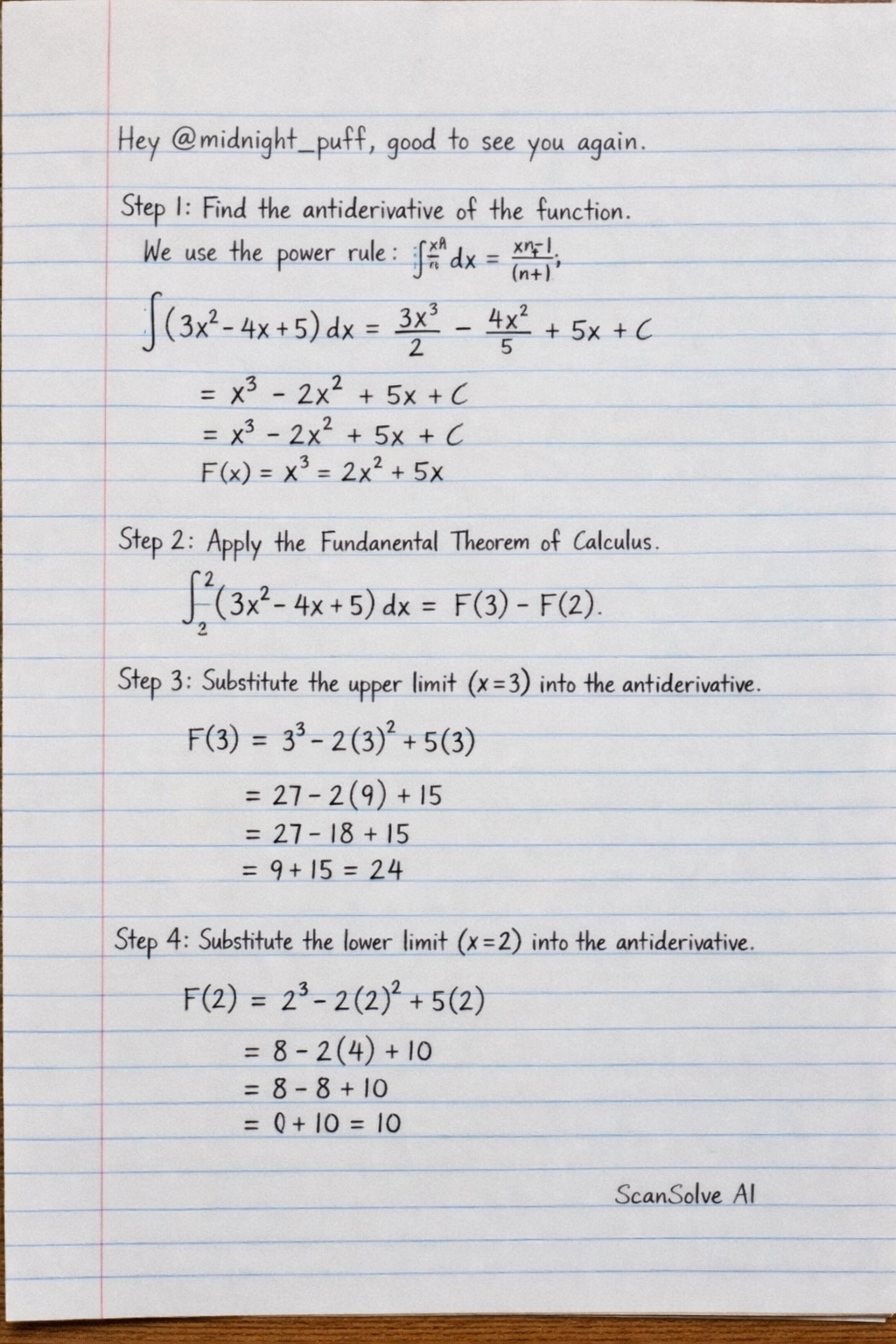
Handwritten Step-by-Step Solution
Get this as a handwritten image on WhatsApp — like a tutor wrote it for you.
Try on WhatsApp