
Binary operation
Computer Science
ScanSolve AI Answer
Answer
Step-by-step solution
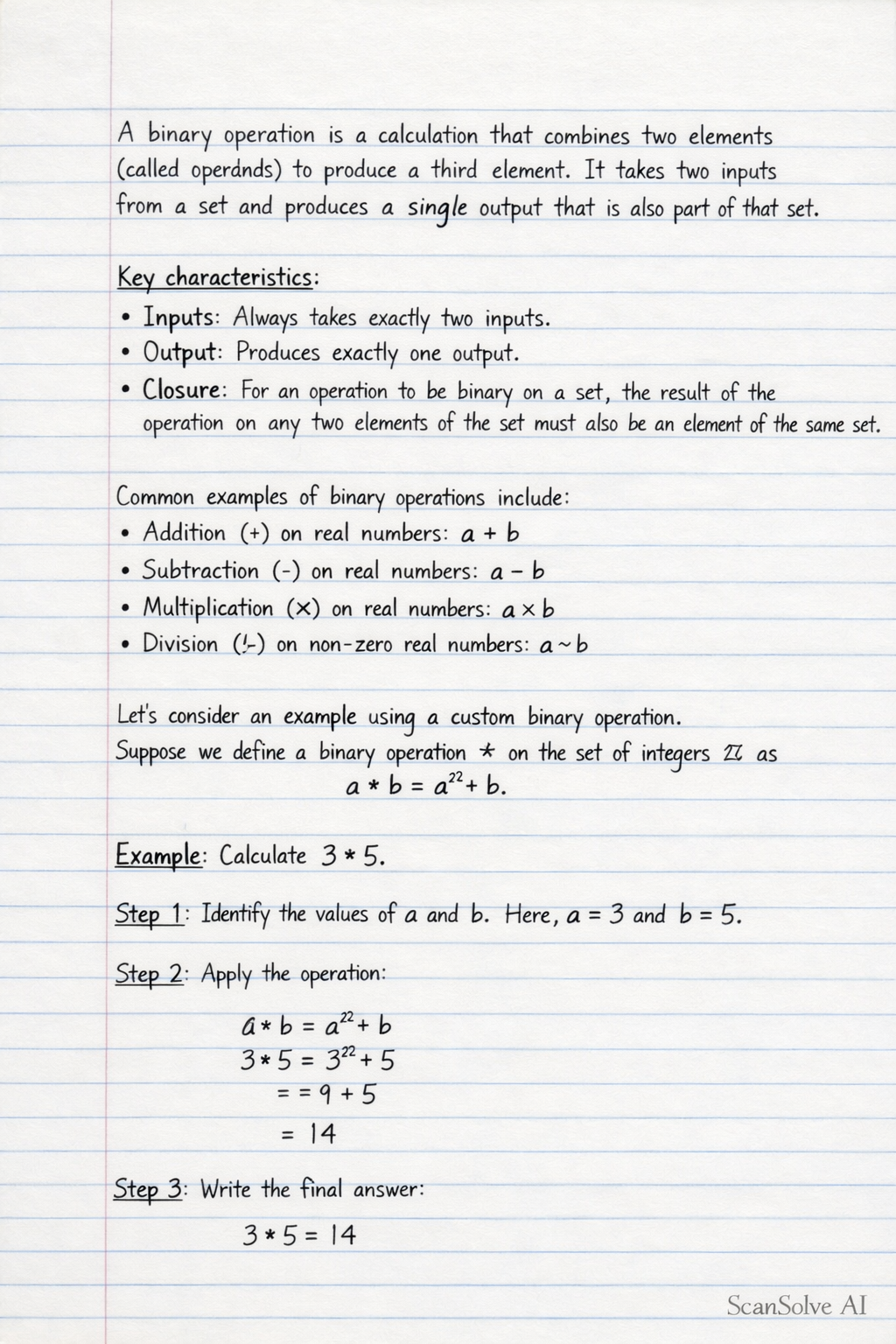
3 stepsA binary operation is a calculation that combines two elements (called operands) to produce a third element. It takes two inputs from a set and produces a single output that is also part of that set.
Key characteristics:
- Inputs: Always takes exactly two inputs.
- Output: Produces exactly one output.
- Closure: For an operation to be binary on a set, the result of the operation on any two elements of the set must also be an element of the same set.
Common examples of binary operations include:
- Addition () on real numbers:
- Subtraction () on real numbers:
- Multiplication () on real numbers:
- Division () on non-zero real numbers:
Let's consider an example using a custom binary operation.
Suppose we define a binary operation on the set of integers as .
Example: Calculate .
Identify the values of and .
Here, and .
Substitute these values into the definition of the operation
Perform the calculation
So, .
Was this helpful?
Still stuck on this one?
Ask a follow-up, and the answer starts from this question.
Got a different question?Ask your own question
More Computer Science Questions
Handwritten Step-by-Step Solution
Get this as a handwritten image on WhatsApp — like a tutor wrote it for you.
Try on WhatsApp