
We read your photo as:
What is computer programming? Define a programming language, list and explain 3 types of computer programming, and what are language translators?
ScanSolve AI Answer
Here are the answers to the questions from the image:
-
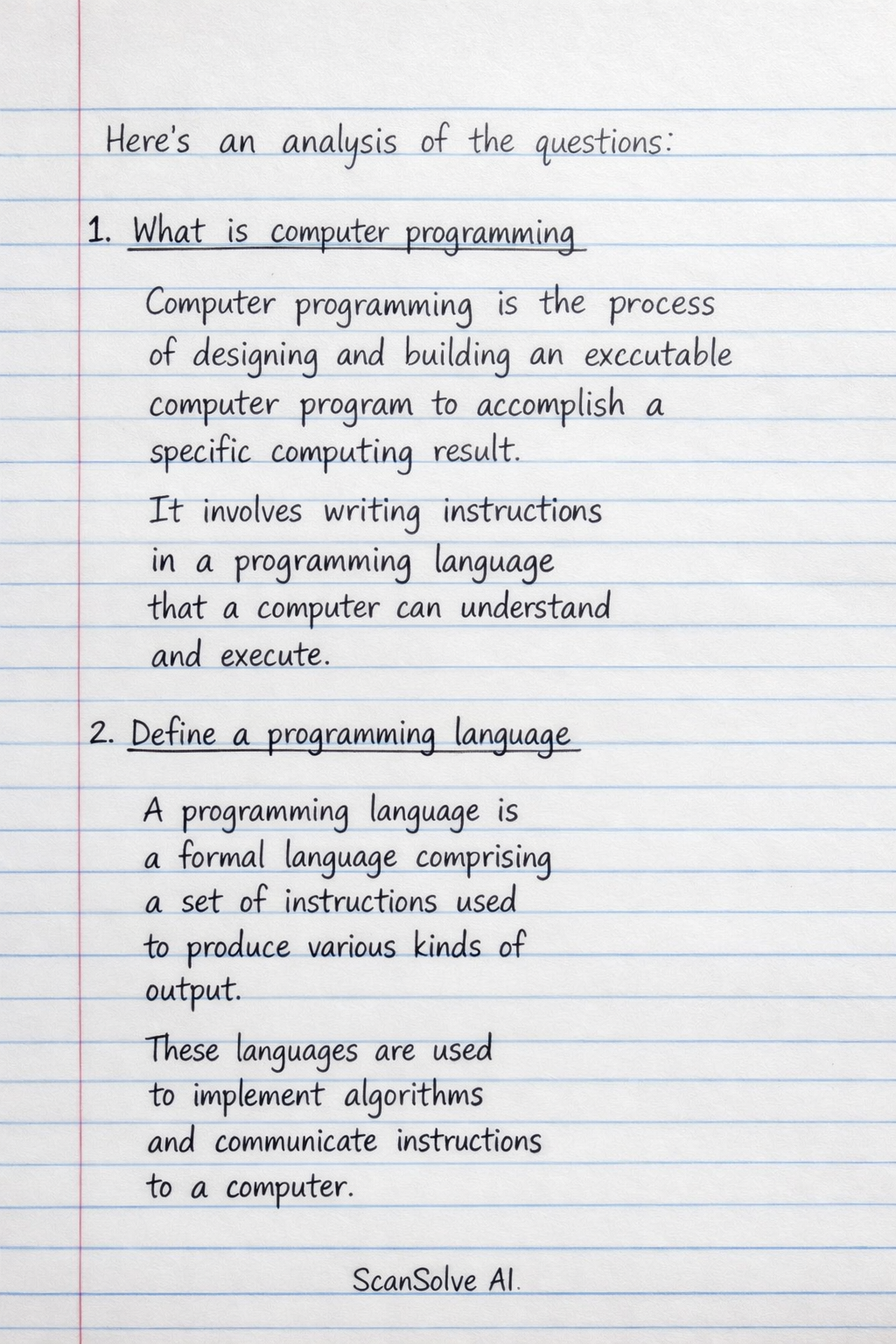
What is computer programming Computer programming is the process of designing and building an executable computer program to accomplish a specific computing result. It involves writing instructions in a programming language that a computer can understand and execute.
-
Define a programming Language A programming language is a formal language comprising a set of instructions used to produce various kinds of output. These languages are used to implement algorithms and communicate instructions to a computer.
-
List and explain 3 types of computer programming
- Procedural Programming: Focuses on a sequence of steps or procedures to perform a task. Programs are organized into functions or subroutines. Examples include C, Pascal, Fortran.
- Object-Oriented Programming (OOP): Organizes software design around data, or objects, rather than functions and logic. It uses concepts like classes, objects, inheritance, and polymorphism. Examples include Java, Python, C++.
- Functional Programming: Treats computation as the evaluation of mathematical functions and avoids changing state and mutable data. It emphasizes expressions and declarations rather than statements. Examples include Haskell, Lisp, Erlang.
-
What are language translators Language translators are software tools that convert source code written in one programming language (the source language) into another programming language (the target language), often machine code or an intermediate code, so that a computer can execute it.
-
List and explain 3 types of Language translators
- Compilers: Translate an entire program written in a high-level language into machine code or an intermediate code before execution. The compiled code can then be run independently.
- Interpreters: Translate and execute source code line by line. They do not produce an executable file; instead, they read, analyze, and execute each statement directly.
- Assemblers: Translate assembly language (a low-level programming language) into machine code. Each assembly language instruction typically corresponds to one machine code instruction.
-
Differentiate between a compiler and interpreter A compiler translates the entire source code into machine code or an intermediate code before execution, generating an executable file. An interpreter, on the other hand, translates and executes the source code line by line, without creating a separate executable file. Compilers generally result in faster execution, while interpreters offer greater flexibility during development.
-
Define an algorithm An algorithm is a finite set of well-defined, unambiguous instructions or a step-by-step procedure for solving a problem or performing a computation. It takes an input, processes it, and produces an output.
-
List and explain the properties of Algorithm
- Finiteness: An algorithm must terminate after a finite number of steps.
- Definiteness: Each step of an algorithm must be precisely and unambiguously defined.
- Input: An algorithm must have zero or more well-defined inputs.
- Output: An algorithm must have one or more well-defined outputs, and should correctly solve the problem.
- Effectiveness: Each operation must be sufficiently basic that it can be done exactly and in a finite amount of time.
-
Design an algorithm with a natural number, n, as its input which calculates the following formula: Assuming is an even natural number, and the series consists of terms .
Algorithm to calculate S:
- START
- INPUT (a natural number)
- IF is odd THEN a. PRINT "Error: n must be an even number." b. GOTO 7 (End)
- INITIALIZE
- FOR from 1 to DO a.
- END
-
Define a number system A number system is a set of symbols and rules used to represent numbers. It defines how numbers are expressed and how arithmetic operations are performed.
-
List and explain the types of a number system you know
- Decimal (Base-10): Uses ten distinct symbols (0-9). Each digit's position represents a power of 10. It is the most commonly used number system in everyday life.
- Binary (Base-2): Uses two distinct symbols (0 and 1). Each digit's position represents a power of 2. It is the fundamental number system for computers.
- Octal (Base-8): Uses eight distinct symbols (0-7). Each digit's position represents a power of 8. It is sometimes used in computing as a compact way to represent binary numbers.
- Hexadecimal (Base-16): Uses sixteen distinct symbols (0-9 and A-F, where A=10, B=11, ..., F=15). Each digit's position represents a power of 16. It is widely used in computing for memory addresses and color codes.
-
Convert the following into decimal
- i)
- ii)
- iii)
-
Explain Logical operators Logical operators are symbols or words (like AND, OR, NOT) used in programming and logic to combine or modify Boolean expressions (expressions that evaluate to either true or false). They produce a Boolean result based on the truth values of their operands.
-
Explain AND, NAND, OR, and NOR operators
- AND (): Returns true only if all its operands are true. Otherwise, it returns false.
- NAND (): (NOT AND) Returns false only if all its operands are true. It is the negation of the AND operator.
- OR (): Returns true if at least one of its operands is true. It returns false only if all operands are false.
- NOR (): (NOT OR) Returns true only if all its operands are false. It is the negation of the OR operator.
-
Copy and complete the table below
| A | B | AB | AB | AB | AB |
|---|---|---|---|---|---|
| T | T | T | T | F | F |
| T | F | F | T | T | F |
| F | T | F | T | T | F |
| F | F | F | F | T | T |
Still stuck on this one?
Ask a follow-up, and the answer starts from this question.
More Computer Science Questions
Handwritten Step-by-Step Solution
Get this as a handwritten image on WhatsApp — like a tutor wrote it for you.
Try on WhatsApp