
We read your photo as:
Explain the concept of computer programming, its benefits for a layperson, and provide four application scenarios. Briefly mention the program life cycle.
ScanSolve AI Answer
Here are the answers to Question One:
I) Computer programming is the process of creating a set of instructions that tell a computer how to perform a specific task. It involves writing code in a programming language, which is then translated into a form that the computer can understand and execute. This process allows us to develop software, applications, and systems that solve problems and automate functions.
II) For a layperson, learning computer programming provides the ability to automate repetitive tasks, making daily work more efficient. It helps in understanding how technology works and how to interact with it more effectively. It also fosters problem-solving skills and can open doors to new career opportunities in a rapidly digitizing world, even for non-traditional tech roles.
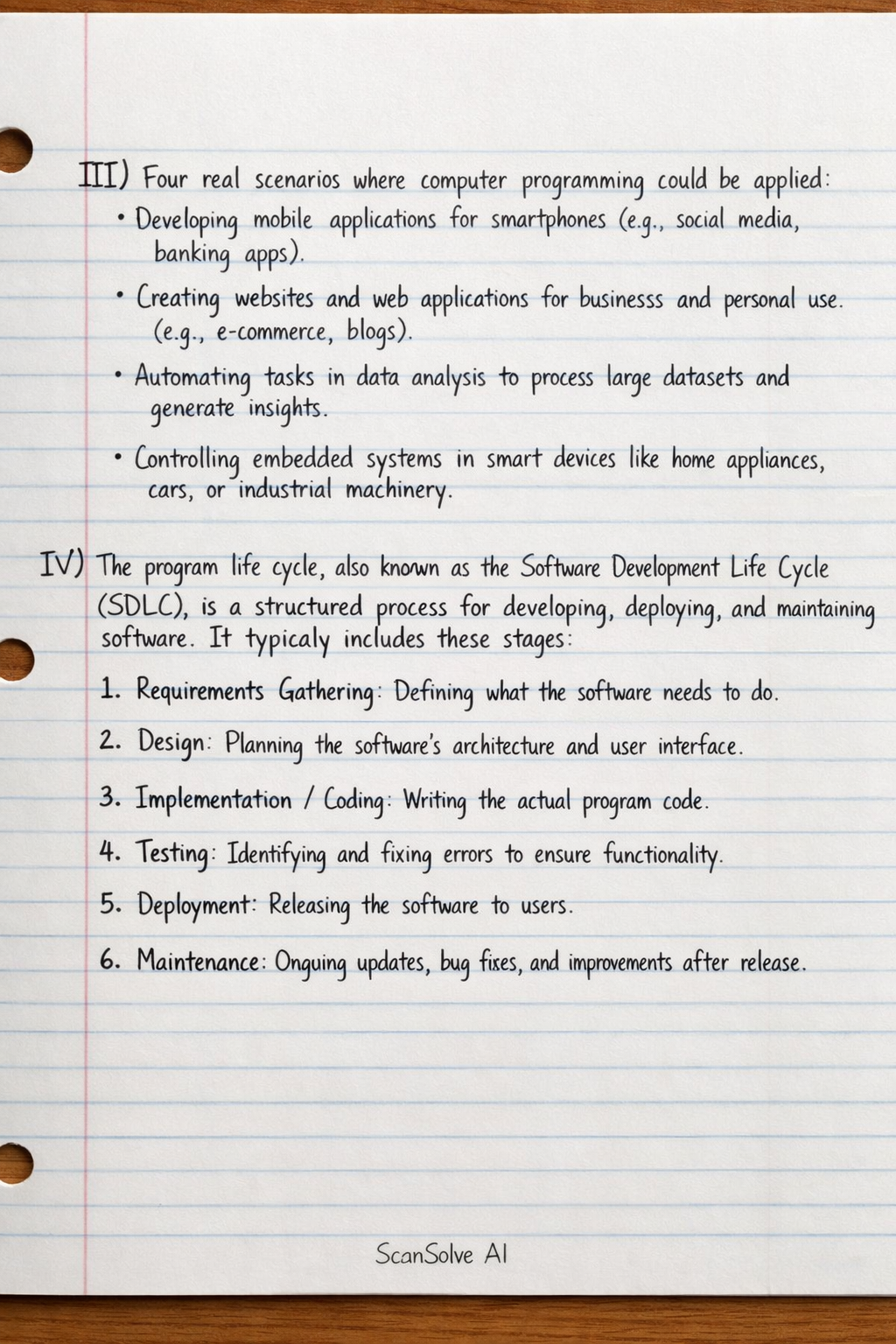
III) Four real scenarios where computer programming could be applied:
- Developing mobile applications for smartphones (e.g., social media, banking apps).
- Creating websites and web applications for businesses and personal use (e.g., e-commerce, blogs).
- Automating tasks in data analysis to process large datasets and generate insights.
- Controlling embedded systems in smart devices like home appliances, cars, or industrial machinery.
IV) The program life cycle, also known as the Software Development Life Cycle (SDLC), is a structured process for developing, deploying, and maintaining software. It typically includes these stages:
- Requirements Gathering: Defining what the software needs to do.
- Design: Planning the software's architecture and user interface.
- Implementation/Coding: Writing the actual program code.
- Testing: Identifying and fixing errors to ensure functionality.
- Deployment: Releasing the software to users.
- Maintenance: Ongoing updates, bug fixes, and improvements after release.
V) Operator precedence in computer programming refers to the rules that determine the order in which operations (like addition, multiplication, or logical comparisons) are performed in an expression. For example, in most languages, multiplication and division are performed before addition and subtraction, similar to the order of operations in mathematics. Parentheses can be used to override this default order.
Still stuck on this one?
Ask a follow-up, and the answer starts from this question.
More Computer Science Questions
Handwritten Step-by-Step Solution
Get this as a handwritten image on WhatsApp — like a tutor wrote it for you.
Try on WhatsApp