
We read your photo as:
Explain LIFO and FIFO with applications. Define source code, why some languages are high level, ways to represent an algorithm, and qualities of a good algorithm. Define computer ethics.
Computer Science
ScanSolve AI Answer
Step-by-step solution
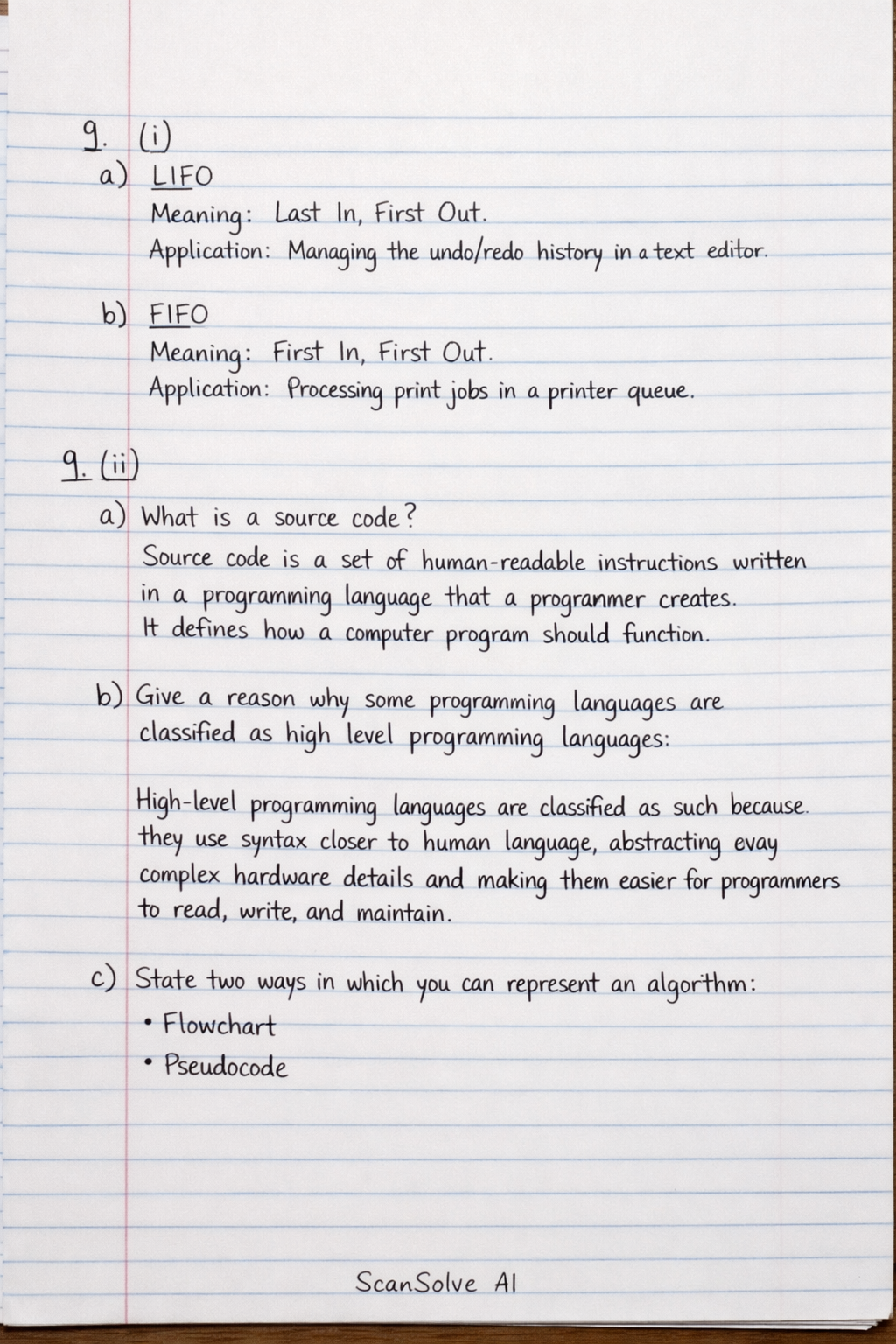
5 steps9. (i)
a) LIFO
- Meaning: Last In, First Out.
- Application: Managing the undo/redo history in a text editor.
b) FIFO
- Meaning: First In, First Out.
- Application: Processing print jobs in a printer queue.
9. (ii)
a) What is a source code?
- Source code is a set of human-readable instructions written in a programming language that a programmer creates. It defines how a computer program should function.
b) Give a reason why some programming languages are classified as high level programming languages.
- High-level programming languages are classified as such because they use syntax closer to human language, abstracting away complex hardware details and making them easier for programmers to read, write, and maintain.
c) State two ways in which you can represent an algorithm.
- • Flowchart
- • Pseudocode
d) State the qualities of a good algorithm.
- • It must be finite (terminate after a finite number of steps).
- • It must be unambiguous (each step is clearly defined).
- • It must be effective (each step can be carried out).
- • It must have zero or more inputs.
- • It must produce one or more outputs.
9. (iii)
a) Computer ethics
- Computer ethics refers to the moral principles and guidelines that govern the responsible and appropriate use of computers, information technology, and digital resources.
b) Hacking
- Hacking is the act of gaining unauthorized access to a computer system, network, or data, often with malicious intent, by exploiting vulnerabilities.
c) Copyright
- Copyright is a legal right granted to the creator of original literary, artistic, musical, or dramatic works, giving them exclusive rights to reproduce, distribute, perform, or display their work.
9. (iv)
a) Evaluate a binary
Divide the decimal number by 2 and record the remainder.
Read the remainders from bottom to top.
b) Evaluate
Align the binary numbers and perform subtraction, borrowing when necessary.
c) Evaluate
Perform binary multiplication similar to decimal multiplication.
Add the partial products.
Was this helpful?
Still stuck on this one?
Ask a follow-up, and the answer starts from this question.
Got a different question?Ask your own question
More Computer Science Questions
QCOMPUTING BASIC 7 HOMEWORK A set of step-by-step instructions given to a computer to perform a…QDefine the following terms: 1. Program 2. Machine language 3. Mnemonic codes 4. Object code 5…QExplain the principle sources of optimization in computer programming.QExplain the concept of computer programming, its benefits for a layperson, and provide four…QComputer Fundamentals: Define processed data, list languages, identify input devices, and define AI…
Handwritten Step-by-Step Solution
Get this as a handwritten image on WhatsApp — like a tutor wrote it for you.
Try on WhatsApp