
We read your photo as:
Explain the principle sources of optimization in computer programming.
Computer Science
ScanSolve AI Answer
Answer
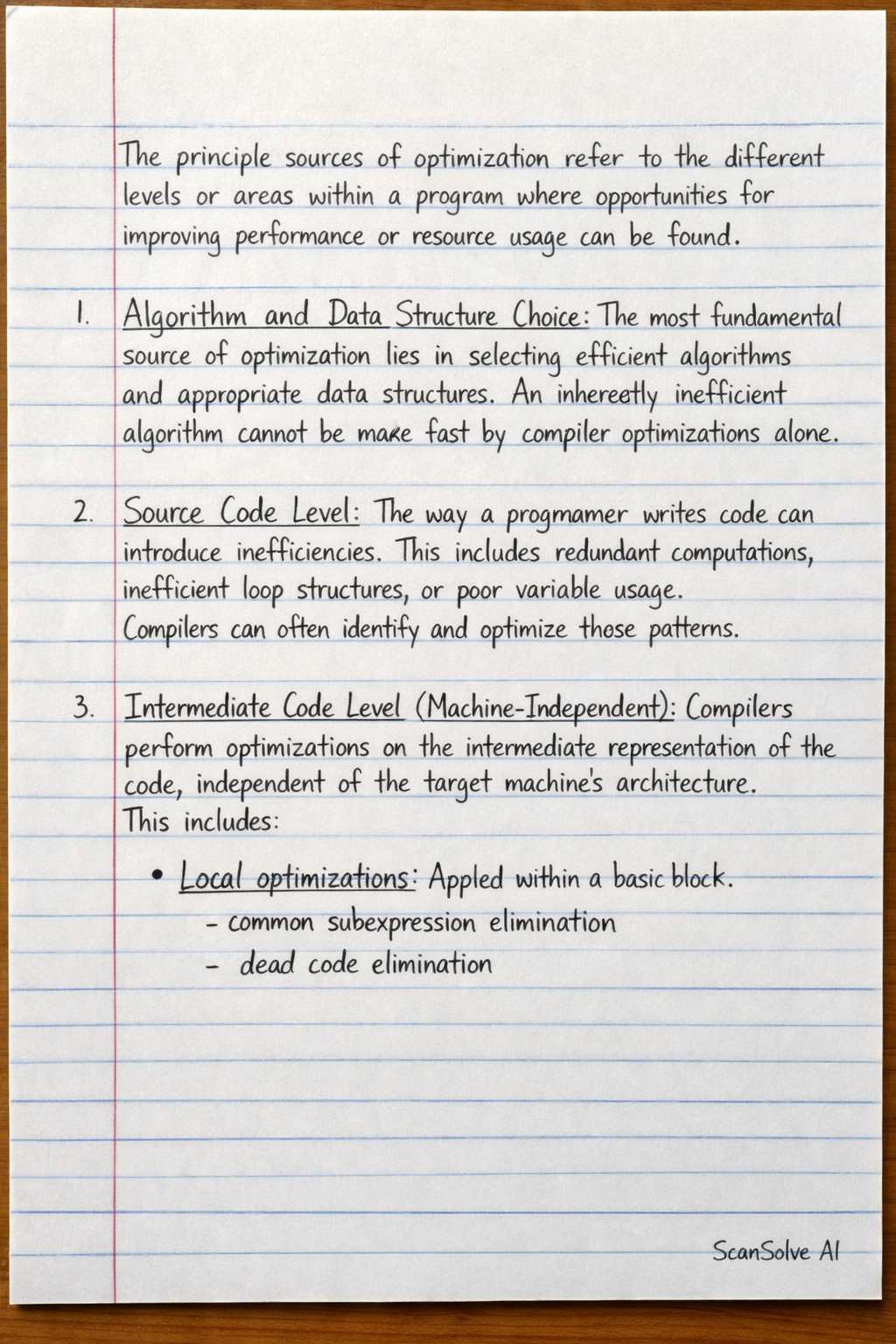
The principle sources of optimization refer to the different levels or areas within a program where opportunities for improving performance or resource usage can be found.
- Algorithm and Data Structure Choice: The most fundamental source of optimization lies in selecting efficient algorithms and appropriate data structures. An inherently inefficient algorithm cannot be made fast by compiler optimizations alone.
- Source Code Level: The way a programmer writes code can introduce inefficiencies. This includes redundant computations, inefficient loop structures, or poor variable usage. Compilers can often identify and optimize these patterns.
- Intermediate Code Level (Machine-Independent): Compilers perform optimizations on the intermediate representation of the code, independent of the target machine's architecture. This includes:
- Local optimizations: Applied within a basic block (e.g., common subexpression elimination, dead code elimination).
- Global optimizations: Applied across basic blocks within a function (e.g., loop optimizations, code motion).
- Target Machine Level (Machine-Dependent): Optimizations at this level exploit the specific features of the target processor architecture. This includes efficient register allocation, instruction scheduling to hide latencies, and using specialized machine instructions.
Was this helpful?
Still stuck on this one?
Ask a follow-up, and the answer starts from this question.
Got a different question?Ask your own question
More Computer Science Questions
QExplain about the principle sources of optimization? In compiler design subjectQCertainly! Here’s a detailed explanation of each question from UNIT 4 based on the provided content…QExplain LIFO and FIFO with applications. Define source code, why some languages are high level, ways…QI) Computer programming is the process of designing, writing, testing, debugging, and maintaining…QWhat are the fundamental characteristics, data types, and function syntax in programming, and how do…
Browse by topic:Programming
Handwritten Step-by-Step Solution
Get this as a handwritten image on WhatsApp — like a tutor wrote it for you.
Try on WhatsApp