
Certainly! Here’s a detailed explanation of each question from UNIT 4 based on the provided content: 4 A i. Explain about the principle sources of optimization? Principle sources of optimization can be classified mainly into: 1. Machine-Independent Optimizations: - These optimizations do not depend on hardware details. - Examples include: - Constant folding: Simplifying constant expressions at compile time. - Algebraic simplifications: Replacing complex expressions by simpler equivalents (e.g., x 2 can be replaced by x + x). - Dead code elimination: Removing code that does not affect the program output. - Code motion: Moving code outside loops when it does not change during iterations. 1. Machine-Dependent Optimizations: - These consider hardware-specific features such as: - Instruction scheduling: Reordering instructions to avoid pipeline stalls. - Register allocation: Optimizing usage of registers to reduce memory access. - Cache optimization: Arranging code/data to improve cache behavior. - These depend heavily on the target machine architecture. Together, these sources contribute to improving code efficiency in runtime, memory usage, or power consumption. 4 A ii. Explain about basic blocks in code optimization? A Basic Block is a straight-line sequence of code instructions with: - One entry point (the first instruction executed when entering the block) - One exit point - No branches (jumps) except at the end - No branch targets into the middle of the block Why basic blocks are important: - They provide a natural unit for optimization since code within a basic block executes linearly. - Simplifies control flow analysis – inside a block, execution order is fixed. - Enables various local optimizations such as instruction scheduling and peephole optimizations. 4 B i. Describe about optimization of basic blocks? Within a basic block, optimization techniques focus on: - Constant Folding: Evaluate constant expressions during compilation to avoid runtime computation. - Dead Code Elimination: Remove instructions whose results are never used. - Strength Reduction: Replace expensive operations with cheaper ones within the block. - Common Subexpression Elimination: Identify repeated expressions and reuse their computed values rather than recalculating. - These transformations improve runtime without altering program semantics. 4 B ii. Explain about structure preserving transformations? Structure preserving transformations are optimizations that preserve the high-level control flow constructs (loops, conditionals) while improving performance: - They maintain the original control flow and program structure. - Examples: - Code motion: Moving invariant code outside loops without changing loop semantics. - Reordering independent instructions: To improve pipeline efficiency or reduce stalls. - These transformations enhance programs without introducing complex control flow changes, which makes debugging and further optimization easier. 4 C i. Explain about flow graphs in code optimization? A Flow Graph (Control Flow Graph) is a graphical representation of program control flow: - Nodes represent basic blocks. - Edges represent possible control transfers between blocks. - It shows how control may flow during program execution. - Flow graphs are essential for: - Identifying loops, reachable code. - Supporting data flow analysis. - Implementing global optimizations by analyzing paths and dependencies. 4 C ii. Explain in detail about Loop Optimization with an example. Loop optimization aims to enhance performance of loops, which often dominate execution time: Common techniques include: - Loop Unrolling: - Replicates loop body multiple times to reduce loop control overhead. - Example: Instead of looping 4 times, unroll to execute 2 iterations per loop with a half iteration count. - Loop Invariant Code Motion: - Move computations that don’t change within the loop outside it. - Example: If x = a + b; inside a loop does not depend on loop variable, move it outside. - Loop Fusion: - Combine two adjacent loops iterating over the same range into a single loop to reduce overhead and improve cache usage. - Example: for (i = 0; i < n; i++) y = a + b; // Loop invariant computation arr[i] = y i; Optimization: y = a + b; // Moved outside the loop for (i = 0; i < n; i++) arr[i] = y * i; This eliminates repeated computation of a + b inside the loop. 4 D i. Explain about data flow analysis? Data flow analysis is a technique to gather information about the state of variables at different program points: - Tracks how data (values of variables) "flows" through the program. - Used for optimizations such as: - Live variable analysis: Determines if a variable’s value is used further. - Reaching definitions: Identifies whereabouts in the program definitions of a variable reach. - Provides foundational info for dead code elimination, constant propagation, and register allocation. - Analysis is performed on the flow graph through iterative algorithms to find fixed points. 4 D ii. Explain different loop optimization techniques? Key techniques include: - Loop Unrolling: Reduce loop overhead by executing multiple iterations per loop pass. - Loop Invariant Code Motion: Move invariant calculations outside. - Loop Fusion: Merge loops with the same iteration space. - Loop Fission (Splitting): Split a loop into multiple loops to improve parallelism/cache usage. - Strength Reduction: Replace expensive operations inside loops with cheaper ones (e.g., multiply replaced by addition). - Induction Variable Simplification: Simplify loop variables whose values change in a predictable way. These techniques improve performance by minimizing overhead and improving instruction level parallelism or memory access patterns. 4 E i. Explain peephole optimization? Peephole optimization involves examining small windows ("peepholes") of target program instructions: - Local, simple transformations. - Look for patterns of instructions that can be replaced with fewer or faster instructions. - Applied repeatedly across the code until no more improvements can be found. Uses: - Remove redundant instructions. - Replace sequences with simpler single instructions. - Eliminate unreachable or no-op code sequences. 4 E ii. Explain different peephole optimization techniques? Common peephole techniques include: - Removal of redundant loads/stores: Eliminate back-to-back memory accesses if values are unchanged. - Branch removal: Remove branches to the next sequential instruction (no-op jumps). - Combining instructions: Replace sequences with combined instructions supported by the machine. - Strength reduction: Replace multiplication/division by constants with faster additions or shifts. - Pattern substitutions: Identify inefficient instruction sequences and replace with optimized equiv
ScanSolve AI Answer
All the explanations provided are accurate and well-detailed.
-
4 A i. Explain about the principle sources of optimization? ✅ Correct. The classification into machine-independent and machine-dependent optimizations, along with the examples, is accurate.
-
4 A ii. Explain about basic blocks in code optimization? ✅ Correct. The definition and characteristics of basic blocks, as well as their importance, are accurately described.
-
4 B i. Describe about optimization of basic blocks? ✅ Correct. The techniques listed (Constant Folding, Dead Code Elimination, Strength Reduction, Common Subexpression Elimination) are key optimizations performed within basic blocks.
-
4 B ii. Explain about structure preserving transformations? ✅ Correct. The definition and examples of structure-preserving transformations are accurate.
-
4 C i. Explain about flow graphs in code optimization? ✅ Correct. The description of flow graphs (Control Flow Graphs) and their uses in optimization is accurate.
-
4 C ii. Explain in detail about Loop Optimization with an example. ✅ Correct. The explanation of loop optimization techniques (Loop Unrolling, Loop Invariant Code Motion, Loop Fusion) with clear examples is accurate.
-
4 D i. Explain about data flow analysis? ✅ Correct. The definition, purpose, and applications of data flow analysis are accurately described.
-
4 D ii. Explain different loop optimization techniques? ✅ Correct. The list of various loop optimization techniques and their brief descriptions are accurate.
-
4 E i. Explain peephole optimization? ✅ Correct. The explanation of peephole optimization, including its local nature and uses, is accurate.
-
4 E ii. Explain different peephole optimization techniques? ✅ Correct. The examples of common peephole optimization techniques are accurate.
Still stuck on this one?
Ask a follow-up, and the answer starts from this question.
More Psychology Questions
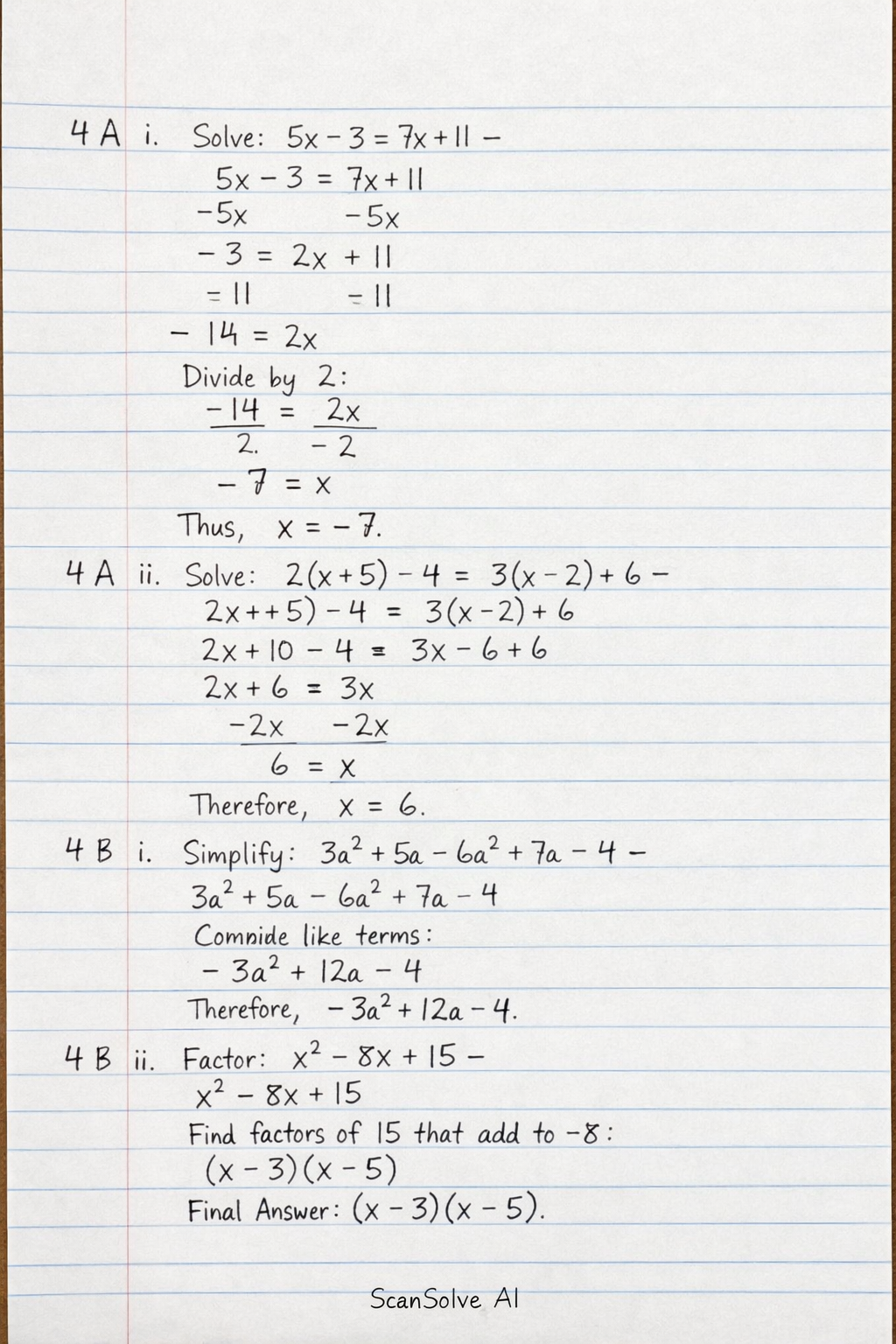
Handwritten Step-by-Step Solution
Get this as a handwritten image on WhatsApp — like a tutor wrote it for you.
Try on WhatsApp