

This biology question covers important biological concepts and processes. The step-by-step explanation below helps you understand the underlying mechanisms and reasoning.
ScanSolve AI Answer
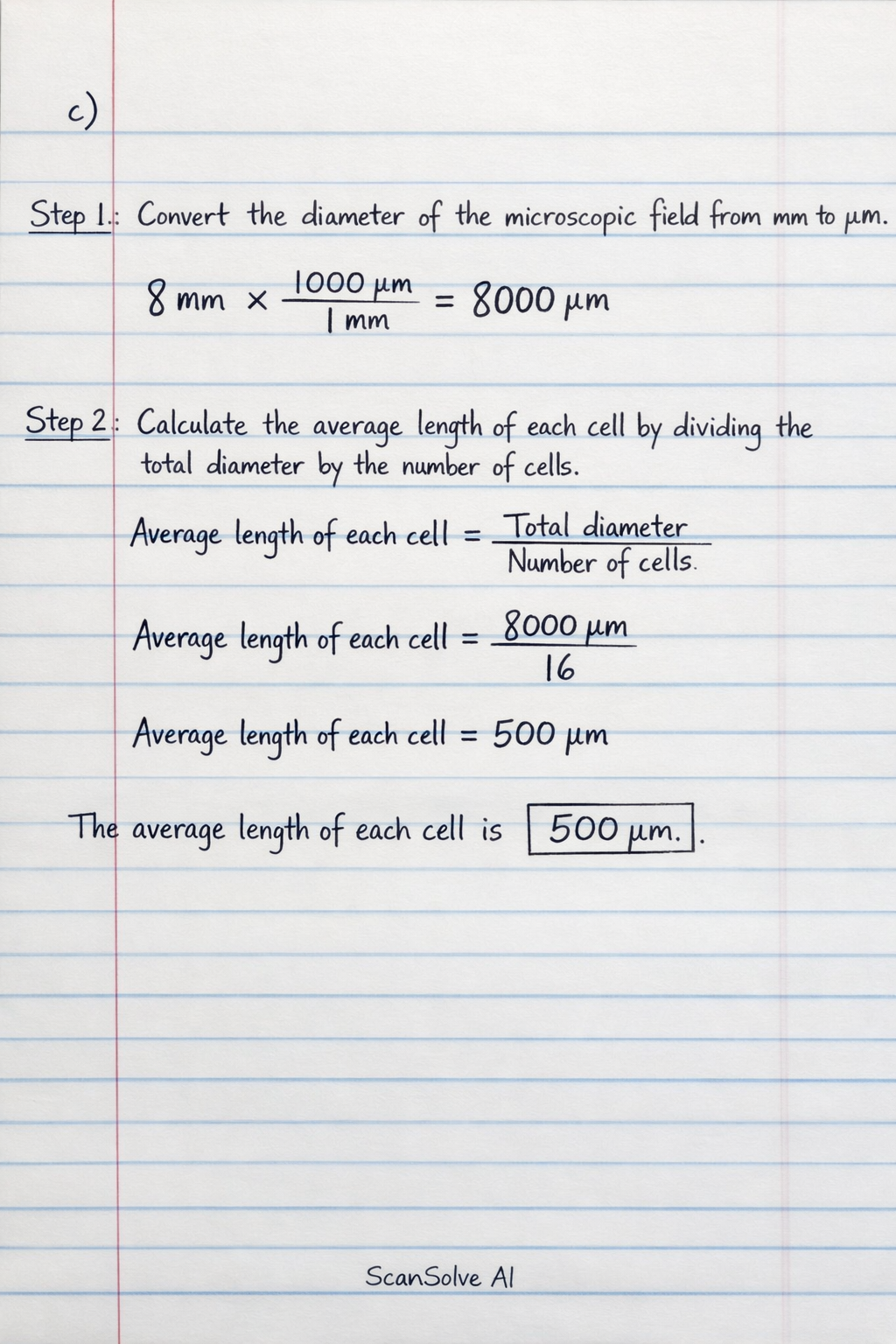
c) Step 1: Convert the diameter of the microscopic field from millimeters (mm) to micrometres (m). 8 mm × 1000 \ 1 mm = 8000 \ Step 2: Calculate the average length of each cell by dividing the total diameter by the number of cells. Average length of each cell = Total diameterNumber of cells Average length of each cell = 8000 \ 16 Average length of each cell = 500 \ The average length of each cell is 500 \ m. 10. • Cell A: Root hair cell Function*: Absorbs water and mineral ions from the soil. • Cell B: Red blood cell (Erythrocyte) Function*: Transports oxygen from the lungs to body tissues. • Cell C: Nerve cell (Neuron) Function*: Transmits electrical impulses (nerve signals) throughout the body. • Cell D: Sperm cell (Spermatozoon) Function*: Fertilizes an egg cell (ovum) during sexual reproduction. • Cell E: White blood cell (e.g., Neutrophil/Phagocyte) Function*: Engulfs and digests pathogens (phagocytosis) as part of the immune system. 11. a) Fine adjustment knob: Used for precise focusing at high magnifications to obtain a sharp image. b) Eyepiece: Contains the ocular lens through which the specimen is viewed; it magnifies the image produced by the objective lens. c) Diaphragm: Controls the amount of light passing through the specimen, adjusting the contrast and brightness of the field of view. 12. a) Ribosomes: Site of protein synthesis. b) Nucleus: Contains the cell's genetic material (DNA) and controls cell activities. c) Nucleolus: Involved in the synthesis of ribosomal RNA (rRNA) and the assembly of ribosomes. 13. a) Respiration: Mitochondria b) Photosynthesis: Chloroplasts 14. The part of the cell that is useful in maintaining support in herbaceous plants is the vacuole (specifically, the central vacuole, which exerts turgor pressure). 15. Apart from magnifying objects, other functions of a microscope include: • Resolution: To distinguish between two closely spaced objects as separate entities. • Illumination: To provide light for viewing the specimen. 16. a) The kingdom of the organism from which the cell was obtained is Plantae. b) Three reasons for the answer in (a) are: • The cell has a distinct, rigid cell wall. • The cell contains a large central vacuole. • The cell has a fixed, regular shape. • The presence of small dots (likely chloroplasts) indicates photosynthesis. c) If the same cell was observed using an electron microscope, five organelles not clearly visible in the diagram that would be observed are: • Endoplasmic Reticulum (Rough ER and Smooth ER) • Golgi apparatus • Mitochondria • Ribosomes • Plasmodesmata d) The main functions of cell sap are: • To maintain turgor pressure against the cell wall, providing structural support to the plant. • To store water, nutrients (e.g., sugars, amino acids), ions, and waste products. • To contain pigments that give color to flowers and fruits. 17. a) Synthesis of proteins: Ribosomes b) Formation of ATP: Mitochondria and Chloroplasts