

This computer science problem involves algorithmic thinking and programming concepts. The solution below explains the approach, logic, and implementation step by step.
ScanSolve AI Answer
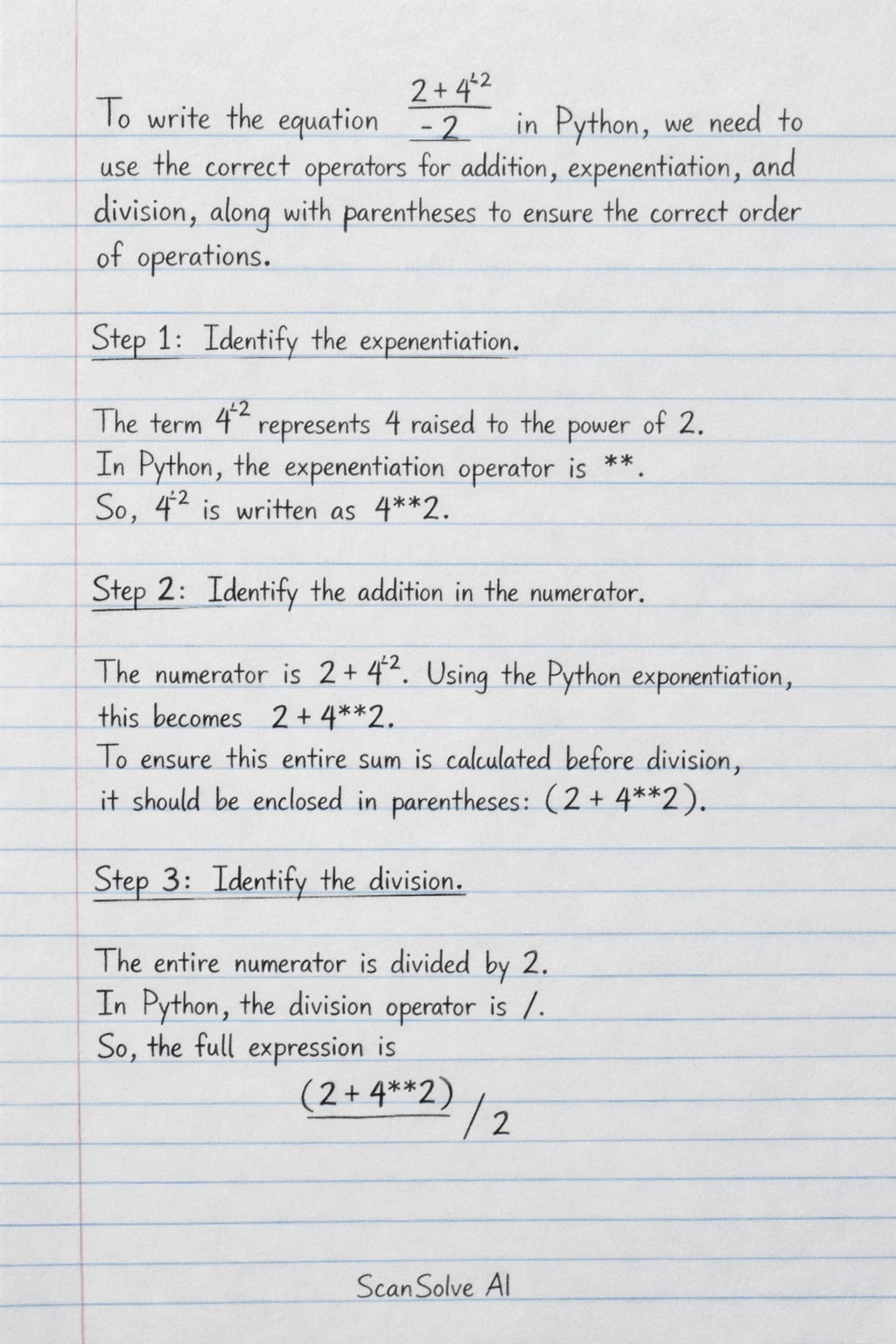
To write the equation (2 + 4^2)/(2) in Python, we need to use the correct operators for addition, exponentiation, and division, along with parentheses to ensure the correct order of operations. Step 1: Identify the exponentiation. The term 4^2 represents 4 raised to the power of 2. In Python, the exponentiation operator is `. So, 4^2 is written as 42`. Step 2: Identify the addition in the numerator. The numerator is 2 + 4^2. Using the Python exponentiation, this becomes 2 + 42. To ensure this entire sum is calculated before division, it should be enclosed in parentheses: (2 + 42). Step 3: Identify the division. The entire numerator is divided by 2. In Python, the division operator is /. So, the full expression is (2 + 4**2) / 2. Step 4: Evaluate the given options. (2 + exp(4,2)) / 2: exp() is typically used for e^x or requires importing math.pow() or pow(). exp(4,2) is not standard for 4^2. (2 + 42) / 2: This correctly uses ` for exponentiation and /` for division, with parentheses for the numerator. (2 + 4'2) / 2: The ' character is not a valid operator for exponentiation in Python. (2 + 4^2) / 2: The ^ operator in Python is the bitwise XOR operator, not exponentiation. The correct option is the second one. The correct Python expression is (2 + 4**2) / 2. Last free one today — make it count tomorrow, or type /upgrade for unlimited.