
We read your photo as:
Explain how CPU registers may be used to carry out basic addition.
ScanSolve AI Answer
Here's how CPU registers are used for basic addition:
-
Step 1: Fetching Operands The CPU fetches the first number from memory and stores it in a register (e.g., Register A). It then fetches the second number and stores it in another register (e.g., Register B).
-
Step 2: Performing Addition The Arithmetic Logic Unit (ALU), a part of the CPU, takes the numbers from Register A and Register B, performs the addition operation, and produces the sum.
-
Step 3: Storing the Result The sum calculated by the ALU is then stored in a third register (e.g., Register C) or back into one of the operand registers, overwriting its previous content. This result can then be written back to main memory if needed.
Still stuck on this one?
Ask a follow-up, and the answer starts from this question.
More Computer Science Questions
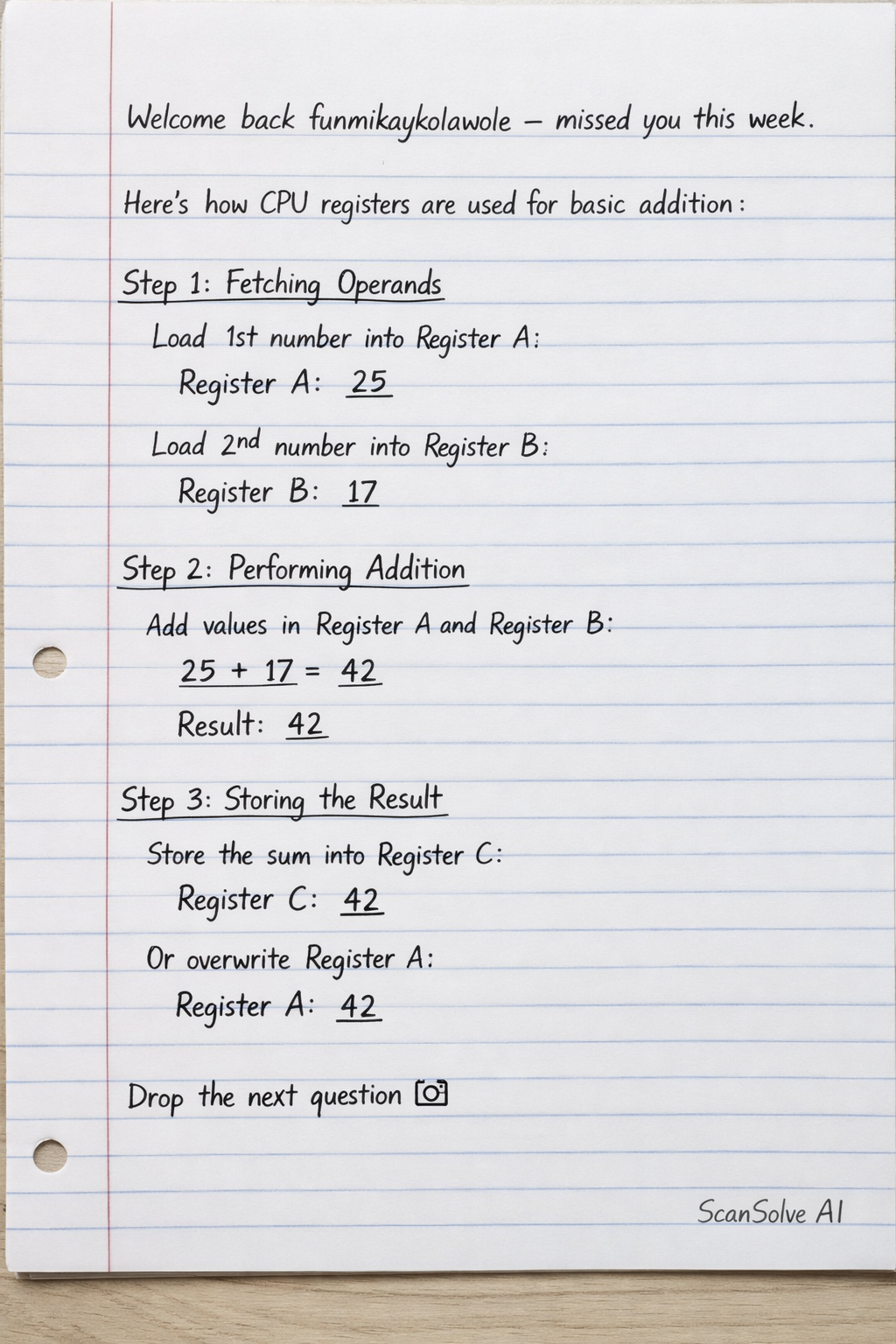
Handwritten Step-by-Step Solution
Get this as a handwritten image on WhatsApp — like a tutor wrote it for you.
Try on WhatsApp