
We read your photo as:
c) Add 127 and -128 in 8-bit 2's complement. What is the denary equivalent of the result obtained? 2.ii. A RAM has a capacity of 32K x 16 a) How many memory addresses does this RAM have? b) How many a
ScanSolve AI Answer
Step-by-step solution
5 stepsHere are the solutions to the next set of questions:
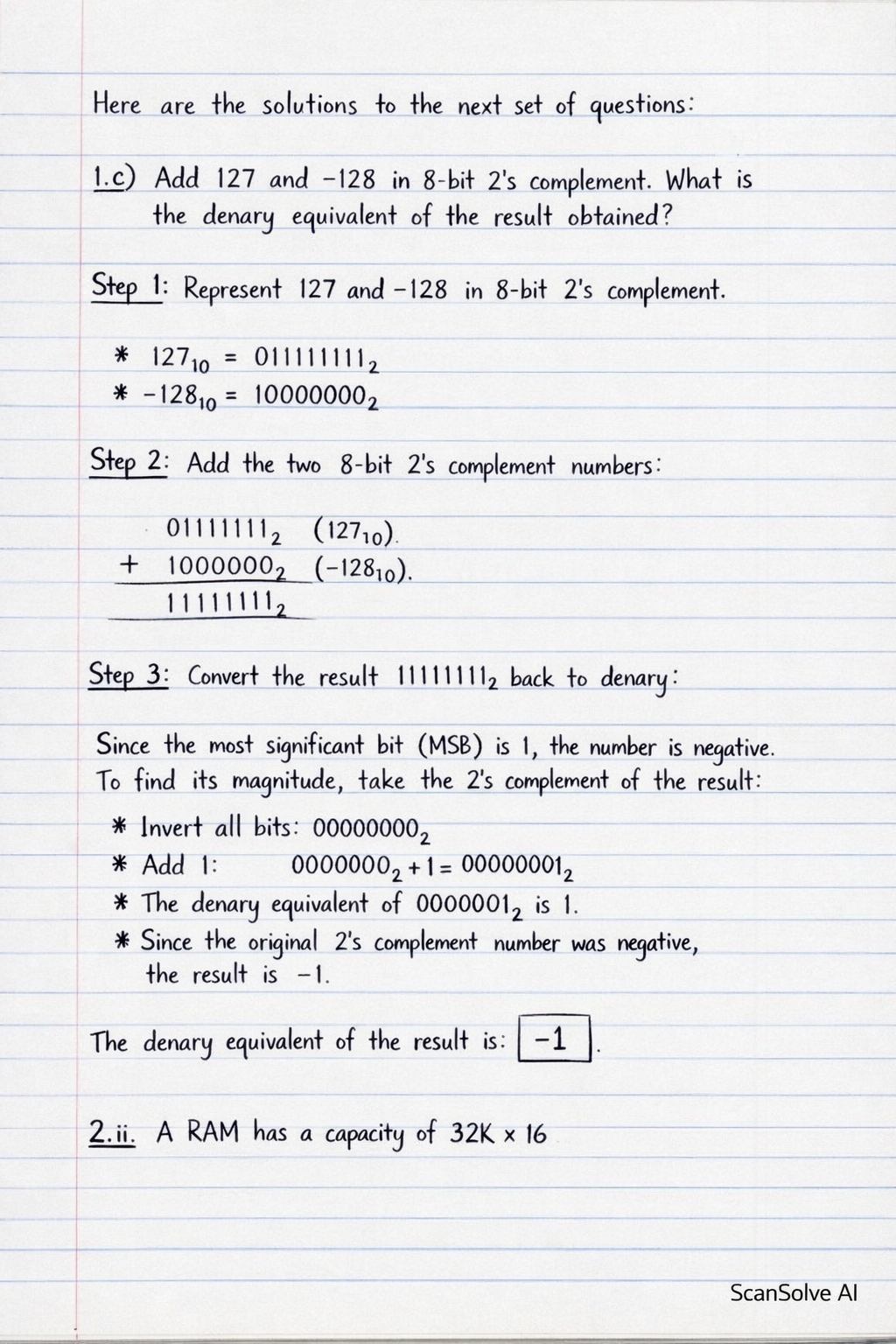
1.c) Add 127 and -128 in 8-bit 2's complement. What is the denary equivalent of the result obtained?
Represent 127 and -128 in 8-bit 2's complement.
Add the two 8-bit 2's complement numbers.
Convert the result back to denary.
Since the most significant bit (MSB) is 1, the number is negative. To find its magnitude, take the 2's complement of the result:
- Invert all bits:
- Add 1:
- The denary equivalent of is 1.
- Since the original 2's complement number was negative, the result is -1.
The denary equivalent of the result is .
2.ii. A RAM has a capacity of 32K x 16
a) How many memory addresses does this RAM have?
Calculate the number of addresses.
The capacity is 32K words. 'K' stands for .
Number of addresses .The RAM has .
b) How many address lines will be needed for this RAM?
Determine the number of address lines.
The number of addresses is 32768. We need to find such that .
.
So, .will be needed.
c) State TWO main differences between RISC and CISC machines.
- Instruction Set Complexity: RISC (Reduced Instruction Set Computer) architectures have a smaller, simpler set of instructions, each typically executing in a single clock cycle. CISC (Complex Instruction Set Computer) architectures have a larger, more complex set of instructions, some of which can perform multiple operations and take multiple clock cycles to execute.
- Instruction Format: RISC typically uses fixed-length instruction formats, simplifying instruction decoding. CISC often uses variable-length instruction formats, which can make decoding more complex.
- Registers: RISC architectures generally have a larger number of general-purpose registers, relying heavily on registers for operations. CISC architectures tend to have fewer general-purpose registers, often using memory for operands.
3.i) Give the differences between the following pairs of transmission modes
a) Parallel and serial transmission
- Parallel Transmission: Multiple bits of data are sent simultaneously over multiple channels (wires) at the same time. It is faster for short distances but more expensive and prone to skew.
- Serial Transmission: Bits of data are sent one after another over a single channel. It is slower than parallel for the same clock rate but more reliable and cost-effective for long distances.
b) Synchronous and asynchronous transmission
- Synchronous Transmission: Data is transmitted in blocks (frames) at a constant rate, synchronized by a shared clock signal between the sender and receiver. It is efficient for large data transfers but requires precise timing.
- Asynchronous Transmission: Data is transmitted character by character, with start and stop bits framing each character to indicate its beginning and end. It does not require a shared clock and is simpler to implement for small, irregular data transfers.
c) Half duplex and full duplex
- Half Duplex: Data can be transmitted in both directions, but only one direction at a time. Devices must take turns sending and receiving.
- Full Duplex: Data can be transmitted simultaneously in both directions at the same time. This allows for continuous two-way communication.
3.ii.a) Is the internet WAN or LAN? Explain. Name one common protocol used in LAN.
The internet is a WAN (Wide Area Network). It spans a vast geographical area, connecting multiple smaller networks (LANs and other WANs) across cities, countries, and continents.
One common protocol used in LAN is Ethernet.3.ii.b) What is the difference between a network identifier and a host address?
- A network identifier (or network address) is the portion of an IP address that identifies the specific network to which a device is connected. All devices on the same network share the same network identifier.
- A host address is the portion of an IP address that uniquely identifies a specific device (host) within that particular network.
3.ii.c) What are the components of the complete internet address of a computer?
The complete internet address of a computer typically consists of:- IP Address: A unique numerical label assigned to each device connected to a computer network that uses the Internet Protocol for communication.
- Port Number: A number that identifies a specific process or application running on a computer, allowing multiple applications to share the same IP address.
3.ii.d) Name three common ways that malware can gain access into a computer system. How can one get rid of malware?
Three common ways malware can gain access:- Phishing/Social Engineering: Tricking users into opening malicious attachments or clicking on infected links in emails or messages.
- Exploiting Software Vulnerabilities: Taking advantage of unpatched security flaws in operating systems, web browsers, or other applications.
- Malicious Downloads/Drive-by Downloads: Downloading infected software from untrusted sources or unknowingly downloading malware when visiting compromised websites.
To get rid of malware, one can:
- Run a full scan with up-to-date antivirus/anti-malware software.
- Disconnect from the internet to prevent further spread or data exfiltration.
- Remove detected threats and quarantine suspicious files.
- Update the operating system and all software to patch vulnerabilities.
- Perform a system restore to a point before the infection, if available.
- In severe cases, a complete reinstallation of the operating system may be necessary.
4.i) Why are databases very important today?
Databases are crucial today because they provide an organized and efficient way to store, manage, and retrieve vast amounts of information. They enable businesses to make data-driven decisions, support complex applications, facilitate data sharing, and ensure data integrity and security, which are essential for almost every industry and modern digital service.4.ii) Define the following terms as far as databases are concerned:
a) Foreign key
A foreign key is a column or a set of columns in one table that refers to the primary key in another table. It establishes a link or relationship between two tables, ensuring referential integrity.b) Entity
An entity in a database context represents a real-world object or concept about which data is stored. Examples include a person, a place, an event, or an object. In a relational database, an entity typically corresponds to a table.4.iii) A school database has TWO tables TEACHERS and SUBJECT, with primary keys Teacher ID and Subject Code respectively. Study the tables below and answer the questions that follow.
a) Define the term referential integrity as used in databases. How does it affect records in a database table? Explain your answer using this database.
Referential integrity is a database concept that ensures that relationships between tables remain consistent. It dictates that a foreign key in one table must either match a primary key in another table or be NULL.How it affects records:
In this database, theSubject Codein theTEACHERtable would likely be a foreign key referencing theSubject Codeprimary key in theSUBJECTtable. Referential integrity would ensure that:- You cannot add a teacher to the
TEACHERtable with aSubject Codethat does not exist in theSUBJECTtable. For example, if a teacher is assignedSubject Code'MATH101', then 'MATH101' must already exist as aSubject Codein theSUBJECTtable. - You cannot delete a
Subject Codefrom theSUBJECTtable if there are teachers in theTEACHERtable currently assigned to that subject. This prevents "orphan" records where a teacher is assigned to a non-existent subject. - You cannot change a
Subject Codein theSUBJECTtable if it is being referenced by records in theTEACHERtable, unless a cascading update rule is in place to automatically update theSubject Codein theTEACHERtable as well.
Still stuck on this one?
Ask a follow-up, and the answer starts from this question.
More Computer Science Questions
Handwritten Step-by-Step Solution
Get this as a handwritten image on WhatsApp — like a tutor wrote it for you.
Try on WhatsApp