
We read your photo as:
b) Using two's complement, work out 3710 - 1710, giving your answer in decimal notation. (4 marks)
Mathematics
ScanSolve AI Answer
Answer
Step-by-step solution
5 stepsHere is the solution to your question:
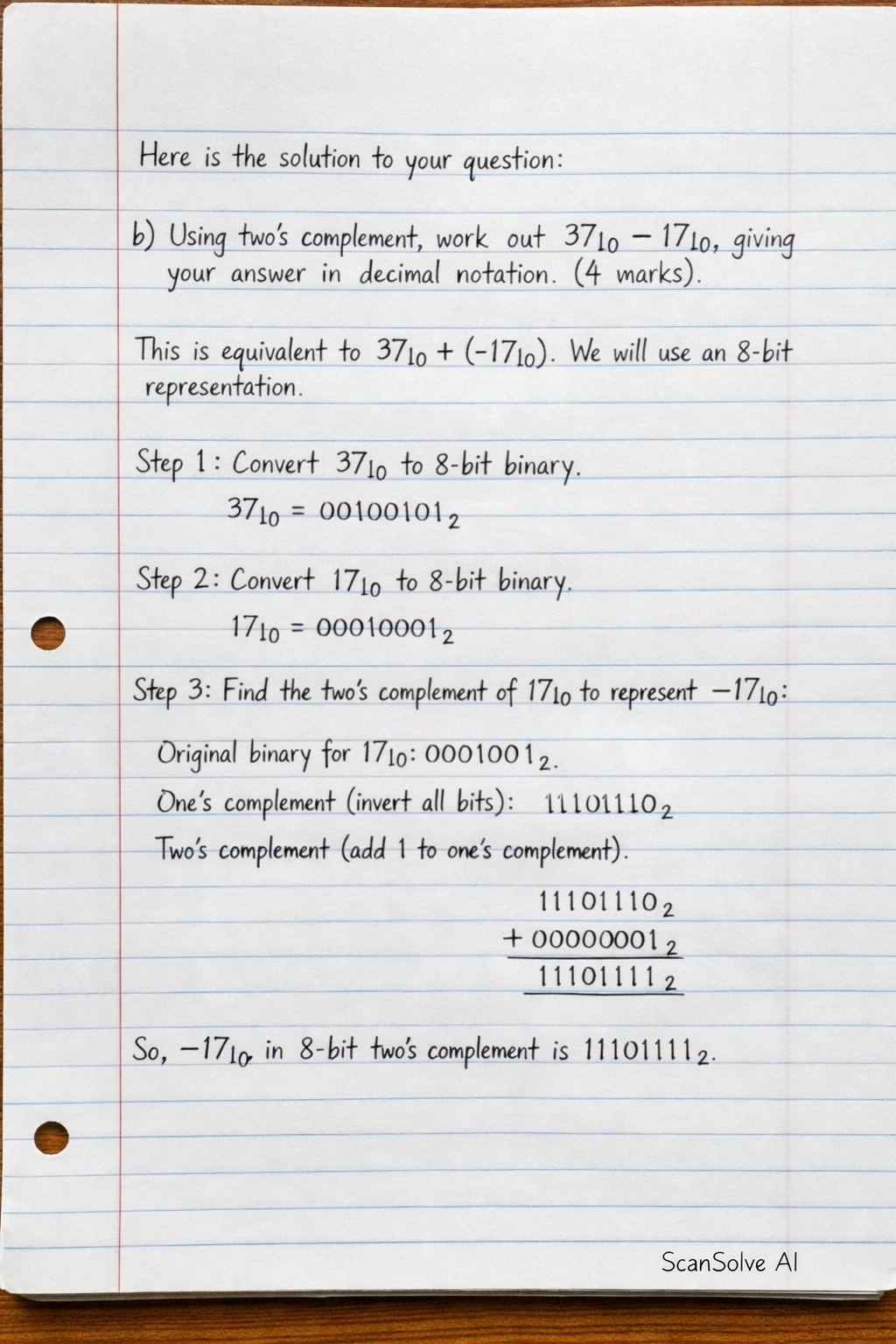
b) Using two's complement, work out , giving your answer in decimal notation. (4 marks)
This is equivalent to . We will use an 8-bit representation.
Convert to 8-bit binary.
Convert to 8-bit binary.
Find the two's complement of to represent .
- Original binary for :
- One's complement (invert all bits):
- Two's complement (add 1 to one's complement):
\quad 11101110_2 \\
+ \quad 00000001_2 \\
\hline
\quad 11101111_2
\end{array}$$
So, $-17_{10}$ in 8-bit two's complement is $11101111_2$.
Add and the two's complement of .
The leftmost '1' is a carry-out. In two's complement arithmetic, a carry-out from the most significant bit is discarded.The result is .
Convert this binary number back to decimal.
The final answer is .
Was this helpful?
Try one yourself
A new problem that tests the same skill.
Still stuck on this one?
Ask a follow-up, and the answer starts from this question.
Got a different question?Ask your own question
More Mathematics Questions
QSolve the following: a) 67433+4899+5432 b) 5324+8765+6543. Express the following in base two: a)…QRound off the following numbers to the nearest 100 and perform the calculations: a) 287, b) 765, c)…QSubtract 17 (octal) from 2016 (octal). Show your work.Qb) Find |AB|, 1) Convert 11010, to a number in base five, b) Arrange the following in ascending…QPerform the following calculations: a) −81 + 0.79, b) 31 + (−16). Simplify: 2.1) 34, 2.2) 1.23, 2.3)…
Browse by topic:Pre-Algebra
Handwritten Step-by-Step Solution
Get this as a handwritten image on WhatsApp — like a tutor wrote it for you.
Try on WhatsApp