
We read your photo as:
Discuss 2 advantages of using AI in Cameroon in agriculture, compare direct and parallel implementation methods, and give 2 reasons why a hospital may prefer parallel implementation.
Computer Science
ScanSolve AI Answer
Here are the answers to your questions:
-
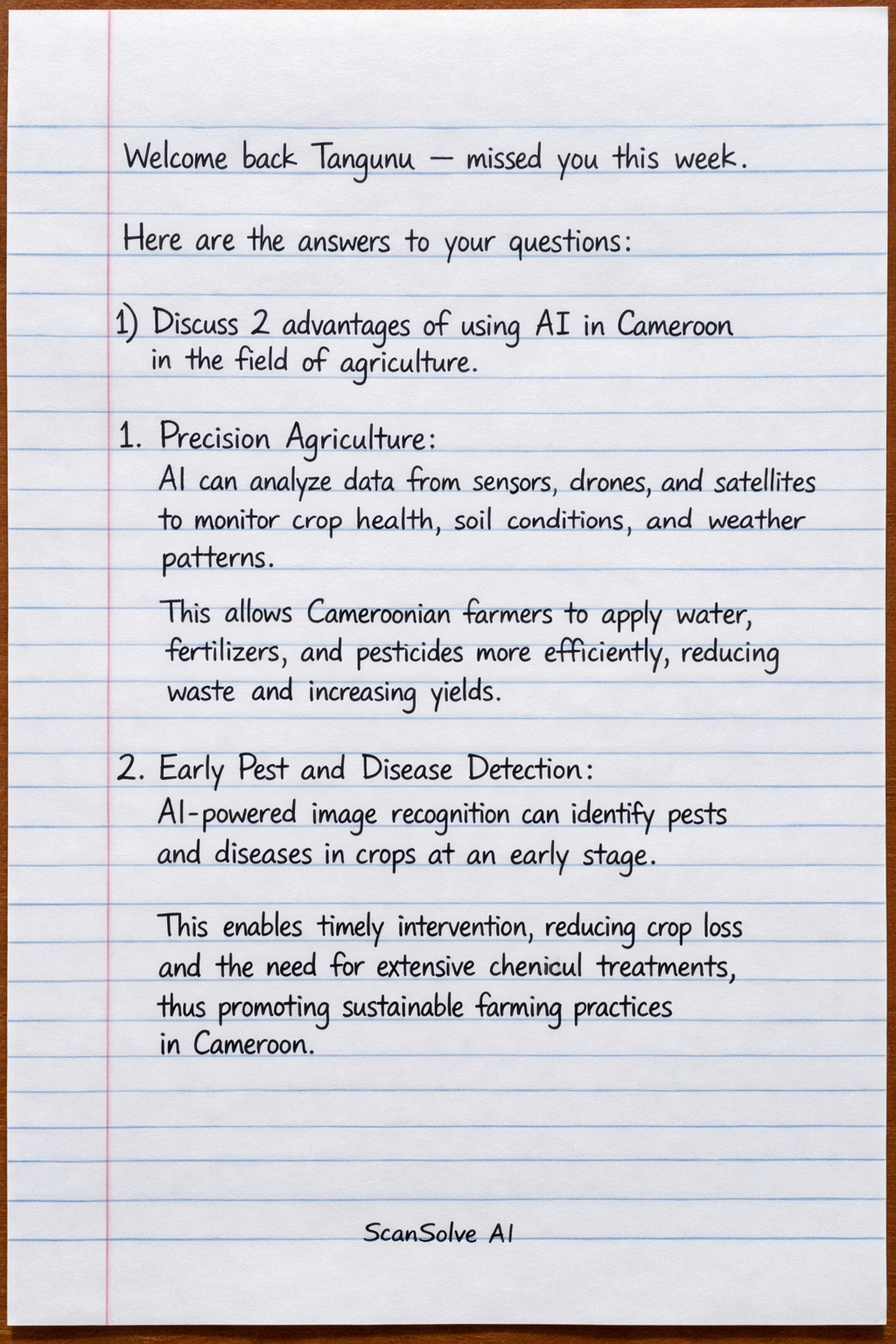
1) Discuss 2 advantages of using AI in Cameroon in the field of agriculture.
- 1. Precision Agriculture: AI can analyze data from sensors, drones, and satellites to monitor crop health, soil conditions, and weather patterns. This allows Cameroonian farmers to apply water, fertilizers, and pesticides more efficiently, reducing waste and increasing yields.
- 2. Early Pest and Disease Detection: AI-powered image recognition can identify pests and diseases in crops at an early stage. This enables timely intervention, reducing crop loss and the need for extensive chemical treatments, thus promoting sustainable farming practices in Cameroon.
-
2) Compare direct and parallel implementation methods.
- Direct Implementation: This method involves immediately replacing the old system with the new one. It is generally faster and less costly in the short term but carries a high risk because if the new system fails, there is no fallback.
- Parallel Implementation: In this method, both the old and new systems run simultaneously for a period. This allows for thorough testing and comparison of the new system's performance against the old one, significantly reducing risk but being more costly and resource-intensive.
-
3) Give 2 reasons why a hospital may prefer a parallel implementation as compared to direct.
- 1. Patient Safety and Continuity of Care: In a hospital, system failure can have critical, life-threatening consequences. Parallel implementation ensures that the old, proven system remains operational while the new system is being tested, guaranteeing uninterrupted patient care and safety.
- 2. Data Integrity and Accuracy: Hospitals handle sensitive and vital patient data. Running both systems concurrently allows for cross-referencing and validation of data migration and processing in the new system, minimizing errors and ensuring the accuracy of patient records.
-
4) State 4 differences between a System Software & Application Software given e.g.
- System Software:
- Purpose: Manages and controls computer hardware and provides a platform for application software.
- Dependency: Essential for the computer to function; the computer cannot run without it.
- User Interaction: Less interactive with the end-user; operates mostly in the background.
- Example: Operating systems like Windows or Linux.
- Application Software:
- Purpose: Performs specific tasks or functions for the end-user.
- Dependency: Cannot run without system software.
- User Interaction: Highly interactive with the end-user.
- Example: Word processors like Microsoft Word or web browsers like Google Chrome.
- System Software:
-
5) Define the term job scheduling & state 2 methods of job scheduling indicating whether they are primitive or non-primitive.
- Job Scheduling: This is the process of deciding which process (or job) to execute next and for how long, to optimize system performance, resource utilization, and meet various objectives such as minimizing response time or maximizing throughput.
- 1. First-Come, First-Served (FCFS):
- Description: Processes are executed in the order they arrive in the ready queue.
- Type: Non-preemptive. Once a process starts, it runs to completion without interruption.
- 2. Round Robin (RR):
- Description: Each process is given a small, fixed unit of CPU time (time quantum). If the process does not complete within this quantum, it is interrupted and moved to the end of the ready queue.
- Type: Preemptive.
Was this helpful?
Still stuck on this one?
Ask a follow-up, and the answer starts from this question.
Got a different question?Ask your own question
More Computer Science Questions
QReorder the following sentences into a logical paragraph about AI in healthcare: The use of AI in…QDiscuss the benefits and challenges of AI in education.QDefine and give uses for the following ICT terms, with specific reference to Cameroon…QExplain the following system conversation method. Give one advantage each A) Pilot running B)…QAdvantages and disadvantages of Artificial intelligence
Handwritten Step-by-Step Solution
Get this as a handwritten image on WhatsApp — like a tutor wrote it for you.
Try on WhatsApp