
We read your photo as:
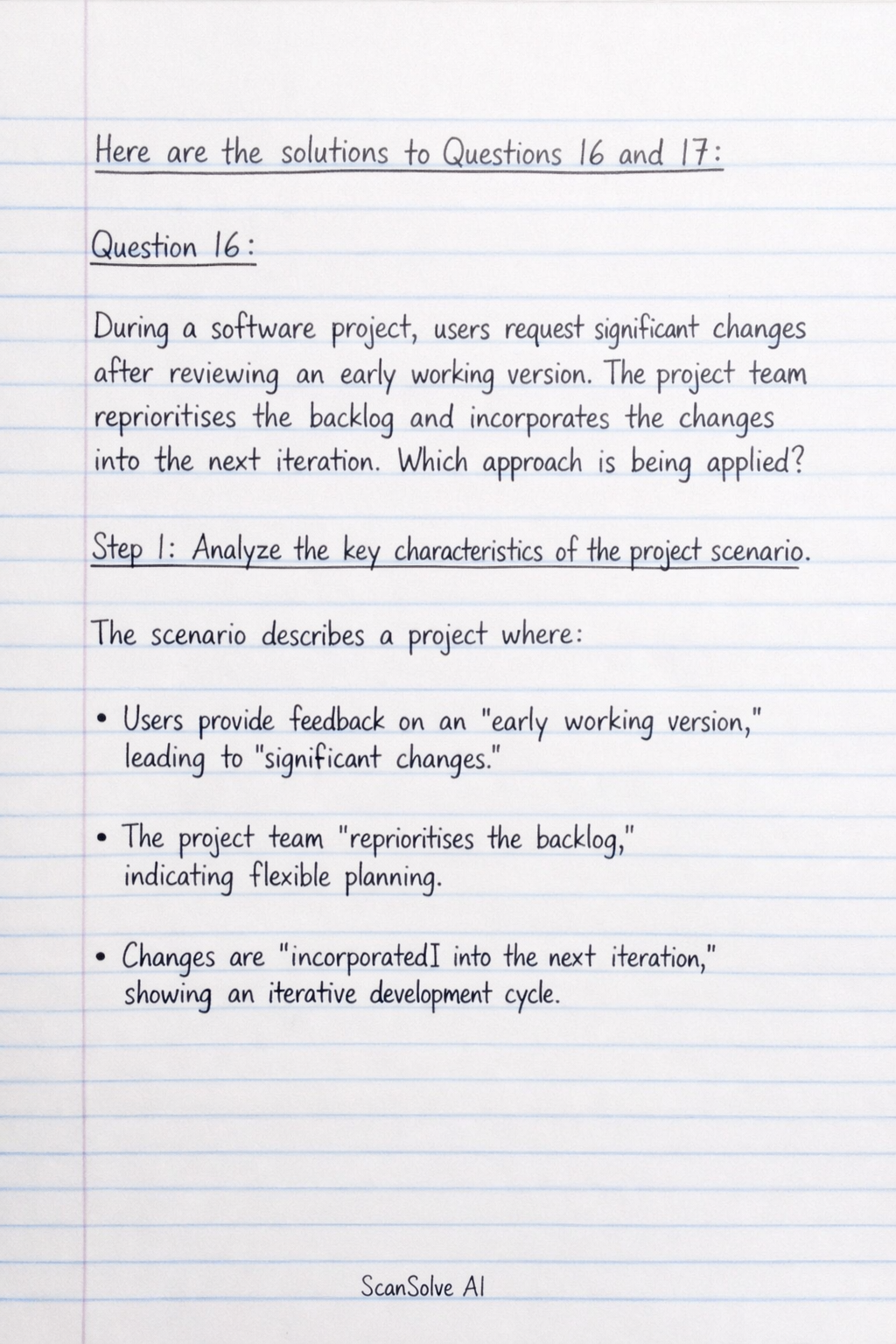
During a software project, users request significant changes after reviewing an early working version. The project team reprioritises the backlog and incorporates the changes into the next iteration. Which approach is being applied?
ScanSolve AI Answer
Answer
Agile project management
Step-by-step solution
6 stepsHere are the solutions to Questions 16 and 17:
Part 16· 3 steps
During a software project, users request significant changes after reviewing an early working version. The project team reprioritises the backlog and incorporates the changes into the next iteration. Which approach is being applied?
Analyze the key characteristics of the project scenario.
The scenario describes a project where:
- Users provide feedback on an "early working version," leading to "significant changes."
- The project team "reprioritises the backlog," indicating flexible planning.
- Changes are "incorporate[d] into the next iteration," showing an iterative development cycle.
Evaluate the given options against these characteristics.
- a. Traditional predictive planning: This approach (like Waterfall) emphasizes upfront planning, fixed requirements, and discourages changes once development begins. This contradicts the scenario.
- b. Agile project management: This approach embraces change, uses iterative and incremental development, incorporates continuous user feedback, and manages work through a prioritized backlog. This perfectly matches the scenario.
- c. Routine operational control: This refers to managing ongoing, repetitive business activities, not a project management approach.
- d. Functional departmental management: This describes an organizational structure, not a project management methodology.
Select the option that best fits the description.
The described activities are hallmarks of Agile project management. Your selection of 'a. Traditional predictive planning' is incorrect.
The correct option is b. Agile project management.
Part 17· 3 steps
Five projects are competing for the same specialist employees. Senior managers currently approve projects based on who argues most persuasively. What is the strongest reason to introduce a project priority system?
Identify the problem in the current project selection process.
The current method of approving projects is based on "who argues most persuasively," which is subjective and likely leads to inconsistent and potentially suboptimal project choices, especially when resources are limited ("competing for the same specialist employees").
Consider the purpose of a project priority system.
A project priority system is designed to provide objective criteria and a structured process for evaluating, selecting, and ranking projects. This ensures that projects are chosen based on their strategic value, feasibility, and resource availability, rather than subjective factors.
Evaluate the given options.
- a. To eliminate all management judgement: While a priority system reduces subjectivity, it's generally not intended to eliminate all management judgment, as strategic decisions often still require human input and interpretation. This statement is too absolute.
- b. To ensure projects are ranked consistently: This directly addresses the problem of subjective and inconsistent project approval. A priority system provides a standardized framework, leading to consistent and objective ranking of projects. This is a strong and accurate reason.
The correct option is b. To ensure projects are ranked consistently.
Try one yourself
A new problem that tests the same skill.
Still stuck on this one?
Ask a follow-up, and the answer starts from this question.
More Computer Science Questions
Handwritten Step-by-Step Solution
Get this as a handwritten image on WhatsApp — like a tutor wrote it for you.
Try on WhatsApp