
We read your photo as:
Explain the following terms: Peripheral Device, Technical Drawing, Isometric Drawing, Freehand Sketching. Name two types of technical drawings and state the difference between artistic and technical d
ScanSolve AI Answer
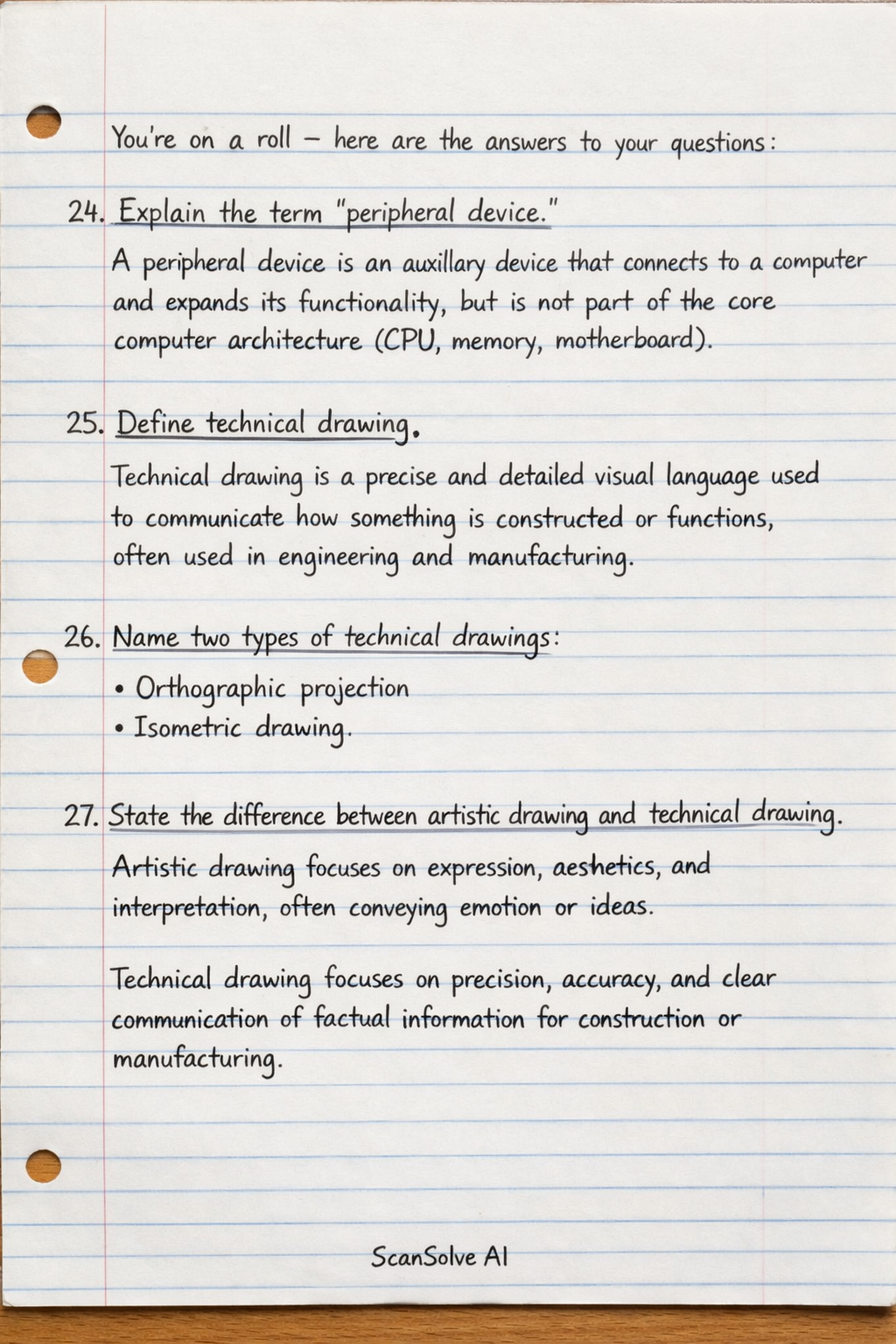
here are the answers to your questions:
24. Explain the term "peripheral device."
A peripheral device is an auxiliary device that connects to a computer and expands its functionality, but is not part of the core computer architecture (CPU, memory, motherboard).
25. Define technical drawing.
Technical drawing is a precise and detailed visual language used to communicate how something is constructed or functions, often used in engineering and manufacturing.
26. Name two types of technical drawings.
- Orthographic projection
- Isometric drawing
27. State the difference between artistic drawing and technical drawing.
Artistic drawing focuses on expression, aesthetics, and interpretation, often conveying emotion or ideas. Technical drawing focuses on precision, accuracy, and clear communication of factual information for construction or manufacturing.
28. What is an isometric drawing?
An isometric drawing is a type of axonometric projection where the object is rotated along its axes, showing three dimensions (height, width, depth) in a single view without perspective distortion.
29. Define freehand sketching.
Freehand sketching is drawing without the aid of instruments like rulers or compasses, relying solely on hand movements to create lines and shapes.
30. Give one use of drawing in engineering.
Drawing in engineering is used to design and communicate specifications for products, structures, and systems.
31. What is a scale drawing?
A scale drawing is a drawing where all elements are proportionally reduced or enlarged from their actual size by a specific ratio, known as the scale.
32. Define dimensioning in technical drawing.
Dimensioning in technical drawing is the process of adding numerical values and symbols to a drawing to specify the size, location, and other geometric characteristics of features on an object.
33. State the types of drawing.
The main types of drawing are artistic drawing and technical drawing.
34. What is artistic drawing?
Artistic drawing is a form of visual art that uses lines, shapes, and tones to create images that express ideas, emotions, or represent observations, often with a focus on aesthetics.
35. List the examples of artistic drawing.
- Portrait drawing
- Landscape drawing
- Still life drawing
36. Name one drawing instrument and its use.
- Ruler: Used for drawing straight lines and measuring distances.
37. Name another drawing instrument and its use.
- Compass: Used for drawing circles and arcs.
38. List the examples of technical drawing.
- Architectural drawings
- Mechanical drawings
- Electrical diagrams
39. Why is a drawing board important?
A drawing board provides a smooth, flat, and stable surface essential for creating accurate and precise technical drawings.
40. Define line types in technical drawing.
Line types in technical drawing are standardized variations of lines (e.g., solid, dashed, thin, thick) used to convey specific information about an object's features, such as visible edges, hidden lines, or centerlines.
41. Give an illustration of a hidden line.
A hidden line is represented by a series of short dashes:
42. Define centre line.
A centre line is a thin line consisting of alternating long and short dashes, used to indicate the axis of symmetry of an object or the center of a circle or arc.
43. What is the difference between thick and thin lines in drawing?
Thick lines are used for visible outlines and edges of an object, making them stand out. Thin lines are used for dimensions, extension lines, projection lines, and hatching, providing detail without obscuring the main object.
44. Explain the importance of proportion in drawings.
Proportion in drawings is crucial because it ensures that all parts of an object are represented in their correct relative sizes. This accuracy is vital for technical drawings to be functional and for artistic drawings to appear realistic and balanced.
Still stuck on this one?
Ask a follow-up, and the answer starts from this question.
More Computer Science Questions
Handwritten Step-by-Step Solution
Get this as a handwritten image on WhatsApp — like a tutor wrote it for you.
Try on WhatsApp