This biology question covers important biological concepts and processes. The step-by-step explanation below helps you understand the underlying mechanisms and reasoning.
What are the key differences between mitosis and meiosis, considering their function, daughter cells, cell type, and chromosome number?
Biology

ScanSolve AI Answer
Here are the key differences between mitosis and meiosis based on the provided text:
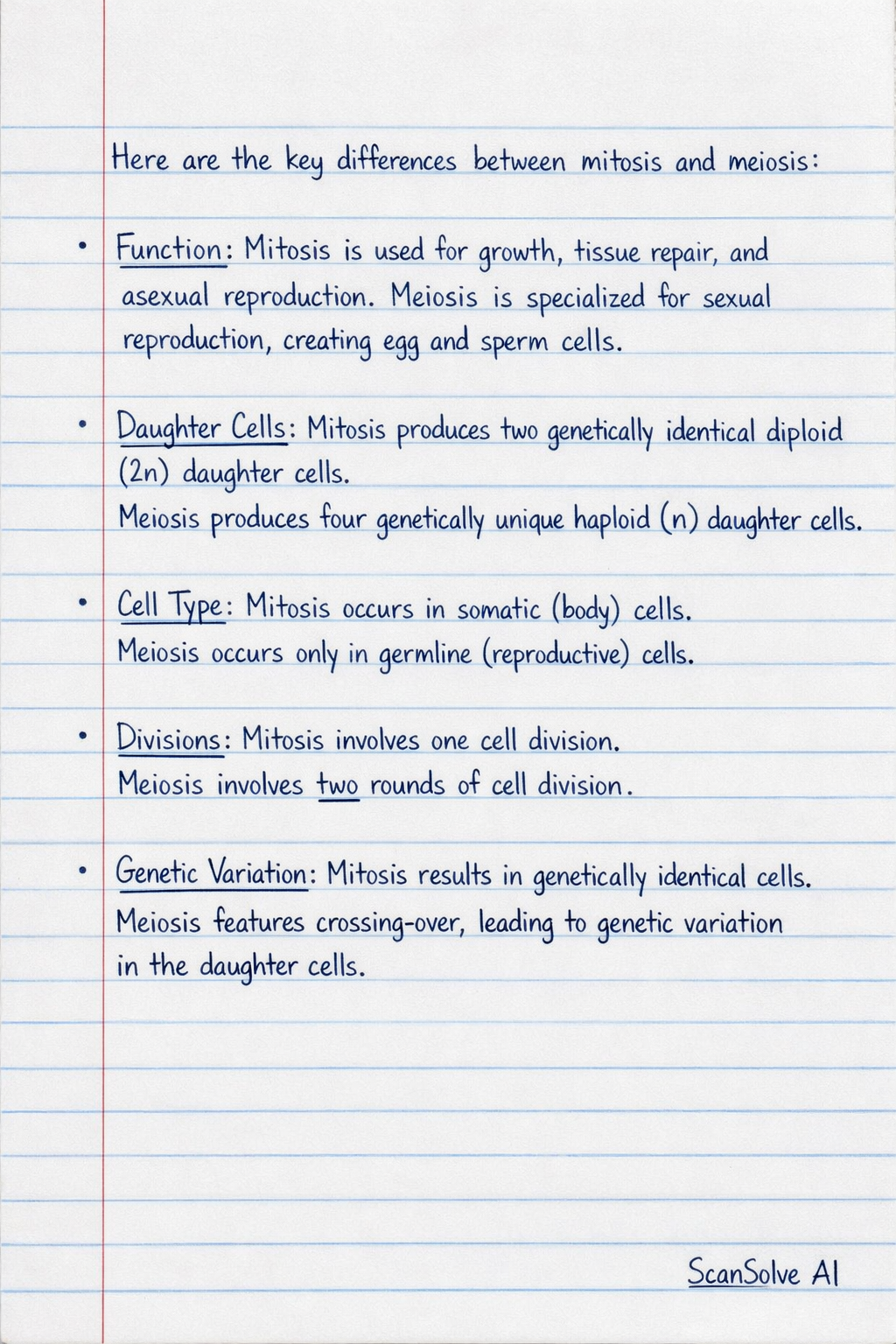
- Function: Mitosis is used for growth, tissue repair, and asexual reproduction. Meiosis is specialized for sexual reproduction, creating egg and sperm cells.
- Daughter Cells: Mitosis produces two genetically identical diploid () daughter cells. Meiosis produces four genetically unique haploid () daughter cells.
- Cell Type: Mitosis occurs in somatic (body) cells. Meiosis occurs only in germline (reproductive) cells.
- Divisions: Mitosis involves one cell division. Meiosis involves two rounds of cell division.
- Genetic Variation: Mitosis results in genetically identical cells. Meiosis features crossing-over, leading to genetic variation in the daughter cells.
Was this helpful?
Need help with your own homework?
Get instant step-by-step solutions to any question. Free to start.
Ask Your Question
Handwritten Step-by-Step Solution
Get this as a handwritten image on WhatsApp — like a tutor wrote it for you.
Try on WhatsAppMore Biology Questions
QFeature Prokaryotic Eukaryotic Nucleus No true nucleus True nucleus Nuclear membrane Absent Present…QWhy do we drink waterQIn a food chain study, learners discussed energy transfer. State two ways energy is lost.QHow many chromosomes were present in the cell at the beginning of meiosis?QName the organelle that is found in plant cells only, where the nucleic acid named in QUESTION 1.4.1…
Still have questions?
Quick Answer
Function: Mitosis is used for growth, tissue repair, and asexual reproduction. Meiosis* is specialized for sexual reproduction, creating egg and sperm cells.
ScanSolve AI Answer
Here are the key differences between mitosis and meiosis based on the provided text: Function: Mitosis is used for growth, tissue repair, and asexual reproduction. Meiosis* is specialized for sexual reproduction, creating egg and sperm cells. Daughter Cells: Mitosis produces two genetically identical diploid (2n) daughter cells. Meiosis* produces four genetically unique haploid (n) daughter cells. Cell Type: Mitosis occurs in somatic (body) cells. Meiosis* occurs only in germline (reproductive) cells. Divisions: Mitosis involves one cell division. Meiosis* involves two rounds of cell division. Genetic Variation: Mitosis results in genetically identical cells. Meiosis* features crossing-over, leading to genetic variation in the daughter cells.