
This biology question covers important biological concepts and processes. The step-by-step explanation below helps you understand the underlying mechanisms and reasoning.
ScanSolve AI Answer
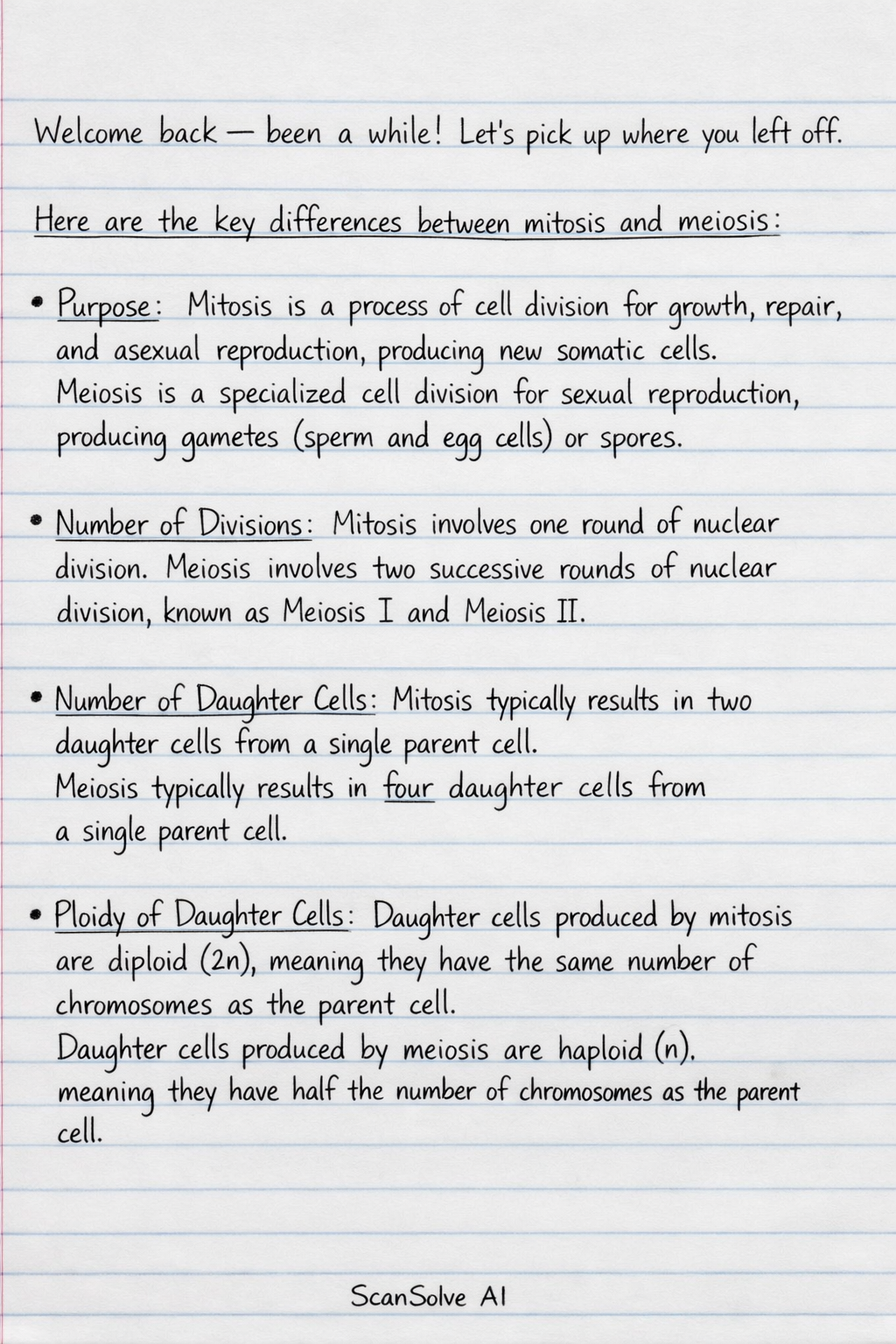
Here are the key differences between mitosis and meiosis: Purpose: Mitosis is a process of cell division for growth, repair, and asexual reproduction, producing new somatic cells. Meiosis is a specialized cell division for sexual reproduction, producing gametes (sperm and egg cells) or spores. Number of Divisions: Mitosis involves one round of nuclear division. Meiosis involves two successive rounds of nuclear division, known as Meiosis I and Meiosis II. Number of Daughter Cells: Mitosis typically results in two daughter cells from a single parent cell. Meiosis typically results in four daughter cells from a single parent cell. Ploidy of Daughter Cells: Daughter cells produced by mitosis are diploid (2n), meaning they have the same number of chromosomes as the parent cell. Daughter cells produced by meiosis are haploid (n), meaning they have half the number of chromosomes as the parent cell. Genetic Identity: Daughter cells produced by mitosis are genetically identical to the parent cell and to each other. Daughter cells produced by meiosis are genetically unique due to processes like crossing over and independent assortment. Crossing Over: Crossing over, the exchange of genetic material between homologous chromosomes, does not occur during mitosis. Crossing over is a crucial event that occurs during Prophase I of meiosis, contributing to genetic variation. Send me the next one 📸