
We read your photo as:
Explain the functions of an operating system and provide examples of application software and memory technologies.
ScanSolve AI Answer
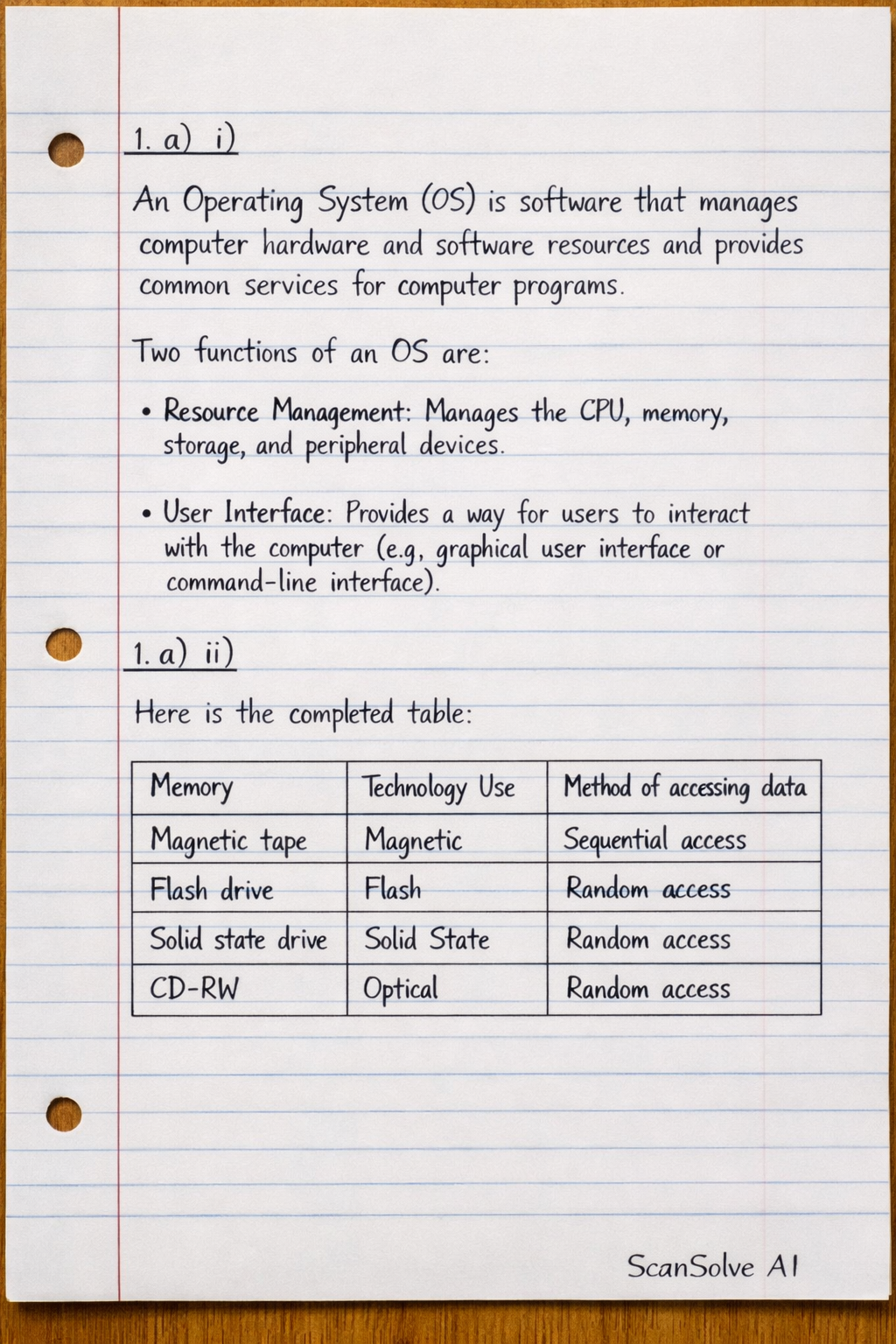
1. a) i)
An Operating System (OS) is software that manages computer hardware and software resources and provides common services for computer programs.
Two functions of an OS are:
- Resource Management: Manages the CPU, memory, storage, and peripheral devices.
- User Interface: Provides a way for users to interact with the computer (e.g., graphical user interface or command-line interface).
1. a) ii)
Here is the completed table:
| Memory | Technology Use | Method of accessing data |
|---|---|---|
| Magnetic tape | Magnetic | Sequential access |
| Flash drive | Flash | Random access |
| Solid state drive | Solid State | Random access |
| CD-RW | Optical | Random access |
1. b) i)
Two examples of application software:
- To enable a learner work with data that requires calculation: Spreadsheet software (e.g., Microsoft Excel, Google Sheets).
- To design graduation certificates: Desktop publishing software (e.g., Adobe InDesign) or Graphic design software (e.g., Adobe Photoshop).
1. b) ii)
I cannot provide a diagram.
The machine cycle (also known as the instruction cycle) is the fundamental operation cycle of a CPU. It consists of four main stages:
- Fetch: The CPU retrieves an instruction from memory.
- Decode: The CPU interprets the instruction to determine what operation needs to be performed.
- Execute: The CPU performs the operation specified by the instruction (e.g., arithmetic calculation, data movement).
- Store: The result of the execution is written back to memory or a register.
1. c) i)
Cloud computing is the on-demand delivery of computing services—including servers, storage, databases, networking, software, analytics, and intelligence—over the Internet ("the cloud") to offer faster innovation, flexible resources, and economies of scale.
1. c) ii)
Two services offered by cloud computing:
- Infrastructure as a Service (IaaS): Provides virtualized computing resources over the internet. Users can rent virtual machines, storage, and networks, giving them control over operating systems and applications.
- Software as a Service (SaaS): Delivers software applications over the internet, on a subscription basis. Users access the software via a web browser or mobile app without needing to install or maintain it locally.
2. a) i)
Source code is a set of human-readable instructions written in a programming language by a programmer. It needs to be translated into machine-executable form.
Object code is the machine-readable output of a compiler or assembler, generated from source code. It consists of machine language instructions that a computer's CPU can directly execute.
2. a) ii)
A program is a set of instructions that a computer can execute to perform a specific task or solve a problem.
2. b) i)
There are 3 variables in the algorithm: T1, T2, Avg.
2. b) ii)
A variable is a named storage location in a computer program's memory that holds a value, which can change during the program's execution.
2. b) iii)
A datatype is a classification that specifies the type of value a variable can hold (e.g., integer, float, string, boolean) and determines the operations that can be performed on it.
2. b) iv)
A suitable datatype for the variables T1, T2, and Avg would be Real (or Float), as test marks and their average can often include decimal values. If only whole numbers are expected, Integer would also be suitable for T1 and T2, with Avg potentially being Real.
2. b) v)
I cannot provide a diagram. Here is a description of the flowchart for the given algorithm:
- Start (Oval symbol)
- Declare T1, T2, Avg (Rectangle symbol for process/declaration)
- Input T1 (Parallelogram symbol for input)
- Input T2 (Parallelogram symbol for input)
- Calculate Avg = (T1 + T2) / 2 (Rectangle symbol for process)
- Is Avg 10? (Diamond symbol for decision)
- If Yes: Display "Passed" (Parallelogram symbol for output)
- If No: Display "Failed" (Parallelogram symbol for output)
- Output "Goodbye" (Parallelogram symbol for output)
- Stop (Oval symbol)
3. a) i)
I cannot provide diagrams. Here are the descriptions of the logic gates:
- XOR (Exclusive OR) Gate:
- Symbol: A standard OR gate symbol with an additional curved line at the input.
- Function: The output is HIGH (1) if an odd number of inputs are HIGH. If both inputs are the same (both 0 or both 1), the output is LOW (0).
- Truth Table (for 2 inputs A, B):
A B Output 0 0 0 0 1 1 1 0 1 1 1 0
- NAND (NOT AND) Gate:
- Symbol: A standard AND gate symbol with a small circle (inverter bubble) at the output.
- Function: The output is LOW (0) only if all inputs are HIGH (1). Otherwise, the output is HIGH (1).
- Truth Table (for 2 inputs A, B):
A B Output 0 0 1 0 1 1 1 0 1 1 1 0
- NOR (NOT OR) Gate:
- Symbol: A standard OR gate symbol with a small circle (inverter bubble) at the output.
- Function: The output is HIGH (1) only if all inputs are LOW (0). Otherwise, the output is LOW (0).
- Truth Table (for 2 inputs A, B):
A B Output 0 0 1 0 1 0 1 0 0 1 1 0
3. a) ii)
A logic gate is an elementary building block of a digital circuit that performs a basic logical function (e.g., AND, OR, NOT) on one or more binary inputs and produces a single binary output.
3. a) iii)
A pixel (short for "picture element") is the smallest individual unit of a digital image or display. It is a single point in a raster image, and when combined with many other pixels, it forms a complete image.
3. b)
The question refers to "Figure 1" and "Figure 2" which are not provided in the image. Therefore, I cannot answer any questions related to the image storage or pixel data based on these missing figures.
Still stuck on this one?
Ask a follow-up, and the answer starts from this question.
More Computer Science Questions
Handwritten Step-by-Step Solution
Get this as a handwritten image on WhatsApp — like a tutor wrote it for you.
Try on WhatsApp