
We read your photo as:
Explain six functions of operating systems.
ScanSolve AI Answer
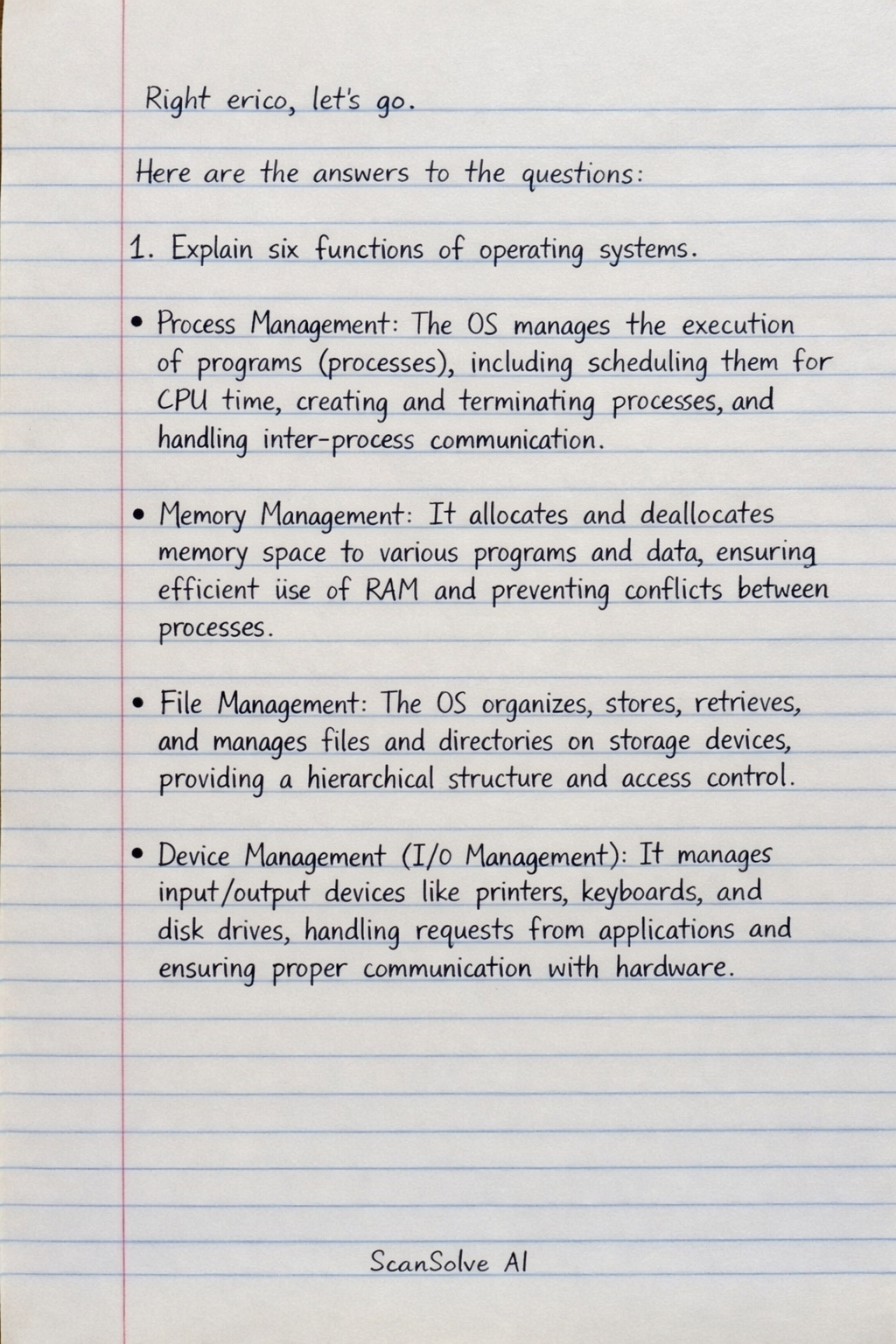
Here are the answers to the questions:
-
Explain six functions of operating systems. An operating system (OS) performs several critical functions to manage computer hardware and software resources. Here are six key functions:
- Process Management: The OS manages the execution of programs (processes), including scheduling them for CPU time, creating and terminating processes, and handling inter-process communication.
- Memory Management: It allocates and deallocates memory space to various programs and data, ensuring efficient use of RAM and preventing conflicts between processes.
- File Management: The OS organizes, stores, retrieves, and manages files and directories on storage devices, providing a hierarchical structure and access control.
- Device Management (I/O Management): It manages input/output devices like printers, keyboards, and disk drives, handling requests from applications and ensuring proper communication with hardware.
- Security and Protection: The OS implements security measures to protect system resources and user data from unauthorized access, including user authentication and access control mechanisms.
- User Interface: It provides an interface (graphical user interface or command-line interface) that allows users to interact with the computer and execute commands.
-
What is the difference between Job and Process?
- A job is a unit of work submitted to the operating system, often consisting of a program, its data, and control instructions. It's a high-level concept, typically used in batch processing, representing a complete task to be performed.
- A process is an instance of a program in execution. It is a dynamic entity that includes the program code, its current activity (program counter, registers), and its associated data and stack. A single job can involve multiple processes, or a process can be a part of a larger job.
-
An operating system has the Kernel and Shell. The two are important in one way or the other. State any four differences of Kernel and an Operating system. This question likely intends to ask for differences between the Kernel and the Shell, as the Kernel is a core part of the Operating System itself. Assuming this interpretation, here are four differences:
- Function: The Kernel is the core component that directly interacts with hardware, managing system resources like CPU, memory, and I/O devices. The Shell is the user interface that interprets user commands and requests services from the kernel.
- Location/Privilege: The Kernel runs in a privileged mode (kernel space) with full access to system hardware. The Shell runs in user mode (user space) and interacts with the kernel through system calls.
- Interaction: Users directly interact with the Shell to issue commands. The Shell then translates these commands into requests that the Kernel can understand and execute.
- Nature: The Kernel is the fundamental program that provides essential services for all other parts of the OS. The Shell is an application program that acts as an intermediary between the user and the kernel.
Still stuck on this one?
Ask a follow-up, and the answer starts from this question.
More Computer Science Questions
Handwritten Step-by-Step Solution
Get this as a handwritten image on WhatsApp — like a tutor wrote it for you.
Try on WhatsApp