
We read your photo as:
Given the information appearing in Fig. 4.119, determine: a) IC, b) RC, c) RB
ScanSolve AI Answer
Step-by-step solution
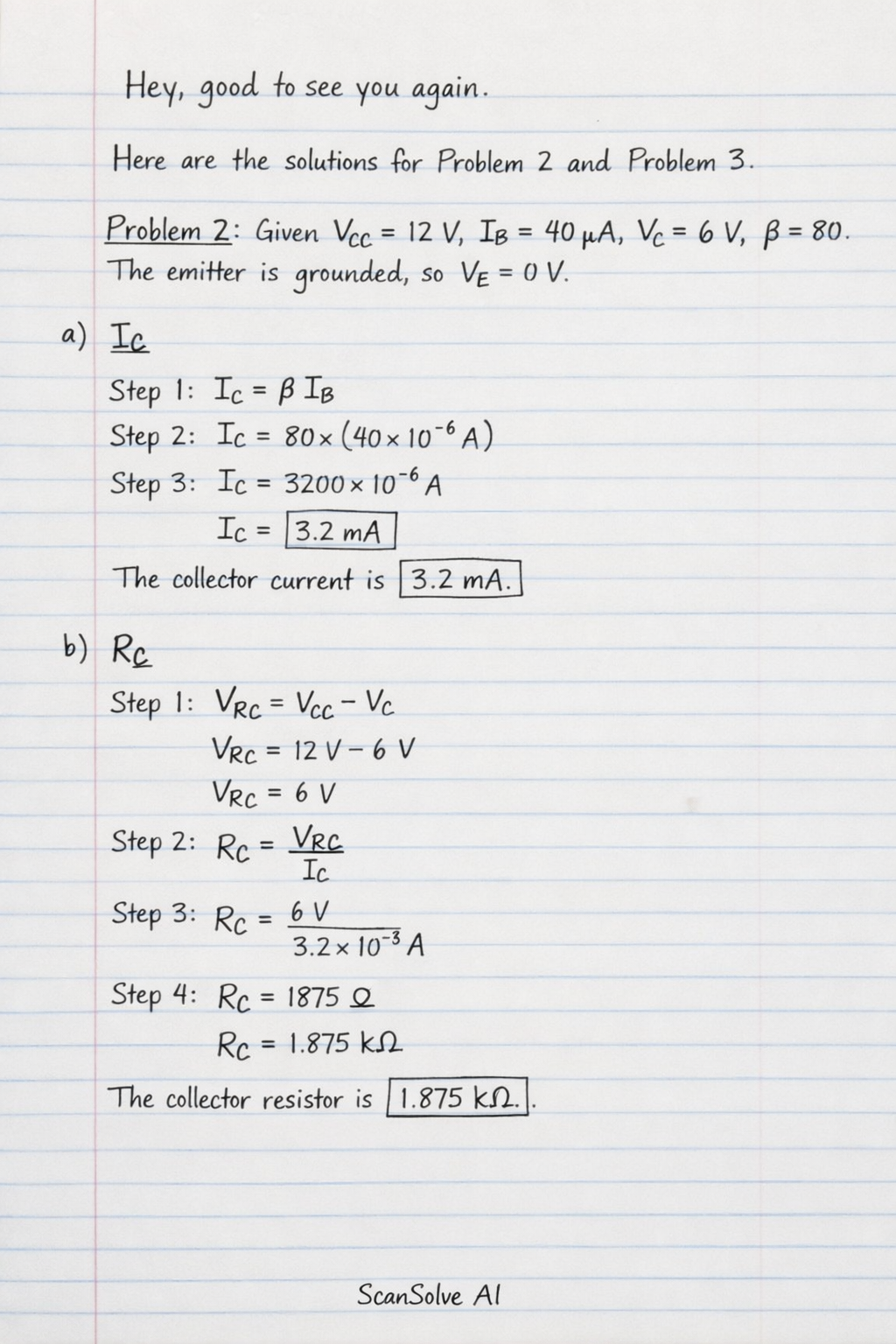
24 stepsHere are the solutions for and .
: Given the information appearing in Fig. 4.119, determine:
Given: , , , . The emitter is grounded, so .
a)
Use the relationship between collector current and base current.
Substitute the given values.
Calculate .
The collector current is .
b)
Calculate the voltage drop across .
Use Ohm's Law to find .
Substitute the values.
Calculate .
The collector resistor is .
c)
Assume for a silicon transistor.
Since , .
Calculate the voltage drop across .
Use Ohm's Law to find .
Substitute the values.
Calculate .
The base resistor is .
d)
Use the definition of .
Substitute the given values.
Calculate .
The collector-emitter voltage is .
: Given the information appearing in Fig. 4.120, determine:
Given: , , , . The emitter is grounded, so .a)
Use the relationship between emitter, collector, and base currents.
Rearrange to solve for .
Substitute the given values.
Calculate .
The collector current is .
b)
Calculate the collector voltage .
Since .
Calculate using the voltage drop across .
Substitute the values.
Calculate .
The supply voltage is .
c)
Use the definition of .
Step
Still stuck on this one?
Ask a follow-up, and the answer starts from this question.
More Computer Science Questions
Handwritten Step-by-Step Solution
Get this as a handwritten image on WhatsApp — like a tutor wrote it for you.
Try on WhatsApp