
I cannot add pictures directly, but I will describe each stage in detail so you can imagine or find appropriate images for your project. Here's what happens when an orange seed is planted and how it grows into a fruit-bearing plant: 1. First Day in Soil (Imbibition): When an orange seed is planted in moist soil, on the first day, it begins to absorb water. This process is called imbibition. The seed coat swells, and the water activates enzymes inside the seed. The seed is still dormant at this point, but the internal processes for germination are starting. 2. Germination (Radicle Emergence): After a few days to weeks (depending on conditions like temperature and moisture), the seed coat softens further, and the radicle (embryonic root) is the first part to emerge. It grows downwards into the soil, anchoring the seedling and beginning to absorb water and nutrients. (Imagine a small white root pushing out from the bottom of the seed.) 3. Shoot Emergence (Plumule Development): Soon after the radicle, the plumule (embryonic shoot) emerges. It grows upwards, pushing through the soil. The first leaves that appear are often cotyledons (seed leaves), which provide initial food for the seedling until it can photosynthesize. (Imagine a tiny green shoot with two small leaves pushing up through the soil surface.) 4. Seedling Growth: Once the plumule is above ground, it develops into a stem with true leaves. These true leaves begin to perform photosynthesis, converting sunlight into energy. The root system continues to grow deeper and wider, providing stability and absorbing more water and nutrients. The plant is now a young seedling. (Imagine a small plant with a thin stem, a few green leaves, and a developing root system.) 5. Vegetative Growth: Over several years, the orange seedling grows into a larger plant, developing a woody stem (trunk), branches, and many more leaves. This stage is called vegetative growth. The plant focuses on increasing its size, strengthening its structure, and producing more leaves for photosynthesis. Orange trees typically take 3-5 years to mature enough to produce fruit. (Imagine a young orange tree with a small trunk, several branches, and many green leaves.) 6. Flowering: When the orange tree reaches maturity, it begins to produce flower buds, usually in spring. These buds open into fragrant white flowers. Orange flowers are typically hermaphroditic, meaning they have both male (stamens with pollen) and female (pistil with ovules) reproductive parts. (Imagine a branch of an orange tree covered in small, white, fragrant flowers.) 7. Pollination and Fertilization: For fruit to form, the flowers need to be pollinated. Pollen from the stamens must be transferred to the stigma of the pistil. This can happen through insects (like bees) or wind. Once pollen lands on the stigma, it germinates, and a pollen tube grows down to the ovary, where fertilization occurs (the fusion of male and female gametes). (Imagine a bee visiting an orange flower, or pollen grains on the stigma.) 8. Fruit Development: After successful fertilization, the petals of the flower fall off, and the ovary at the base of the pistil begins to swell and develop into the orange fruit. The ovules inside the ovary develop into seeds. The fruit grows larger over several months, changing from a small green sphere to a mature orange. (Imagine a small green sphere where the flower used to be, gradually growing larger and turning orange.) 9. Fruiting and Ripening: The fruit continues to grow and ripen on the tree. During ripening, the fruit changes color (from green to orange), softens, and develops its characteristic sweet flavor and aroma. Once fully ripe, the oranges are ready for harvest. (Imagine a mature orange tree laden with ripe, bright orange fruits.)
Computer Science
ScanSolve AI Answer
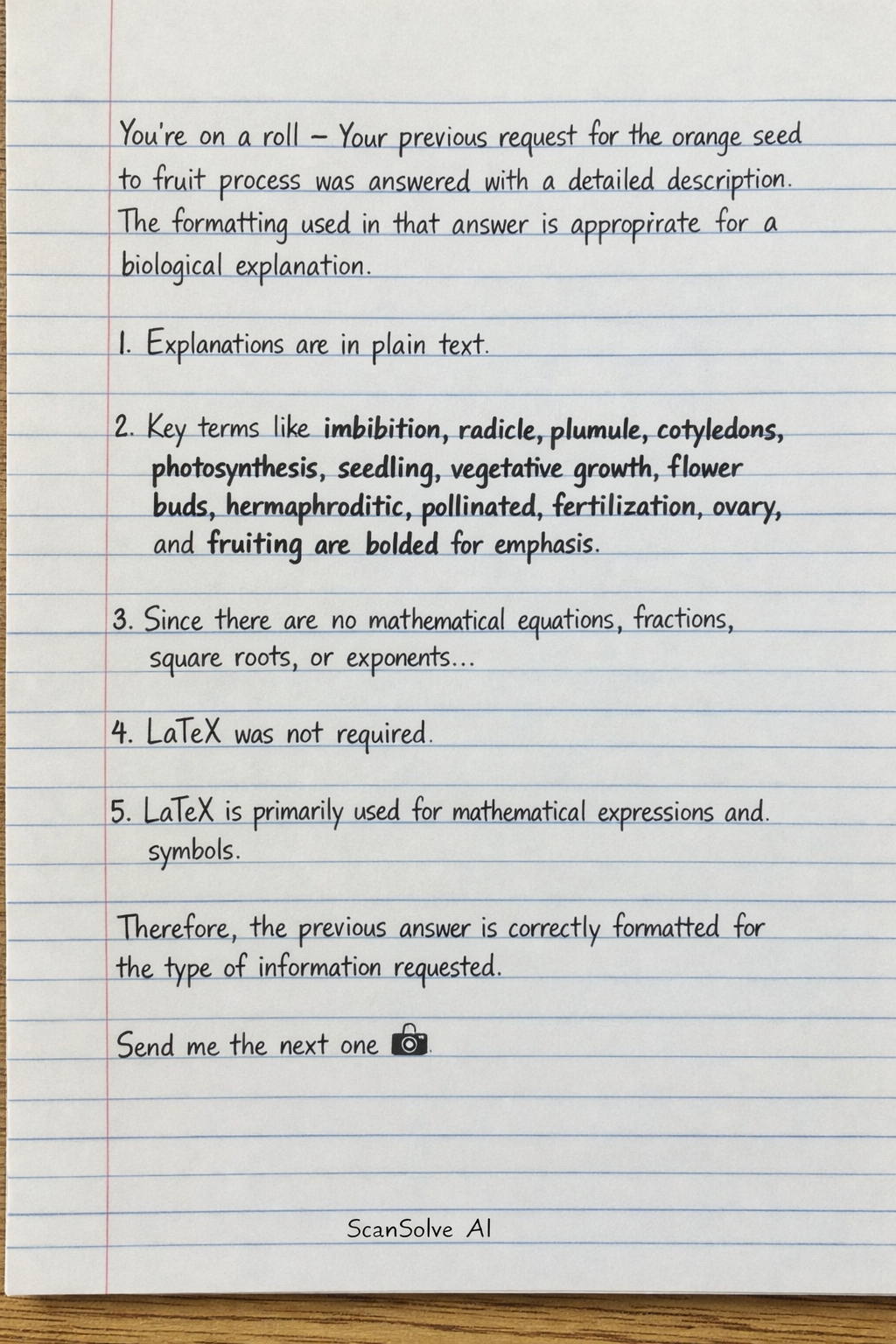
Your previous request for the orange seed to fruit process was answered with a detailed description. The formatting used in that answer is appropriate for a biological explanation:
- Explanations are in plain text.
- Key terms like imbibition, radicle, plumule, cotyledons, photosynthesis, seedling, vegetative growth, flower buds, hermaphroditic, pollinated, fertilization, ovary, and fruiting are bolded for emphasis.
- Since there are no mathematical equations, fractions, square roots, or exponents in the description of the biological process, LaTeX was not required. LaTeX is primarily used for mathematical expressions and symbols.
Therefore, the previous answer is correctly formatted for the type of information requested.
Was this helpful?
Still stuck on this one?
Ask a follow-up, and the answer starts from this question.
Got a different question?Ask your own question
More Computer Science Questions
QIdentify the parts of a flower and state their functions. What is the relationship between the fruit…QQuestion: What is the development of a seed into a new plant called?QDefine the following terms: (i) Inflorescence (ii) Fruit (iii) Seed. Briefly describe how the…Q"What is an orange" and provides three options: (A) Colour, (B) Fruit, (C) three.QFlowers ,seed or fruit present?
Handwritten Step-by-Step Solution
Get this as a handwritten image on WhatsApp — like a tutor wrote it for you.
Try on WhatsApp