
We read your photo as:
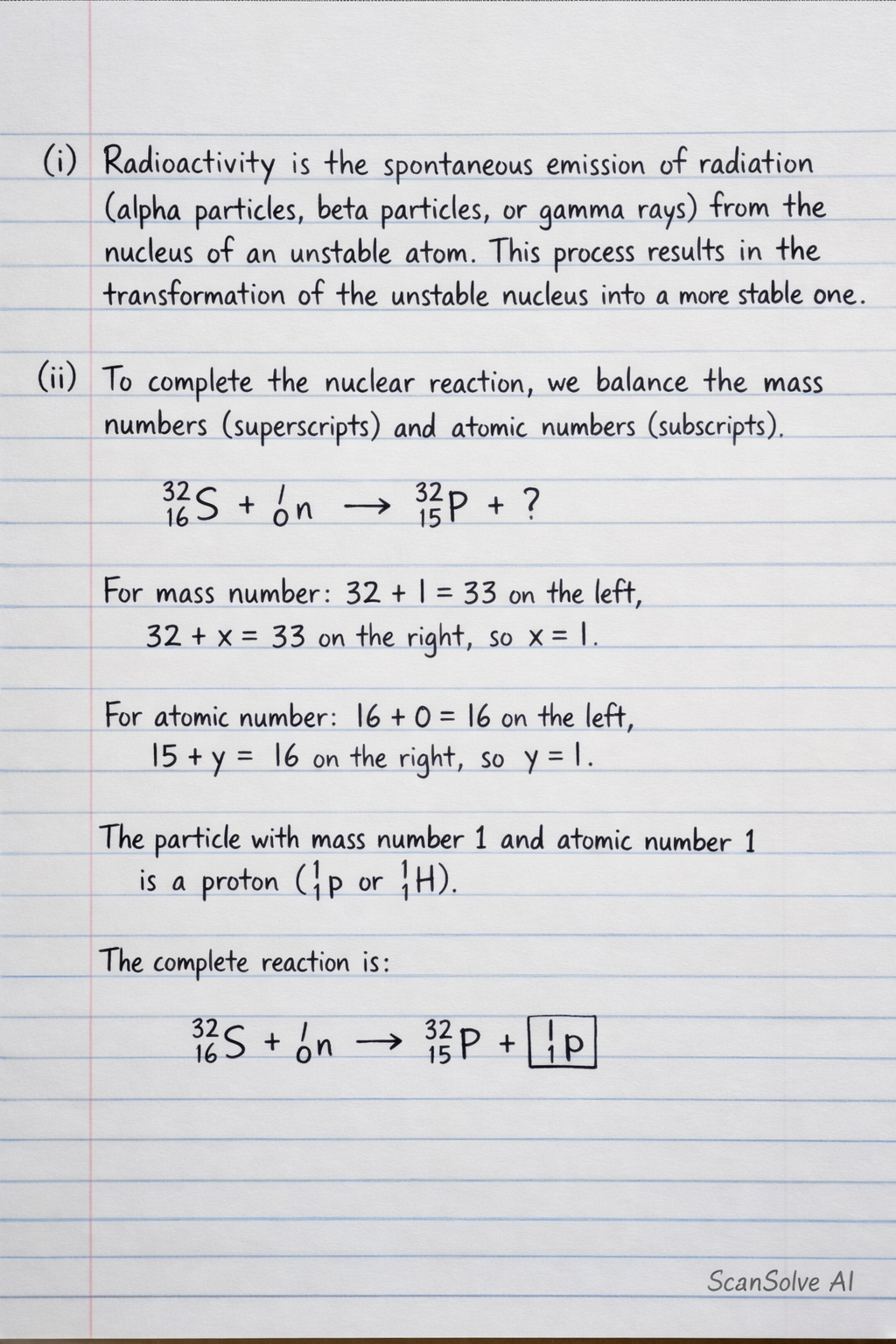
Radioactivity is the spontaneous emission of radiation (alpha particles, beta particles, or gamma rays) from the nucleus of an unstable atom. This process results in the transformation of the unst
ScanSolve AI Answer
Step-by-step solution
8 stepsPart a(ii)
To complete the nuclear reaction, we balance the mass numbers (superscripts) and atomic numbers (subscripts).
(i) Radioactivity is the spontaneous emission of radiation (alpha particles, beta particles, or gamma rays) from the nucleus of an unstable atom. This process results in the transformation of the unstable nucleus into a more stable one.
For mass number: on the left. on the right, so .
For atomic number: on the left. on the right, so .
The particle with mass number 1 and atomic number 1 is a proton ( or ).
The complete reaction is:
Part b· 4 steps
To balance the chemical equation
Balance K and Cr.
There are 2 K on the left, so put 2 in front of KCl.
There are 2 Cr on the left, so put 2 in front of CrCl.Balance O.
There are 7 O on the left, so put 7 in front of HO.
Balance H.
There are H on the right, so put 14 in front of HCl.
Balance Cl.
On the left, there are 14 Cl.
On the right, there are Cl.
To balance Cl, we need Cl atoms to come from . This means .
Part c(i)
Three characteristics of a catalyst are
- A catalyst increases the rate of a chemical reaction without being consumed in the overall reaction.
- A catalyst provides an alternative reaction pathway with a lower activation energy.
- A catalyst does not change the position of equilibrium or the thermodynamics of the reaction.
Part c(ii)· 4 steps
For a first-order reaction of type
Write the differential rate law.
Rearrange the equation to separate variables.
Integrate both sides from initial concentration at to concentration at time .
Multiply by -1 and use the logarithm property .
(iii) A catalyst alters the rate of a chemical reaction by providing an alternative reaction mechanism with a lower activation energy. By lowering the activation energy, a larger fraction of reactant molecules possess sufficient energy to overcome the energy barrier, leading to an increased frequency of successful collisions and thus a faster reaction rate.
Still stuck on this one?
Ask a follow-up, and the answer starts from this question.
More Computer Science Questions
Handwritten Step-by-Step Solution
Get this as a handwritten image on WhatsApp — like a tutor wrote it for you.
Try on WhatsApp