
We read your photo as:
I) Respiration is the biochemical process by which living organisms break down organic substances, like glucose, to release energy for metabolic activities.
ScanSolve AI Answer
Step-by-step solution
3 steps2(a)
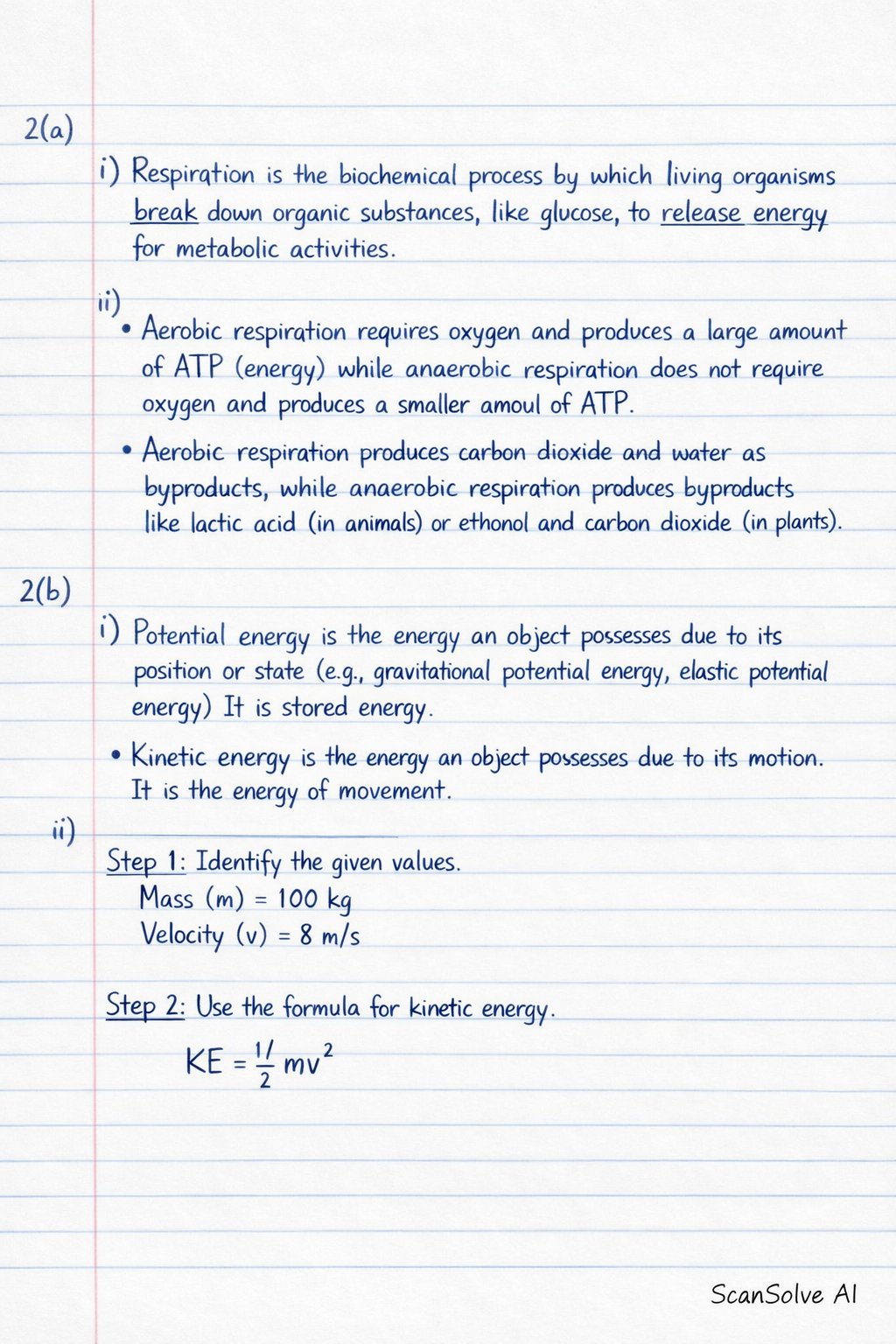
i) Respiration is the biochemical process by which living organisms break down organic substances, like glucose, to release energy for metabolic activities.
ii)
- Aerobic respiration requires oxygen and produces a large amount of ATP (energy), while anaerobic respiration does not require oxygen and produces a smaller amount of ATP.
- Aerobic respiration produces carbon dioxide and water as byproducts, while anaerobic respiration produces byproducts like lactic acid (in animals) or ethanol and carbon dioxide (in plants/yeast).
2(b)
i)
- Potential energy is the energy an object possesses due to its position or state (e.g., gravitational potential energy, elastic potential energy). It is stored energy.
- Kinetic energy is the energy an object possesses due to its motion. It is the energy of movement.
ii)
Identify the given values.
Mass () =
Velocity () =Use the formula for kinetic energy.
Substitute the values and calculate.
The kinetic energy is .
2(c)
i) Electronic configuration is the distribution of electrons of an atom or molecule in atomic or molecular orbitals. It describes how electrons are arranged around the nucleus.
ii)
- Protons are positively charged particles found in the nucleus of an atom, while electrons are negatively charged particles that orbit the nucleus.
- Protons have a significantly larger mass compared to electrons (approximately 1836 times heavier).
2(d)
Four importance of soil water:- It is essential for plant growth as it dissolves nutrients for absorption.
- It helps in regulating soil temperature.
- It facilitates the decomposition of organic matter by microorganisms.
- It is a component of the soil solution, which transports nutrients.
3. a (i)
α) Ecosystem: An ecosystem is a community of living organisms (biotic components) interacting with each other and with their non-living environment (abiotic components) in a particular area.
β) Adaptation: Adaptation is a heritable trait that helps an organism survive and reproduce in its specific environment. It can be structural, physiological, or behavioral.
μ) Habitat: A habitat is the natural environment or home where a particular organism lives. It provides the necessary resources for survival, such as food, water, and shelter.3. a (ii)
Three adaptations of a fish in its habitat:- Streamlined body shape: Reduces drag and allows for efficient movement through water.
- Gills: Specialized organs for extracting oxygen from water.
- Fins: Used for propulsion, steering, and maintaining balance in water.
3. b.
Four uses of the periscope:- Used in submarines to see above the water surface.
- Used in tanks to observe the surroundings from inside.
- Used in trenches during warfare to observe enemy positions without exposing oneself.
- Used by spectators in crowded events to see over obstacles.
3. c (i)
- Hard water contains a high concentration of dissolved mineral ions, primarily calcium () and magnesium () ions.
- Soft water contains a low concentration of these mineral ions.
3. c (ii)
Two advantages of hard water over soft water:- It provides essential minerals like calcium and magnesium, which are beneficial for human health (e.g., bone development).
- It has a better taste for drinking due to the dissolved minerals.
3. d (i)
Fertilizer application is the process of adding nutrients to the soil or directly to plants to enhance plant growth and crop yield.3. d (ii)
Four methods of fertilizer application:- Broadcasting: Spreading fertilizer uniformly over the entire field.
- Placement: Applying fertilizer in concentrated bands near the seeds or plants.
- Foliar application: Spraying liquid fertilizer directly onto the leaves of plants.
- Fertigation: Applying fertilizer dissolved in irrigation water.
4. a.
Four importance of the carbon cycle:- It regulates the Earth's climate by controlling the concentration of carbon dioxide in the atmosphere.
- It is essential for photosynthesis, providing carbon dioxide for plants to produce organic matter.
- It facilitates the transfer of energy through ecosystems as carbon compounds move through food chains.
- It is crucial for the formation of fossil fuels (coal, oil, natural gas) over geological time.
4. b.
i) Soil structure: Refers to the arrangement of soil particles (sand, silt, clay) into aggregates or peds. It influences water infiltration, aeration, and root penetration.
ii) Soil texture: Describes the relative proportions of different-sized mineral particles (sand, silt, and clay) in a soil. It determines how water and nutrients are held.
iii) Soil porosity: The volume of pore spaces (empty spaces) within the soil, which can be filled with air or water. It affects aeration and water retention.
iv) Soil capillarity: The ability of soil to draw water upwards against the force of gravity through its pore spaces, due to adhesive and cohesive forces.
4. c. (i)
A compound is a substance formed when two or more different chemical elements are chemically bonded together in a fixed ratio.4. c. (ii)
Three differences between a compound and a mixture:- In a compound, elements are chemically bonded, forming new substances with different properties, while in a mixture, substances are physically combined and retain their original properties.
- A compound has a fixed composition by mass, whereas a mixture has a variable composition.
- The components of a compound can only be separated by chemical means, while the components of a mixture can be separated by physical means.
4. d. (i)
Frictional force is a force that opposes motion or attempted motion between two surfaces in contact.4. d. (ii)
Three applications of friction:- Walking: Friction between shoes and the ground allows us to walk without slipping.
- Braking: Friction in brakes helps to slow down or stop vehicles.
- Writing: Friction between a pen/pencil and paper allows ink/graphite to be deposited.
5. a. (i)
- Transpiration is the process by which plants release water vapor into the atmosphere, primarily through stomata on their leaves. It is mainly a physical process driven by water potential gradients.
- Photosynthesis is the process by which green plants and some other organisms convert light energy into chemical energy, synthesizing sugars from carbon dioxide and water. It is a biochemical process.
Still stuck on this one?
Ask a follow-up, and the answer starts from this question.
More Computer Science Questions
Handwritten Step-by-Step Solution
Get this as a handwritten image on WhatsApp — like a tutor wrote it for you.
Try on WhatsApp