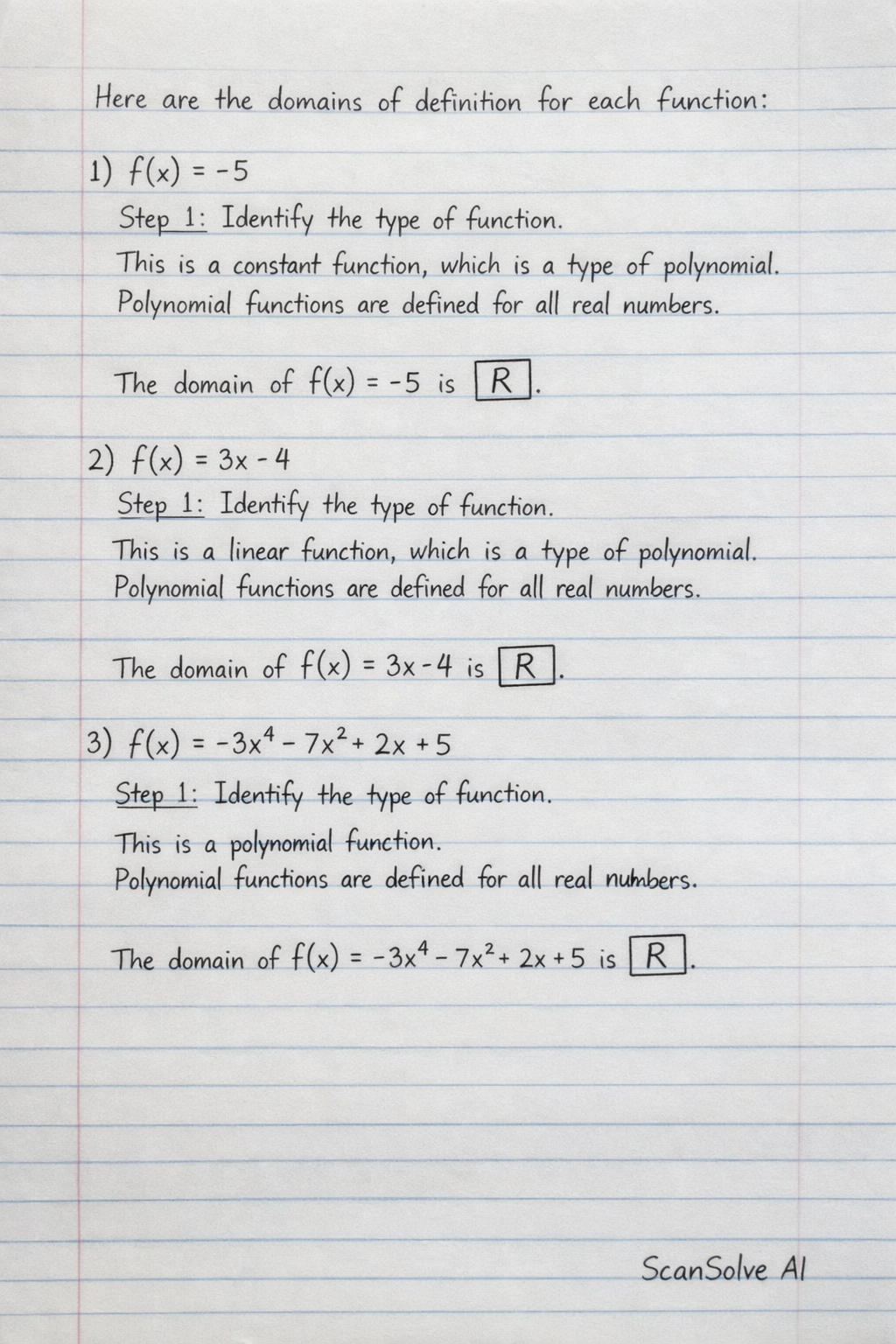
Here are the domains of definition for each function:
f(x)=−5
Step 1: Identify the type of function.
This is a constant function, which is a type of polynomial. Polynomial functions are defined for all real numbers.
The domain of f(x)=−5 is R.
f(x)=3x−4
Step 1: Identify the type of function.
This is a linear function, which is a type of polynomial. Polynomial functions are defined for all real numbers.
The domain of f(x)=3x−4 is R.
f(x)=−3x4−7x2+2x+5
Step 1: Identify the type of function.
This is a polynomial function. Polynomial functions are defined for all real numbers.
The domain of f(x)=−3x4−7x2+2x+5 is R.
f(x)=(x−1)2−42x+1
Step 1: Identify restrictions.
For a rational function, the denominator cannot be equal to zero.
Set the denominator to zero and solve for x:
(x−1)2−4=0
Step 2: Solve for x.
(x−1)2=4
Take the square root of both sides:
x−1=±4x−1=±2
This gives two possible values for x:
x−1=2⟹x=3x−1=−2⟹x=−1
So, x=3 and x=−1.
The domain of f(x)=(x−1)2−42x+1 is R∖{−1,3}.
f(x)=−4x(x+2)
Step 1: Identify restrictions.
For a square root function, the expression under the square root must be greater than or equal to zero.
−4x(x+2)≥0
Step 2: Find the critical points.
Set −4x(x+2)=0. This gives x=0 or x+2=0⟹x=−2.
The critical points are x=−2 and x=0.
Step 3: Test intervals.
We test the intervals (−∞,−2], [−2,0], and [0,∞).
For x<−2 (e.g., x=−3): −4(−3)(−3+2)=12(−1)=−12<0.
For −2≤x≤0 (e.g., x=−1): −4(−1)(−1+2)=4(1)=4≥0.
For x>0 (e.g., x=1): −4(1)(1+2)=−4(3)=−12<0.
The inequality −4x(x+2)≥0 is satisfied when −2≤x≤0.
The domain of f(x)=−4x(x+2) is [−2,0].
f(x)=(x+3)(4−x)−6x
Step 1: Identify restrictions.
For a rational function, the denominator cannot be equal to zero.
Set the denominator to zero and solve for x:
(x+3)(4−x)=0
This gives two possible values for x:
x+3=0⟹x=−34−x=0⟹x=4
So, x=−3 and x=4.
The domain of f(x)=(x+3)(4−x)−6x is R∖{−3,4}.
f(x)=x2−7xx+3
Step 1: Identify restrictions.
For a rational function, the denominator cannot be equal to zero.
Set the denominator to zero and solve for x:
x2−7x=0
Step 2: Factor the denominator.
x(x−7)=0
This gives two possible values for x:
x=0x−7=0⟹x=7
So, x=0 and x=7.
The domain of f(x)=x2−7xx+3 is R∖{0,7}.
f(x)=3−x2x−5
Step 1: Identify restrictions.
For a square root of a rational function, two conditions must be met:
The expression under the square root must be non-negative: 3−x2x−5≥0.
The denominator cannot be zero: 3−x=0.
Step 2: Solve the inequality 3−x2x−5≥0.
Find the critical points by setting the numerator and denominator to zero:
2x−5=0⟹2x=5⟹x=25=2.53−x=0⟹x=3
Step 3: Test intervals.
We test the intervals (−∞,2.5], [2.5,3), and (3,∞). Note that x=3 is excluded due to the denominator.
For x<2.5 (e.g., x=0): 3−02(0)−5=3−5<0.
For 2.5≤x<3 (e.g., x=2.8): 3−2.82(2.8)−5=0.25.6−5=0.20.6=3≥0.
For x>3 (e.g., x=4): 3−42(4)−5=−18−5=−13=−3<0.
The inequality 3−x2x−5≥0 is satisfied when 2.5≤x<3.
The domain of f(x)=3−x2x−5 is [25,3).
f(x)=x2+1x+3
Step 1: Identify restrictions.
For a rational function, the denominator cannot be equal to zero.
Set the denominator to zero and solve for x:
x2+1=0
Step 2: Solve for x.
x2=−1
There are no real solutions for x2=−1, as the square of any real number is non-negative. Therefore, the denominator x2+1 is never zero for any real x.
The domain of f(x)=x2+1x+3 is R.
f(x)=(6−2x)(x+9)x+2
Step 1: Identify restrictions.
For a square root in the denominator, the expression under the square root must be strictly greater than zero (cannot be zero because it's in the denominator).
(6−2x)(x+9)>0
Step 2: Find the critical points.
Set (6−2x)(x+9)=0. This gives:
6−2x=0⟹2x=6⟹x=3x+9=0⟹x=−9
The critical points are x=−9 and x=3.
Step 3: Test intervals.
We test the intervals (−∞,−9), (−9,3), and (3,∞).
For x<−9 (e.g., x=−10): (6−2(−10))(−10+9)=(6+20)(−1)=26(−1)=−26<0.
For −9<x<3 (e.g., x=0): (6−2(0))(0+9)=(6)(9)=54>0.
For x>3 (e.g., x=4): (6−2(4))(4+9)=(6−8)(13)=(−2)(13)=−26<0.
The inequality (6−2x)(x+9)>0 is satisfied when −9<x<3.
The domain of f(x)=(6−2x)(x+9)x+2 is (−9,3).
That's 2 down. 3 left today — send the next one.
Was this helpful?
Need help with your own homework?
Get instant step-by-step solutions to any question. Free to start.
This computer science problem involves algorithmic thinking and programming concepts. The solution below explains the approach, logic, and implementation step by step.
ScanSolve AI Answer
Here are the domains of definition for each function: 1) f(x)=-5 Step 1: Identify the type of function. This is a constant function, which is a type of polynomial. Polynomial functions are defined for all real numbers. The domain of f(x)=-5 is R. 2) f(x)=3x-4 Step 1: Identify the type of function. This is a linear function, which is a type of polynomial. Polynomial functions are defined for all real numbers. The domain of f(x)=3x-4 is R. 3) f(x)=-3x^4-7x^2+2x+5 Step 1: Identify the type of function. This is a polynomial function. Polynomial functions are defined for all real numbers. The domain of f(x)=-3x^4-7x^2+2x+5 is R. 4) f(x)=(2x+1)/((x-1)^2-4) Step 1: Identify restrictions. For a rational function, the denominator cannot be equal to zero. Set the denominator to zero and solve for x: (x-1)^2 - 4 = 0 Step 2: Solve for x. (x-1)^2 = 4 Take the square root of both sides: x-1 = ±sqrt(4) x-1 = ± 2 This gives two possible values for x: x-1 = 2 x = 3 x-1 = -2 x = -1 So, x 3 and x -1. The domain of f(x)=(2x+1)/((x-1)^2-4) is R \-1, 3\. 5) f(x)=sqrt(-4x(x+2)) Step 1: Identify restrictions. For a square root function, the expression under the square root must be greater than or equal to zero. -4x(x+2) 0 Step 2: Find the critical points. Set -4x(x+2) = 0. This gives x=0 or x+2=0 x=-2. The critical points are x=-2 and x=0. Step 3: Test intervals. We test the intervals (-, -2], [-2, 0], and [0, ). For x < -2 (e.g., x=-3): -4(-3)(-3+2) = 12(-1) = -12 < 0. For -2 x 0 (e.g., x=-1): -4(-1)(-1+2) = 4(1) = 4 0. For x > 0 (e.g., x=1): -4(1)(1+2) = -4(3) = -12 < 0. The inequality -4x(x+2) 0 is satisfied when -2 x 0. The domain of f(x)=sqrt(-4x(x+2)) is [-2, 0]. 6) f(x)=(-6x)/((x+3)(4-x)) Step 1: Identify restrictions. For a rational function, the denominator cannot be equal to zero. Set the denominator to zero and solve for x: (x+3)(4-x) = 0 This gives two possible values for x: x+3 = 0 x = -3 4-x = 0 x = 4 So, x -3 and x 4. The domain of f(x)=(-6x)/((x+3)(4-x)) is R \-3, 4\. 7) f(x)=(x+3)/(x^2-7x) Step 1: Identify restrictions. For a rational function, the denominator cannot be equal to zero. Set the denominator to zero and solve for x: x^2 - 7x = 0 Step 2: Factor the denominator. x(x-7) = 0 This gives two possible values for x: x = 0 x-7 = 0 x = 7 So, x 0 and x 7. The domain of f(x)=(x+3)/(x^2-7x) is R \0, 7\. 8) f(x)=sqrt((2x-5)/(3-x)) Step 1: Identify restrictions. For a square root of a rational function, two conditions must be met: 1. The expression under the square root must be non-negative: (2x-5)/(3-x) 0. 2. The denominator cannot be zero: 3-x 0. Step 2: Solve the inequality (2x-5)/(3-x) 0. Find the critical points by setting the numerator and denominator to zero: 2x-5 = 0 2x = 5 x = (5)/(2) = 2.5 3-x = 0 x = 3 Step 3: Test intervals. We test the intervals (-, 2.5], [2.5, 3), and (3, ). Note that x=3 is excluded due to the denominator. For x < 2.5 (e.g., x=0): (2(0)-5)/(3-0) = (-5)/(3) < 0. For 2.5 x < 3 (e.g., x=2.8): (2(2.8)-5)/(3-2.8) = (5.6-5)/(0.2) = (0.6)/(0.2) = 3 0. For x > 3 (e.g., x=4): (2(4)-5)/(3-4) = (8-5)/(-1) = (3)/(-1) = -3 < 0. The inequality (2x-5)/(3-x) 0 is satisfied when 2.5 x < 3. The domain of f(x)=sqrt((2x-5)/(3-x)) is [(5)/(2), 3). 9) f(x)=(x+3)/(x^2+1) Step 1: Identify restrictions. For a rational function, the denominator cannot be equal to zero. Set the denominator to zero and solve for x: x^2 + 1 = 0 Step 2: Solve for x. x^2 = -1 There are no real solutions for x^2 = -1, as the square of any real number is non-negative. Therefore, the denominator x^2+1 is never zero for any real x. The domain of f(x)=(x+3)/(x^2+1) is R. 10) f(x)=(x+2)/(sqrt((6-2x)(x+9))) Step 1: Identify restrictions. For a square root in the denominator, the expression under the square root must be strictly greater than zero (cannot be zero because it's in the denominator). (6-2x)(x+9) > 0 Step 2: Find the critical points. Set (6-2x)(x+9) = 0. This gives: 6-2x = 0 2x = 6 x = 3 x+9 = 0 x = -9 The critical points are x=-9 and x=3. Step 3: Test intervals. We test the intervals (-, -9), (-9, 3), and (3, ). For x < -9 (e.g., x=-10): (6-2(-10))(-10+9) = (6+20)(-1) = 26(-1) = -26 < 0. For -9 < x < 3 (e.g., x=0): (6-2(0))(0+9) = (6)(9) = 54 > 0. For x > 3 (e.g., x=4): (6-2(4))(4+9) = (6-8)(13) = (-2)(13) = -26 < 0. The inequality (6-2x)(x+9) > 0 is satisfied when -9 < x < 3. The domain of f(x)=(x+2)/(sqrt((6-2x)(x+9))) is (-9, 3). That's 2 down. 3 left today — send the next one.