Instructions: Answer Any Five (5) Questions. 1a. What is time division switching? With the help of block diagram, explain basic time division time switching method.
|Computer Science
Instructions: Answer Any Five (5) Questions. 1a. What is time division switching? With the help of block diagram, explain basic time division time switching method.
ScanSolve AI Answer
Answer
Z0=37.36−j2.12Ω
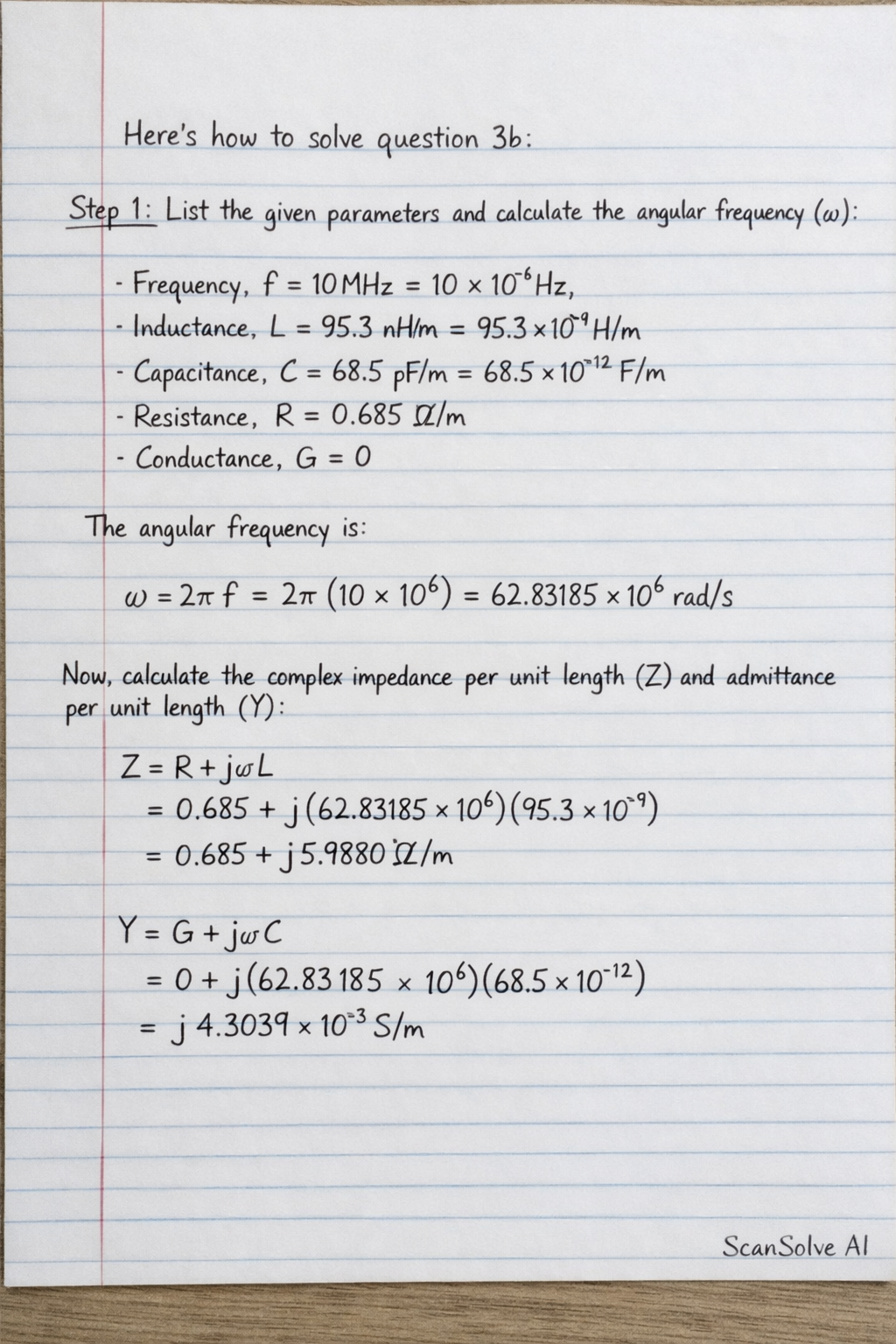
Here's how to solve question 3b:
Step 1: List the given parameters and calculate the angular frequency (ω).
• Frequency, f=10MHz=10×106 Hz
• Inductance, L=95.3nH/m=95.3×10−9 H/m
• Capacitance, C=68.5pF/m=68.5×10−12 F/m
• Resistance, R=0.685Ω/m
• Conductance, G=0
The angular frequency is:
ω=2πf=2π(10×106Hz)=62.83185×10⁶ rad/s
Now, calculate the complex impedance per unit length (Z) and admittance per unit length (Y):
Z=R+jωL=0.685+j(62.83185×10⁶)(95.3×10⁻⁹)=0.685+j5.9880Ω/mY=G+jωC=0+j(62.83185×106)(68.5×10−12)=j4.3039×10−3 S/m
Step 2: Calculate the characteristics impedance (Z0).
The characteristic impedance is given by:
Z0=YZ=G+jωCR+jωLZ0=j4.3039×10−30.685+j5.9880
To simplify, multiply the numerator and denominator inside the square root by −j:
Z0=j4.3039×10−3(−j)(0.685+j5.9880)(−j)=4.3039×10−35.9880−j0.685Z0=1391.26−j159.15
Convert the complex number to polar form:
Magnitude: 1391.262+(−159.15)2=1400.33
Angle: arctan(1391.26−159.15)=−6.51∘
So, 1391.26−j159.15=1400.33∠−6.51∘.
Z0=1400.33∠−6.51∘=1400.33∠(2−6.51∘)Z0=37.42∠−3.26∘Ω
In rectangular form:
Z0=37.42cos(−3.26∘)+j37.42sin(−3.26∘)=37.36−j2.12Ω
The characteristics impedance is: Z0=37.36−j2.12Ω
Step 3: Calculate the propagation constant (γ=α+jβ).
The propagation constant is given by:
γ=Z⋅Y=(R+jωL)(G+jωC)γ=(0.685+j5.9880)(j4.3039×10−3)γ=j(0.685×4.3039×10−3)+j2(5.9880×4.3039×10−3)γ=j(2.9481×10⁻³)−(25.770×10⁻³)γ=−0.025770+j0.0029481
Convert the complex number to polar form:
Magnitude: (−0.025770)2+(0.0029481)2=0.025938
Angle: arctan(−0.0257700.0029481)=−6.51∘. Since the real part is negative and the imaginary part is positive, the angle is in the second quadrant: 180∘−6.51∘=173.49∘.
So, −0.025770+j0.0029481=0.025938∠173.49∘.
γ=0.025938∠173.49∘=0.025938∠(2173.49∘)γ=0.16105∠86.745∘
In rectangular form:
γ=0.16105cos(86.745∘)+j0.16105sin(86.745∘)γ=0.00913+j0.1608
Step 4: Determine the attenuation constant (α) and phase constant (β).
From γ=α+jβ:
The attenuation constant is α=Re(γ)=0.00913 Np/m.
The phase constant (space shift constant) is β=Im(γ)=0.1608 rad/m.
Convert the attenuation constant to dB/m:
αdB=8.686×α=8.686×0.00913=0.0793 dB/m
The attenuation constant is: α=0.00913 Np/m or 0.0793 dB/m
The space shift constant is: β=0.1608 rad/m
Step 5: Calculate the velocity of propagation (vp).
The velocity of propagation is given by:
vp=βωvp=0.1608rad/m62.83185×106rad/svp=390.74×106 m/svp=3.91×108 m/s
The velocity of propagation is: vp=3.91×10⁸ m/s
Last free one today — make it count tomorrow, or type /upgrade for unlimited.
Was this helpful?
Need help with your own homework?
Get instant step-by-step solutions to any question. Free to start.
Here's how to solve question 3b: Step 1: List the given parameters and calculate the angular frequency ().
Instructions: Answer Any Five (5) Questions. 1a. What is time division switching? With the help of block diagram, explain basic time division time switching method.
This computer science problem involves algorithmic thinking and programming concepts. The solution below explains the approach, logic, and implementation step by step.
ScanSolve AI Answer
Here's how to solve question 3b: Step 1: List the given parameters and calculate the angular frequency (). • Frequency, f = 10 MHz = 10 × 10^6 Hz • Inductance, L = 95.3 nH/m = 95.3 × 10^-9 H/m • Capacitance, C = 68.5 pF/m = 68.5 × 10^-12 F/m • Resistance, R = 0.685 /m • Conductance, G = 0 The angular frequency is: = 2 f = 2 (10 × 10^6 Hz) = 62.83185 × 10^6 rad/s Now, calculate the complex impedance per unit length (Z) and admittance per unit length (Y): Z = R + j L = 0.685 + j(62.83185 × 10^6)(95.3 × 10^-9) = 0.685 + j5.9880 /m Y = G + j C = 0 + j(62.83185 × 10^6)(68.5 × 10^-12) = j4.3039 × 10^-3 S/m Step 2: Calculate the characteristics impedance (Z_0). The characteristic impedance is given by: Z_0 = sqrt((Z)/(Y)) = sqrt((R + j L)/(G + j C)) Z_0 = sqrt((0.685 + j5.9880)/(j4.3039 × 10^-3)) To simplify, multiply the numerator and denominator inside the square root by -j: Z_0 = sqrt(((0.685 + j5.9880)(-j))/(j4.3039 × 10^-3)(-j)) = sqrt((5.9880 - j0.685)/(4.3039 × 10^-3)) Z_0 = sqrt(1391.26 - j159.15) Convert the complex number to polar form: Magnitude: sqrt(1391.26^2 + (-159.15)^2) = 1400.33 Angle: ((-159.15)/(1391.26)) = -6.51^ So, 1391.26 - j159.15 = 1400.33 -6.51^. Z_0 = sqrt(1400.33 -6.51^) = sqrt(1400.33) ((-6.51^)/(2)) Z_0 = 37.42 -3.26^ In rectangular form: Z_0 = 37.42 (-3.26^) + j37.42 (-3.26^) = 37.36 - j2.12 The characteristics impedance is: Z_0 = 37.36 - j2.12 Step 3: Calculate the propagation constant ( = + j). The propagation constant is given by: = sqrt(Z · Y) = sqrt((R + j L)(G + j C)) = sqrt((0.685 + j5.9880)(j4.3039 × 10^-3)) = sqrt(j(0.685 × 4.3039 × 10^-3)) + j^2(5.9880 × 4.3039 × 10^-3) = sqrt(j(2.9481 × 10^-3)) - (25.770 × 10^-3) = sqrt(-0.025770 + j0.0029481) Convert the complex number to polar form: Magnitude: sqrt((-0.025770)^2 + (0.0029481)^2) = 0.025938 Angle: ((0.0029481)/(-0.025770)) = -6.51^. Since the real part is negative and the imaginary part is positive, the angle is in the second quadrant: 180^ - 6.51^ = 173.49^. So, -0.025770 + j0.0029481 = 0.025938 173.49^. = sqrt(0.025938 173.49^) = sqrt(0.025938) ((173.49^)/(2)) = 0.16105 86.745^ In rectangular form: = 0.16105 (86.745^) + j0.16105 (86.745^) = 0.00913 + j0.1608 Step 4: Determine the attenuation constant () and phase constant (). From = + j: The attenuation constant is = Re() = 0.00913 Np/m. The phase constant (space shift constant) is = Im() = 0.1608 rad/m. Convert the attenuation constant to dB/m: _dB = 8.686 × = 8.686 × 0.00913 = 0.0793 dB/m The attenuation constant is: = 0.00913 Np/m or 0.0793 dB/m The space shift constant is: = 0.1608 rad/m Step 5: Calculate the velocity of propagation (v_p). The velocity of propagation is given by: v_p = ()/() v_p = 62.83185 × 10^6 rad/s0.1608 rad/m v_p = 390.74 × 10^6 m/s v_p = 3.91 × 10^8 m/s The velocity of propagation is: v_p = 3.91 × 10^8 m/s Last free one today — make it count tomorrow, or type /upgrade for unlimited.