

This computer science problem involves algorithmic thinking and programming concepts. The solution below explains the approach, logic, and implementation step by step.
ScanSolve AI Answer
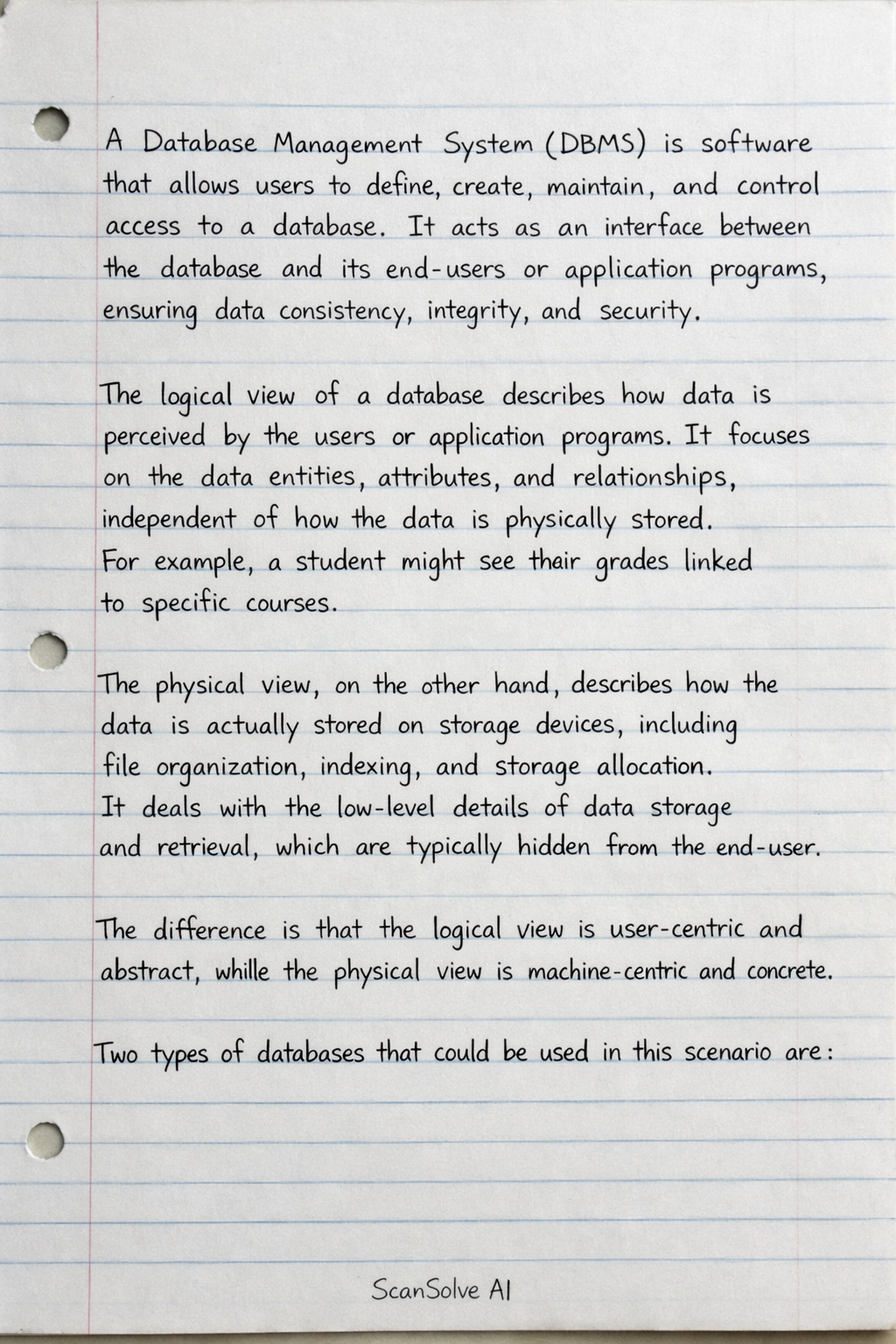
A Database Management System (DBMS) is software that allows users to define, create, maintain, and control access to a database. It acts as an interface between the database and its end-users or application programs, ensuring data consistency, integrity, and security. The logical view of a database describes how data is perceived by the users or application programs. It focuses on the data entities, attributes, and relationships, independent of how the data is physically stored. For example, a student might see their grades linked to specific courses. The physical view, on the other hand, describes how the data is actually stored on storage devices, including file organization, indexing, and storage allocation. It deals with the low-level details of data storage and retrieval, which are typically hidden from the end-user. The difference is that the logical view is user-centric and abstract, while the physical view is machine-centric and concrete. Two types of databases that could be used in this scenario are: Relational Database: This type organizes data into tables (relations) with rows and columns. Each table represents an entity (e.g., Students, Courses), and relationships between entities are established using primary and foreign keys. This structure is highly suitable for managing structured data like student IDs, names, course codes, and grades, ensuring data integrity and allowing complex queries. An example would be using MySQL or PostgreSQL to store student records, where one table holds student details, another holds course information, and a third links students to courses with their respective grades. Document Database: A type of NoSQL database, document databases store data in flexible, semi-structured formats, often JSON-like documents. Each document can contain varying fields, making it suitable for data with evolving schemas. For a college, this could be used to store comprehensive student profiles, where each student's document might include personal details, enrolled courses, grades, and even extracurricular activities, all within a single, flexible structure. An example would be using MongoDB to store student records, where each student's entire profile (including nested course and grade information) is stored as a single document.