
We read your photo as:
Describe three types of databases and explain the components of a DBMS.
ScanSolve AI Answer
Here are the solutions to your questions.
QUESTION SIX
a) Describe three types of databases
- Relational Databases (RDBMS): These databases organize data into tables with rows and columns, using Structured Query Language (SQL) for data management. Relationships between tables are defined using primary and foreign keys.
- NoSQL Databases: Designed for handling large volumes of unstructured or semi-structured data, offering flexible schemas and horizontal scalability. Examples include document databases (e.g., MongoDB), key-value stores (e.g., Redis), and graph databases.
- Object-Oriented Databases (OODBMS): These databases store data as objects, similar to objects in object-oriented programming. They are suitable for complex data types and relationships, often used in applications requiring complex data modeling.
b) Explain the components of a DBMS
A Database Management System (DBMS) consists of several key components:
- Query Processor: This component interprets and optimizes user queries (e.g., SQL statements) to determine the most efficient way to retrieve or modify data.
- Storage Manager: Responsible for managing the storage of data on disk, including file organization, indexing, and buffer management to optimize data access.
- Transaction Manager: Ensures data integrity and consistency by controlling concurrent access to the database and providing recovery mechanisms in case of system failures.
- Data Definition Language (DDL) Processor: Handles commands that define and modify the database schema, such as creating, altering, or dropping tables and indexes.
c) Describe the logical and physical view of databases
- Logical View (Conceptual/External View): This describes how users or applications perceive the data. It focuses on the data entities, attributes, and relationships that are relevant to a specific user, abstracting away the underlying storage details. Different users can have different logical views of the same data.
- Physical View (Internal View): This describes how the data is actually stored on physical storage devices. It deals with low-level details such as file organization, indexing structures, data compression, and the physical location of data blocks on disk.
QUESTION SEVEN
Here is the CUSTOMER table:
| CustomerId | CustomerNumber | LastName | FirstName | AreaCode | Address | Phone |
|---|---|---|---|---|---|---|
| 1 | 1000 | Smith | John | 12 | California | 11111111 |
| 2 | 1001 | Jackson | Smith | 45 | London | 22222222 |
| 3 | 1002 | Johnsen | John | 32 | London | 33333333 |
a) SELECT Customer ID, Last Name, First Name FROM Customer
Output:
| CustomerId | LastName | FirstName |
|---|---|---|
| 1 | Smith | John |
| 2 | Jackson | Smith |
| 3 | Johnsen | John |
b) SELECT * FROM CUSTOMER ORDER BY Last Name
Output:
| CustomerId | CustomerNumber | LastName | FirstName | AreaCode | Address | Phone |
|---|---|---|---|---|---|---|
| 2 | 1001 | Jackson | Smith | 45 | London | 22222222 |
| 3 | 1002 | Johnsen | John | 32 | London | 33333333 |
| 1 | 1000 | Smith | John | 12 | California | 11111111 |
c) SELECT DISTINCT First Name FROM CUSTOMER
Output:
| FirstName |
|---|
| John |
| Smith |
d) SELECT * FROM CUSTOMER WHERE Last Name LIKE 'Ja%'
Output:
| CustomerId | CustomerNumber | LastName | FirstName | AreaCode | Address | Phone |
|---|---|---|---|---|---|---|
| 2 | 1001 | Jackson | Smith | 45 | London | 22222222 |
e) SELECT * FROM CUSTOMER WHERE Last Name='Smith' AND (First Name='John' OR First Name='Smith')
Output:
| CustomerId | CustomerNumber | LastName | FirstName | AreaCode | Address | Phone |
|---|---|---|---|---|---|---|
| 1 | 1000 | Smith | John | 12 | California | 11111111 |
f) SELECT TOP 1 * FROM CUSTOMER
Output:
| CustomerId | CustomerNumber | LastName | FirstName | AreaCode | Address | Phone |
|---|---|---|---|---|---|---|
| 1 | 1000 | Smith | John | 12 | California | 11111111 |
Still stuck on this one?
Ask a follow-up, and the answer starts from this question.
More Computer Science Questions
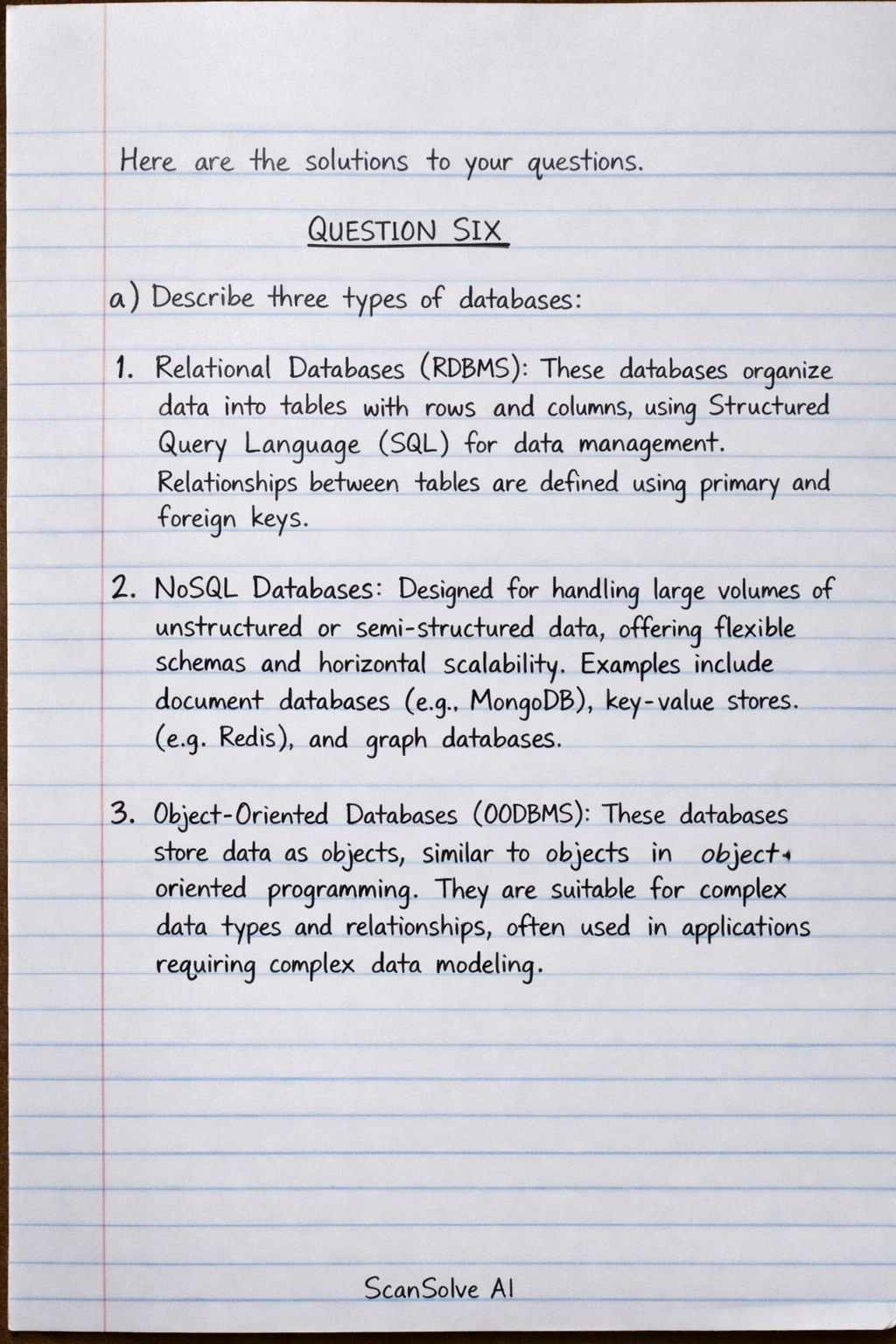
Handwritten Step-by-Step Solution
Get this as a handwritten image on WhatsApp — like a tutor wrote it for you.
Try on WhatsApp