
We read your photo as:
Define database, list three business uses, state five advantages over paper systems, and list five DBMS functions.
ScanSolve AI Answer
Answer
Step-by-step solution
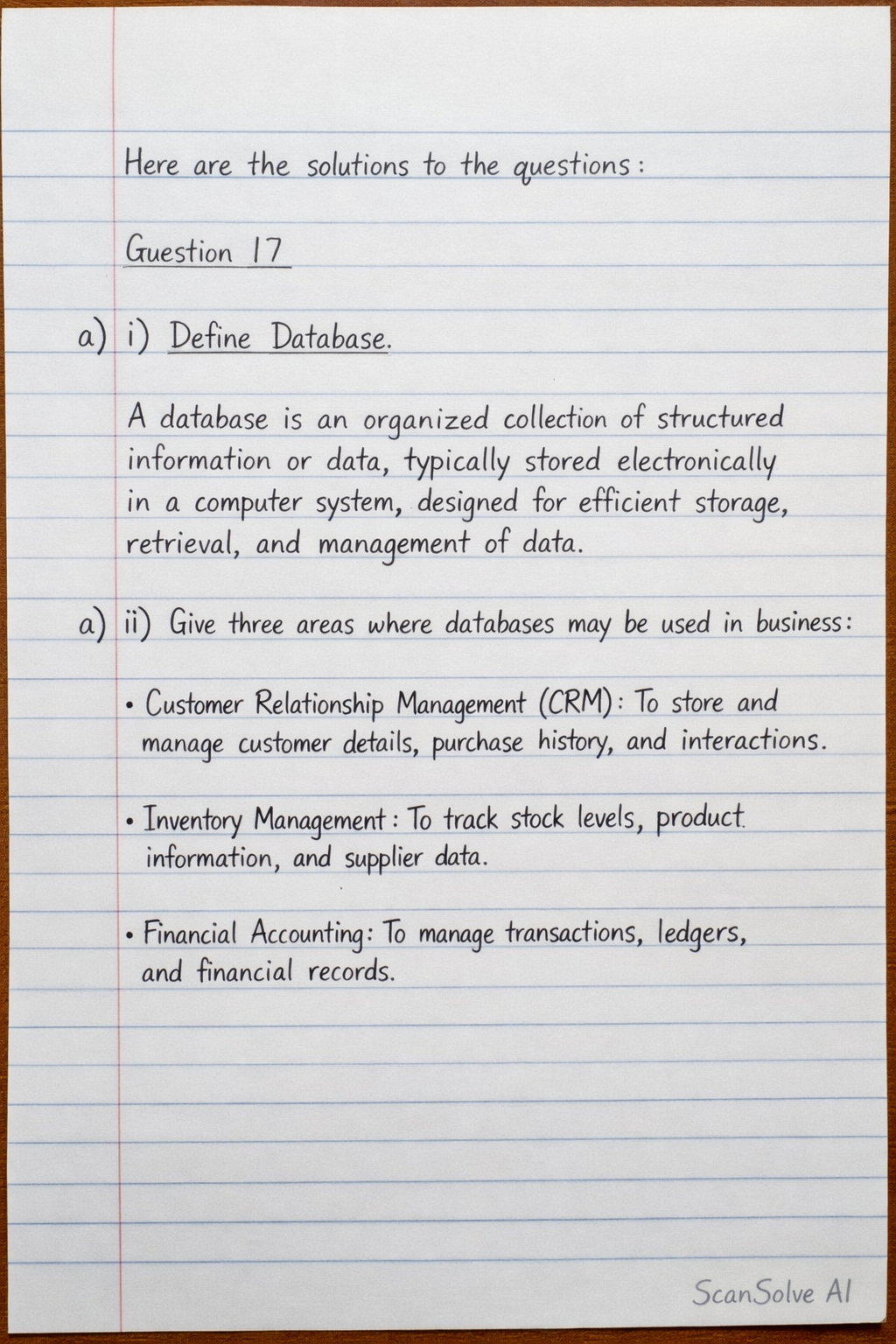
3 stepsHere are the solutions to the questions:
Part 17
-
a) i) Define Database A database is an organized collection of structured information or data, typically stored electronically in a computer system, designed for efficient storage, retrieval, and management of data.
-
a) ii) Give three areas where databases may be used in business
- Customer Relationship Management (CRM): To store and manage customer details, purchase history, and interactions.
- Inventory Management: To track stock levels, product information, and supplier data.
- Financial Accounting: To manage transactions, ledgers, and financial records.
-
b) i) State five advantages that modern database systems have over paper-based systems
- Reduced Data Redundancy: Data is stored once, minimizing duplication and inconsistencies.
- Improved Data Consistency: Enforces rules and constraints to ensure data accuracy across the system.
- Enhanced Data Security: Provides mechanisms for access control, encryption, and backup/recovery.
- Faster Data Retrieval: Allows quick and efficient searching, sorting, and querying of large datasets.
- Better Data Sharing: Multiple users can access and update data concurrently, facilitating collaboration.
-
b) ii) STATE five major functions of DBMS in computerized information processing
- Data Definition: Allows users to define the structure of the database, including data types, relationships, and constraints.
- Data Manipulation: Provides tools for inserting, updating, deleting, and retrieving data (e.g., using SQL).
- Data Security and Integrity: Manages user access, permissions, and ensures data accuracy and consistency through validation rules.
- Data Storage Management: Handles the physical storage of data on disk and manages access to it.
- Data Backup and Recovery: Provides utilities to create backups and restore the database in case of system failure or data loss.
Part 18
-
a) Describe the octal number system. The octal number system is a base-8 number system that uses eight distinct digits: 0, 1, 2, 3, 4, 5, 6, and 7. Each position in an octal number represents a power of 8. It is often used as a compact way to represent binary numbers, as three binary digits can be represented by a single octal digit.
-
b) Convert each of the following to the number system indicated:
-
i) to decimal To convert to decimal:
The decimal equivalent is .
-
ii) to binary Convert the integer part (): remainder 0 remainder 1 remainder 1 remainder 1 Reading remainders upwards:
Convert the fractional part ():
Reading integer parts downwards:Combining both parts:
The binary equivalent is .
-
-
c) Convert the number into 8-bit signed magnitude representation
Convert the magnitude to binary.
$17 \div 2 = 8$ R 1 $8 \div 2 = 4$ R 0 $4 \div 2 = 2$ R 0 $2 \div 2 = 1$ R 0 $1 \div 2 = 0$ R 1 So, $17_{10} = 10001_2$.Represent the magnitude in 7 bits (since 1 bit is for the sign).
$0010001_2$For a negative number in signed magnitude, the most significant bit (MSB) is 1.
The 8-bit signed magnitude representation for $-17_{10}$ is $10010001_2$.
The 8-bit signed magnitude representation is $\boxed{\text{10010001}}$.
Try one yourself
A new problem that tests the same skill.
Still stuck on this one?
Ask a follow-up, and the answer starts from this question.
More Computer Science Questions
Handwritten Step-by-Step Solution
Get this as a handwritten image on WhatsApp — like a tutor wrote it for you.
Try on WhatsApp