
We read your photo as:
Explain the concept of a database, and discuss the disadvantages of file-based systems and the advantages of using databases.
ScanSolve AI Answer
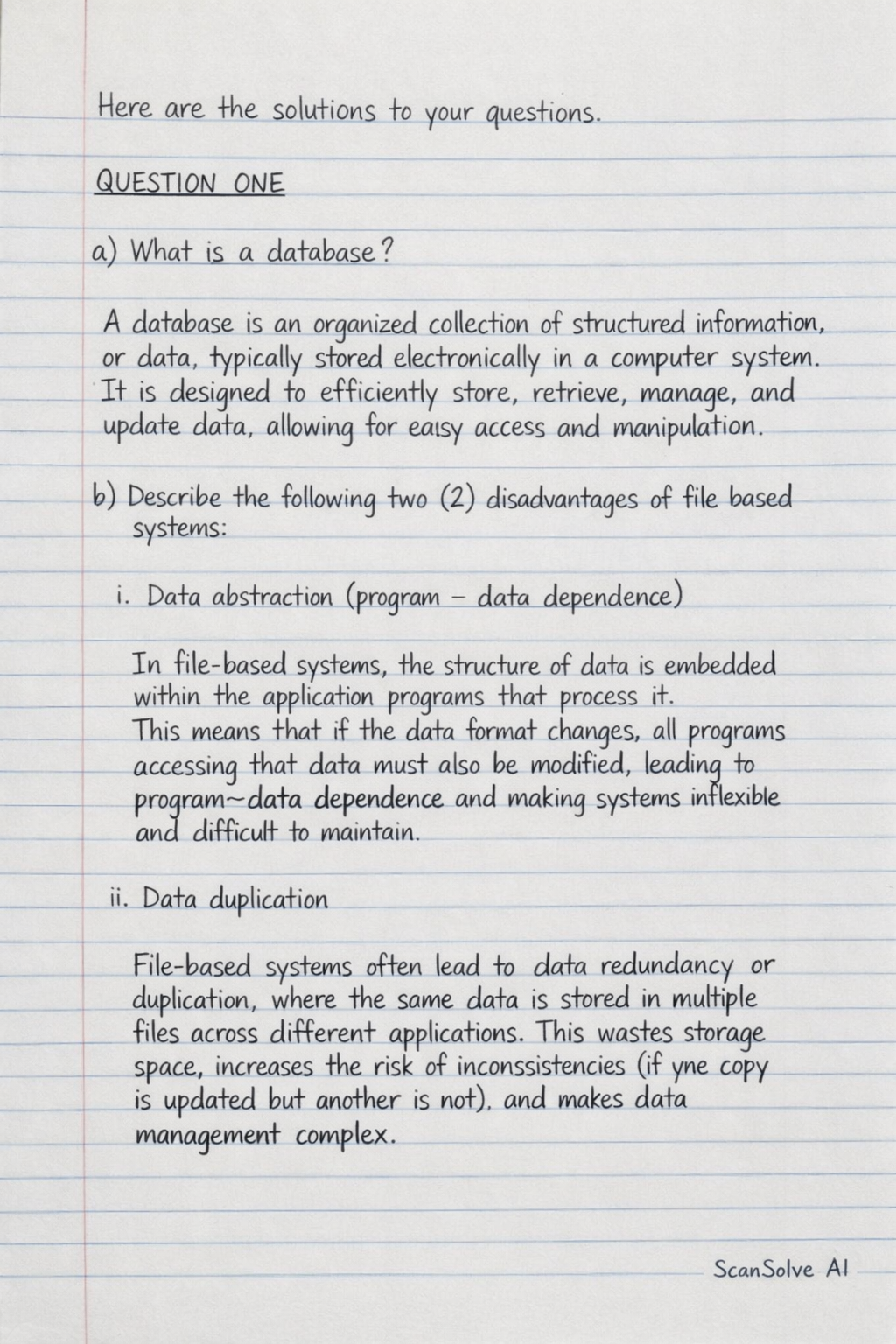
Here are the solutions to your questions.
QUESTION ONE
a) What is a database?
A database is an organized collection of structured information, or data, typically stored electronically in a computer system. It is designed to efficiently store, retrieve, manage, and update data, allowing for easy access and manipulation.
b) Describe the following two (2) disadvantages of file based systems:
- i. Data abstraction (program – data dependence) In file-based systems, the structure of data is embedded within the application programs that process it. This means that if the data format changes, all programs accessing that data must also be modified, leading to program-data dependence and making systems inflexible and difficult to maintain.
- ii. Data duplication File-based systems often lead to data redundancy or duplication, where the same data is stored in multiple files across different applications. This wastes storage space, increases the risk of inconsistencies (if one copy is updated but another is not), and makes data management complex.
c) Describe any two (2) advantages of using databases.
- Reduced Data Redundancy: Databases minimize data duplication by storing data in a centralized and structured manner, ensuring that each piece of information is stored only once. This saves storage space and improves data consistency.
- Improved Data Integrity: Databases enforce rules and constraints to ensure the accuracy and consistency of data. This includes validation checks, referential integrity, and transaction management, which help maintain the quality and reliability of the stored information.
QUESTION TWO
a) In regards to databases, explain the following:
- i. Tuple In a relational database, a tuple refers to a single row in a table. It represents a single record or instance of the entity described by the table, containing a set of related data values for each attribute (column).
- ii. Primary key A primary key is a column or a set of columns in a table that uniquely identifies each row in that table. It must contain unique values for each record and cannot have NULL values, ensuring that every record can be distinctly identified.
- iii. Foreign key A foreign key is a column or a set of columns in one table that refers to the primary key in another table. It establishes a link or relationship between two tables, enforcing referential integrity and ensuring that relationships between data are consistent.
- iv. Weak entity A weak entity is an entity that cannot be uniquely identified by its own attributes alone and must rely on the primary key of another entity (called its owner or identifying entity) to form its own primary key. It has a partial key (discriminator) that, combined with the owner's primary key, uniquely identifies it.
QUESTION THREE
Here is the CUSTOMER table:
| CustomerID | CustomerNumber | LastName | FirstName | AreaCode | Address | Phone |
|---|---|---|---|---|---|---|
| 1 | 10 | Banda | Kaluba | 12 | Chipata | 1111 |
| 2 | 11 | Lubinda | Banda | 45 | Kitwe | 2222 |
| 3 | 12 | Longwe | Kaluba | 32 | Kitwe | 3333 |
a) SELECT CustomerID, LastName, FirstName FROM CUSTOMER
Output:
| CustomerID | LastName | FirstName |
|---|---|---|
| 1 | Banda | Kaluba |
| 2 | Lubinda | Banda |
| 3 | Longwe | Kaluba |
b) SELECT * FROM CUSTOMER ORDER BY LastName
Output:
| CustomerID | CustomerNumber | LastName | FirstName | AreaCode | Address | Phone |
|---|---|---|---|---|---|---|
| 1 | 10 | Banda | Kaluba | 12 | Chipata | 1111 |
| 3 | 12 | Longwe | Kaluba | 32 | Kitwe | 3333 |
| 2 | 11 | Lubinda | Banda | 45 | Kitwe | 2222 |
c) SELECT DISTINCT FirstName FROM CUSTOMER
Output:
| FirstName |
|---|
| Kaluba |
| Banda |
d) SELECT TOP 1 FROM CUSTOMER
Output:
| CustomerID | CustomerNumber | LastName | FirstName | AreaCode | Address | Phone |
|---|---|---|---|---|---|---|
| 1 | 10 | Banda | Kaluba | 12 | Chipata | 1111 |
Still stuck on this one?
Ask a follow-up, and the answer starts from this question.
More Computer Science Questions
Handwritten Step-by-Step Solution
Get this as a handwritten image on WhatsApp — like a tutor wrote it for you.
Try on WhatsApp