
We read your photo as:
Define database and list three business applications and five advantages over paper systems.
ScanSolve AI Answer
Step-by-step solution
2 stepsHere are the solutions to the questions from the image:
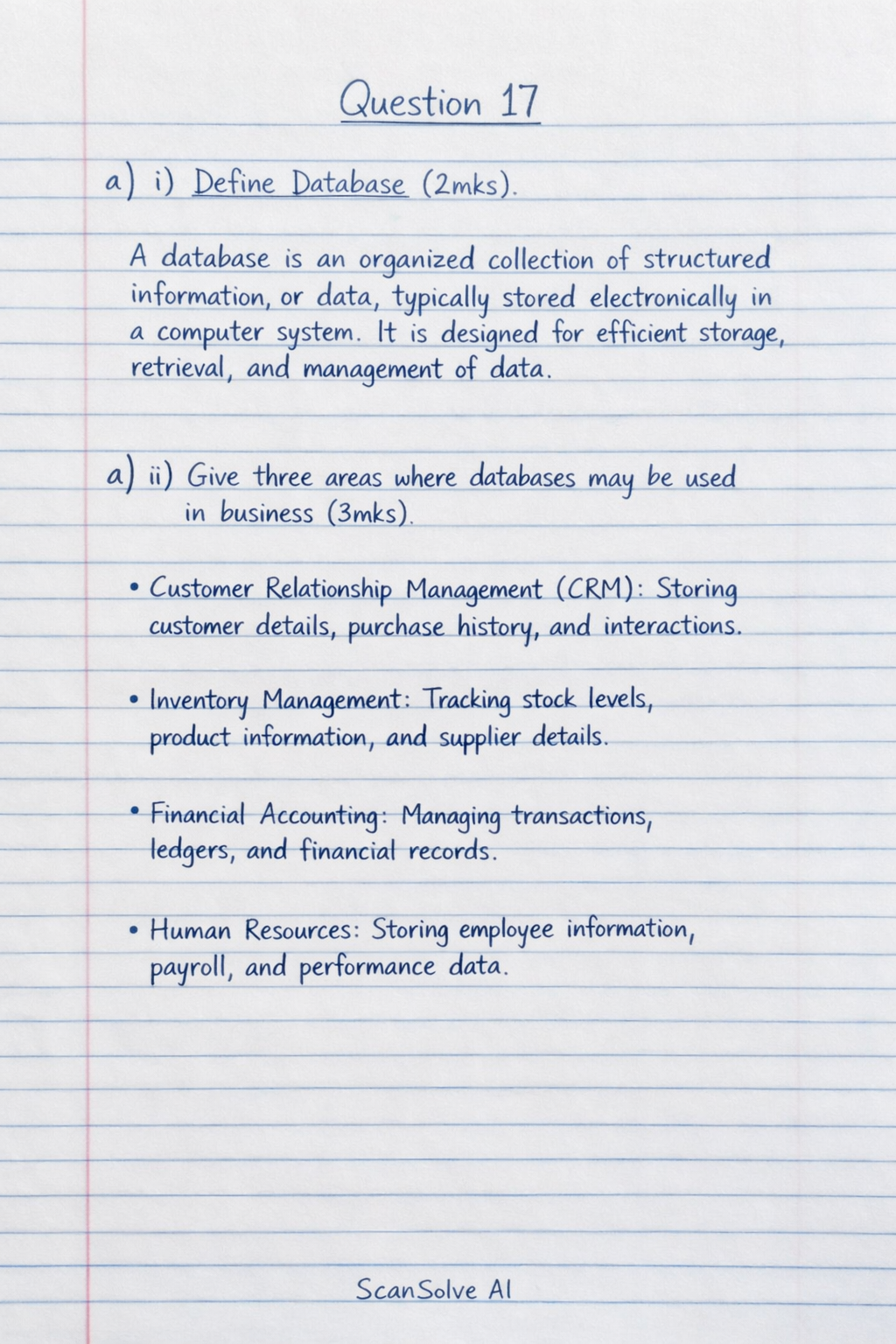
Question 17
a) i) Define Database (2mks)
A database is an organized collection of structured information, or data, typically stored electronically in a computer system. It is designed for efficient storage, retrieval, and management of data.
a) ii) Give three areas where databases may be used in business (3mks)
- Customer Relationship Management (CRM): Storing customer details, purchase history, and interactions.
- Inventory Management: Tracking stock levels, product information, and supplier details.
- Financial Accounting: Managing transactions, ledgers, and financial records.
- Human Resources: Storing employee information, payroll, and performance data.
b) i) State five advantages that modern database systems have over paper-based systems (5mks)
- Reduced Data Redundancy: Data is stored once, minimizing duplication.
- Improved Data Consistency: Ensures that data is uniform and accurate across the system.
- Enhanced Data Security: Provides mechanisms for access control and data protection.
- Easier Data Sharing: Multiple users can access and share data concurrently.
- Faster Data Retrieval and Updates: Allows quick searching, sorting, and modification of data.
- Better Data Integrity: Enforces rules to maintain the quality and reliability of data.
- Reduced Storage Space: Digital storage is more compact than physical paper records.
- Data Backup and Recovery: Facilitates easy backup and restoration of data in case of loss.
b) ii) STATE five major functions of DBMS in computerized information processing (5 mks)
- Data Definition: Allows users to define the structure of the database, including data types, relationships, and constraints.
- Data Manipulation: Provides tools for adding, deleting, modifying, and retrieving data from the database.
- Data Security and Integrity: Manages user access, permissions, and ensures data accuracy and consistency through validation rules.
- Data Storage Management: Handles the physical storage of data on disk and manages access to it.
- Data Backup and Recovery: Provides utilities to create backups of the database and restore it in case of system failure or data loss.
- Concurrency Control: Manages simultaneous access to the database by multiple users, preventing conflicts and ensuring data consistency.
Question 18
a) Describe the octal number system (2mks)
The octal number system is a base-8 number system, meaning it uses eight distinct digits (0, 1, 2, 3, 4, 5, 6, 7) to represent numbers. Each position in an octal number represents a power of 8.
b) Convert each of the following to the number system indicated:
i) to decimal (2 marks)
To convert a binary number to decimal, multiply each digit by its corresponding power of 2.
ii) to binary (2 marks)
To convert a decimal number to binary, convert the integer and fractional parts separately.
-
Integer part (14): Divide by 2 and collect remainders. R 0 R 1 R 1 R 1 Reading remainders from bottom up:
-
Fractional part (0.6875): Multiply by 2 and collect integer parts. Reading integer parts from top down:
Combining the integer and fractional parts:
c) Convert the number into 8-bit i) Signed magnitude representation (2 marks)
Convert the absolute value to binary
to binary:
R 1
R 0
R 0
R 0
R 1
So, .Represent in 8-bit signed magnitude
In 8-bit signed magnitude, the leftmost bit (Most Significant Bit, MSB) is the sign bit (0 for positive, 1 for negative), and the remaining 7 bits represent the magnitude.
The magnitude needs 5 bits. Padded to 7 bits, it becomes .
Since the number is , the sign bit is 1.Therefore, the 8-bit signed magnitude representation of is:
Still stuck on this one?
Ask a follow-up, and the answer starts from this question.
More Computer Science Questions
Handwritten Step-by-Step Solution
Get this as a handwritten image on WhatsApp — like a tutor wrote it for you.
Try on WhatsApp