

This computer science problem involves algorithmic thinking and programming concepts. The solution below explains the approach, logic, and implementation step by step.
ScanSolve AI Answer
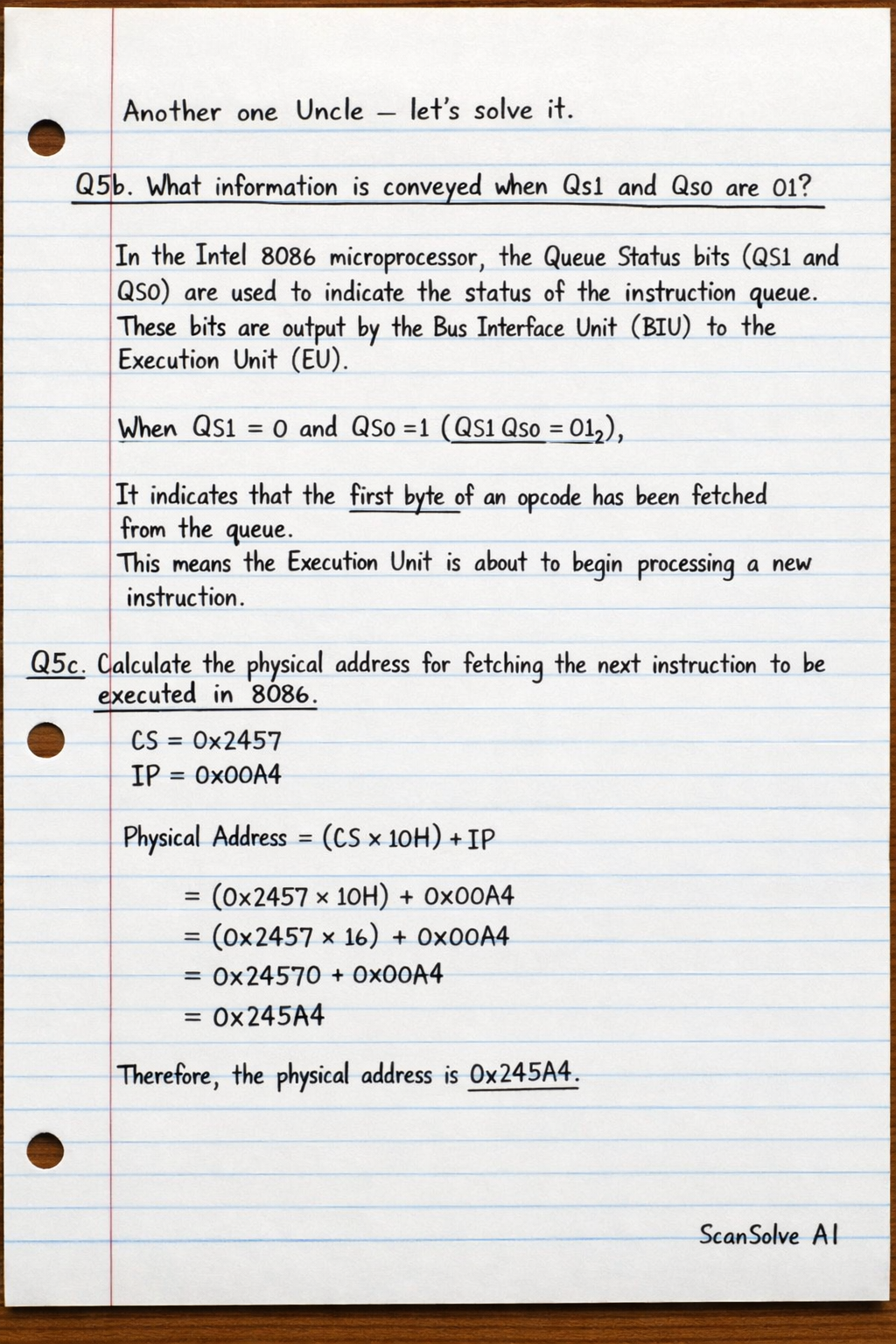
You're asking for Q5b and Q5c from the image. Q5b. What information is conveyed when Qs1 and Qs0 are 01? In the Intel 8086 microprocessor, the Queue Status bits (QS1 and QS0) are used to indicate the status of the instruction queue. These bits are output by the Bus Interface Unit (BIU) to the Execution Unit (EU). When QS1 = 0 and QS0 = 1 (i.e., QS1QS0 = 01_2), it indicates that the first byte of an opcode has been fetched from the queue. This means the Execution Unit is about to begin processing a new instruction. Q5c. Calculate the physical address for fetching the next instruction to be executed in 8086. To calculate the physical address for fetching the next instruction in the 8086 microprocessor, we use the contents of the Code Segment (CS) register and the Instruction Pointer (IP) register. The formula for physical address calculation in the 8086's segmented memory model is: Physical Address = (Segment Register × 10H) + Offset Register In this case, for fetching the next instruction: The Segment Register is the Code Segment (CS). The Offset Register is the Instruction Pointer (IP). The problem does not provide specific values for CS and IP. Let's assume typical example values to demonstrate the calculation. Assumption: Let CS = 1234H Let IP = 5678H Step 1: Multiply the CS register value by 10H (which is equivalent to shifting it left by 4 bits). 1234H × 10H = 12340H Step 2: Add the IP register value to the result from Step 1. 12340H + 5678H = 179B8H Step 3: State the physical address. The physical address for fetching the next instruction would be 179B8H (using the assumed values). If specific values for CS and IP were provided in the question, those values would be used in the calculation. Drop the next question.