
We read your photo as:
Produce freehand pictorial sketches (oblique and isometric) of a fixed body with specific dimensions and features.
ScanSolve AI Answer
Step-by-step solution
8 stepsTask 1
1. Freehand Pictorial Sketching
Part a· 4 steps
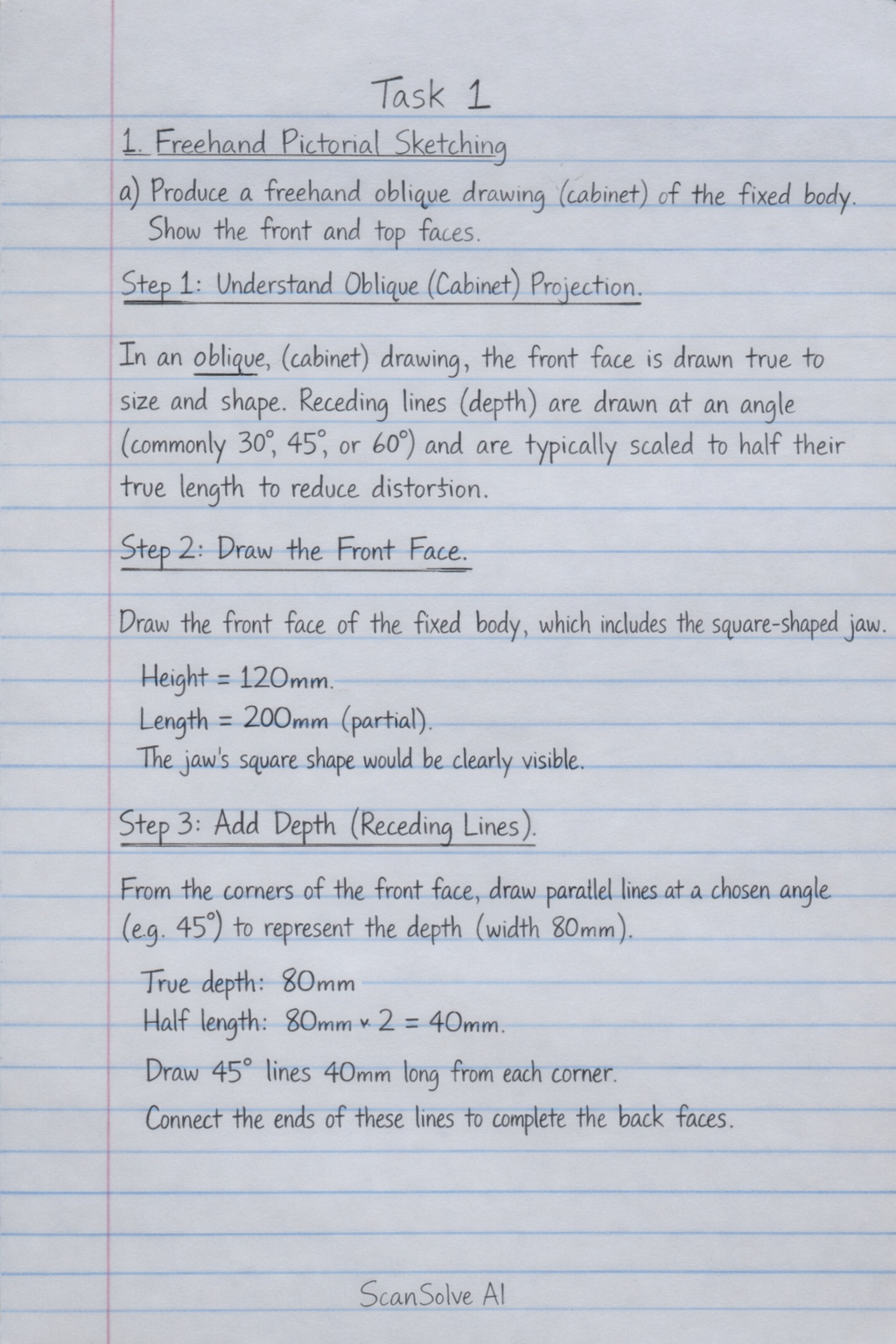
Produce a freehand oblique drawing (cabinet) of the fixed body. Show the front and top faces.
Understand Oblique (Cabinet) Projection.
In an oblique (cabinet) drawing, the front face is drawn true to size and shape. Receding lines (depth) are drawn at an angle (commonly 30°, 45°, or 60°) and are typically scaled to half their true length to reduce distortion.
Draw the Front Face.
Draw the front face of the fixed body, which includes the square-shaped jaw. This face should be drawn with its true dimensions: Height 120mm and a portion of the Length 200mm. The jaw's square shape would be clearly visible.
Add Depth (Receding Lines).
From the corners of the front face, draw parallel lines at a chosen angle (e.g., 45°) to represent the depth (width 80mm). These lines should be drawn at half their true length, so 40mm. Connect the ends of these lines to complete the back faces.
Include Features.
Show the rectangular base with its mounting slots on the bottom surface. The square-shaped jaw at the front should be clearly depicted as part of the fixed body. The top face will be visible, showing the length and width.
Part b· 4 steps
Produce a freehand isometric drawing of the same fixed body.
Understand Isometric Projection.
In an isometric drawing, three axes are drawn at 120° to each other. All lines parallel to these axes are drawn to their true length. This projection shows three faces (front, top, and one side) equally foreshortened.
Establish Isometric Axes.
Draw a vertical line and two lines extending from its base at 30° to the horizontal, one to the left and one to the right. These represent the height, length, and width axes.
Draw the Overall Box.
Construct a box using the given dimensions along the isometric axes: Length 200mm, Height 120mm, and Width 80mm. All lines parallel to the axes are drawn to their true length.
Detail the Fixed Body.
Within this isometric box, sketch the features of the fixed body.
- The rectangular base with its mounting slots would be visible on the bottom surface, drawn in isometric perspective.
- The square-shaped jaw at the front would be drawn, with its edges aligned to the isometric axes, showing its three visible faces.
- The overall form of the fixed body, including its main block and the jaw, would be represented with all edges parallel to the isometric axes.
Still stuck on this one?
Ask a follow-up, and the answer starts from this question.
More Computer Science Questions
Handwritten Step-by-Step Solution
Get this as a handwritten image on WhatsApp — like a tutor wrote it for you.
Try on WhatsApp