
We read your photo as:
Q1. information technology plays a crucial role in the socio economic development of country. critically analyze the role of Information Technology plays in the development of sierra Leone; (25mks)
ScanSolve AI Answer
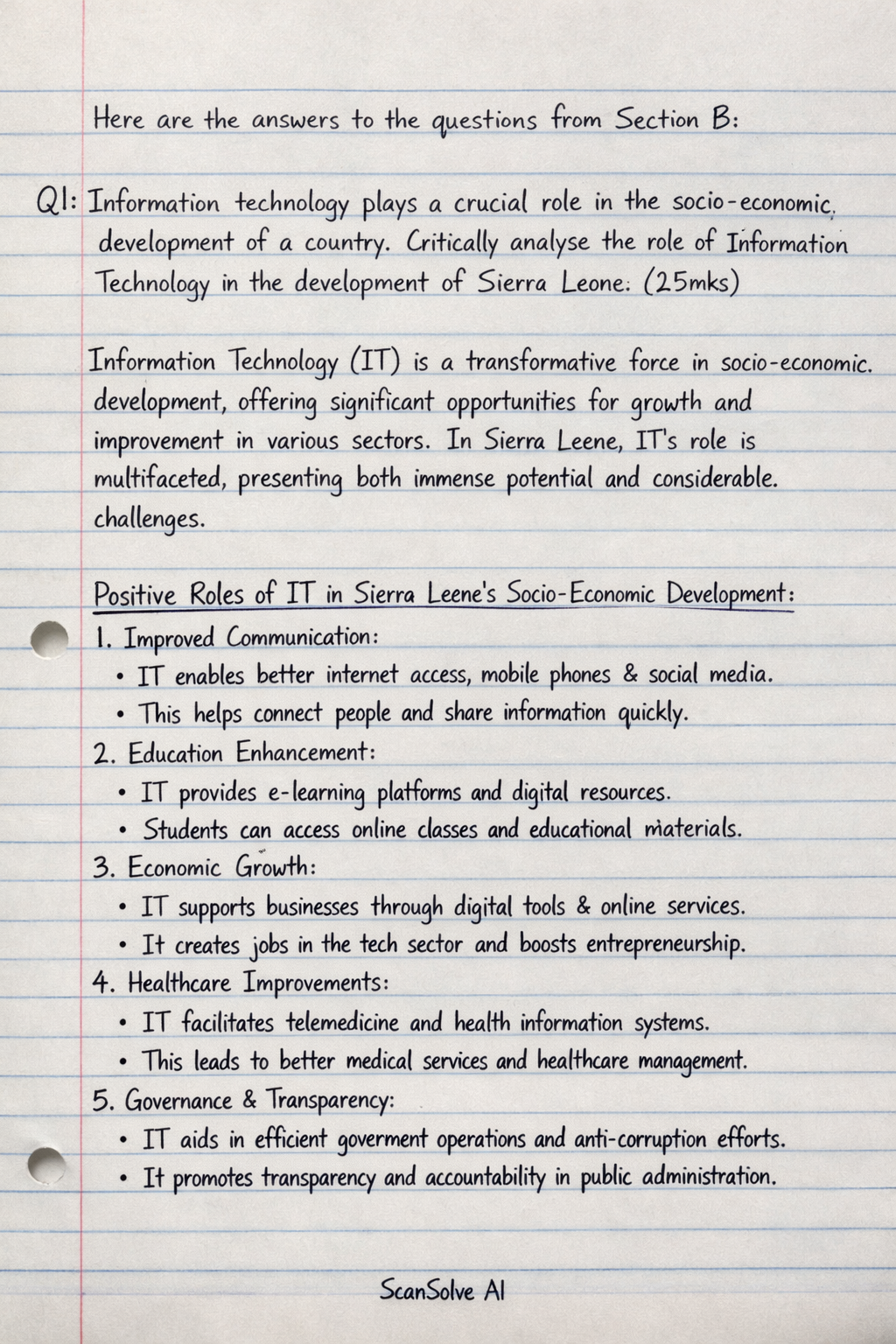
Here are the answers to the questions from Section B:
Q1: Information technology plays a crucial role in the socio-economic development of a country. Critically analyze the role of Information Technology in the development of Sierra Leone. (25mks)
Information Technology (IT) is a transformative force in socio-economic development, offering significant opportunities for growth and improvement in various sectors. In Sierra Leone, IT's role is multifaceted, presenting both immense potential and considerable challenges.
Positive Roles of IT in Sierra Leone's Socio-Economic Development:
- Economic Growth and Job Creation: IT fosters new industries and services, leading to job creation in areas like software development, digital marketing, and IT support. It enables digital entrepreneurship and provides platforms for local businesses to access wider markets through e-commerce, thereby stimulating economic activity.
- Enhanced Productivity and Efficiency: IT tools and systems can streamline operations in government, private businesses, and non-governmental organizations, leading to increased efficiency, reduced costs, and improved service delivery. This includes areas like digital record-keeping and automated processes.
- Financial Inclusion: Mobile banking and digital payment systems have expanded access to financial services for a significant portion of the population, particularly in rural areas where traditional banking infrastructure is limited. This promotes savings, facilitates remittances, and supports small businesses.
- Education and Skill Development: IT provides access to e-learning platforms, online courses, and digital educational resources, helping to bridge educational gaps and improve literacy rates. It also facilitates remote learning, which is crucial for continuous education and skill upgrades.
- Healthcare Improvement: Telemedicine can connect remote communities with medical specialists, improving access to healthcare services. Health information systems aid in managing patient records, tracking disease outbreaks, and optimizing resource allocation.
- Improved Governance and Transparency: E-governance initiatives can enhance public service delivery, increase transparency, and reduce corruption by digitizing government processes and providing platforms for citizen engagement and feedback.
- Communication and Information Dissemination: IT, particularly mobile communication, connects communities, facilitates social interaction, and enables rapid dissemination of vital information, especially during emergencies or public health crises.
Critical Analysis: Challenges and Limitations in Sierra Leone:
Despite its potential, Sierra Leone faces significant impediments to fully leveraging IT for development:
- Inadequate Infrastructure: Limited access to reliable and affordable internet, especially in rural areas, remains a major barrier. Unreliable electricity supply further hinders the adoption and sustained use of IT.
- Digital Divide: A substantial gap exists between urban and rural populations, and between different socio-economic groups, in terms of access to IT devices, internet connectivity, and digital literacy. This exacerbates existing inequalities.
- Lack of Digital Literacy and Skills Gap: A significant portion of the population lacks basic digital literacy, and there is a shortage of skilled IT professionals to develop, maintain, and innovate within the IT sector.
- Policy and Regulatory Frameworks: Nascent or inadequate legal and regulatory frameworks for cybersecurity, data protection, and the digital economy can deter investment and hinder trust in digital services.
- High Cost of Technology: The cost of IT devices, internet subscriptions, and related services can be prohibitive for the average Sierra Leonean, limiting widespread adoption.
- Sustainability Issues: Challenges in funding, maintaining, and upgrading IT infrastructure and systems often lead to projects becoming unsustainable in the long term.
In conclusion, while Information Technology offers a powerful pathway for Sierra Leone's socio-economic advancement by fostering economic growth, improving public services, and enhancing human capital, its full potential is constrained by critical infrastructure deficits, a pronounced digital divide, and a need for robust policy and skill development initiatives. Addressing these challenges is paramount for IT to truly serve as a catalyst for inclusive and sustainable development in the country.
Q3: The structure, arrangement or manner in which a network is set up is called a network topology. Discuss this statement with illustrations and diagrams. (25mks)
Network topology refers to the physical or logical arrangement of nodes (devices) and connections (links) in a computer network. It dictates how data flows through the network and impacts its performance, reliability, and cost. Understanding different topologies is crucial for designing efficient and robust networks.
Here are common types of network topologies, with descriptions and conceptual illustrations:
1. Bus Topology
- Description: All devices are connected to a single central cable, known as the backbone or bus. Data travels in one direction along this backbone, and terminators are used at both ends to prevent signal reflection.
- Illustration: Imagine a long horizontal line representing the backbone cable. Several computers (represented by squares or circles) are connected to this line via short drop lines. Terminators are at both ends of the backbone.
- Advantages: Simple to install, requires less cabling than some other topologies, and is cost-effective for small networks.
- Disadvantages: A single point of failure (a break in the backbone cable brings down the entire network), difficult to troubleshoot, and performance degrades significantly as more devices are added.
2. Star Topology
- Description: All devices in the network are connected to a central hub or switch. Each device has a dedicated point-to-point connection to the central device.
- Illustration: A central circle (representing a hub or switch) with lines radiating outwards to several other circles (representing computers).
- Advantages: Easy to install and manage, fault isolation (the failure of one device or its cable does not affect others), and easy to add or remove devices.
- Disadvantages: The central hub/switch is a single point of failure (if it fails, the entire network goes down), requires more cabling than a bus topology, and can be more expensive due to the central device.
3. Ring Topology
- Description: Devices are connected in a closed loop, with each device connected to exactly two other devices. Data typically travels in one direction around the ring.
- Illustration: Several circles (computers) arranged in a circular pattern, each connected to its immediate neighbors to form a closed loop. An arrow on the connecting lines indicates the direction of data flow.
- Advantages: Data travels fast (as there are no collisions), and all nodes have equal access to the network medium.
- Disadvantages: A single point of failure (a cable break or device failure can disrupt the entire network), difficult to add or remove devices without interrupting the network, and troubleshooting can be complex.
4. Mesh Topology
- Description: In a full mesh topology, every device is connected to every other device in the network. In a partial mesh, some devices are connected to multiple others, but not necessarily all.
- Illustration: For a full mesh with 4 devices: Four circles (computers) are arranged, and each circle has a direct line connecting it to every other circle. For example, device A connects to B, C, D; B connects to A, C, D; C connects to A, B, D; and D connects to A, B, C.
- Advantages: High redundancy and fault tolerance (if one link fails, data can still find another path), robust, and offers high security.
- Disadvantages: Very expensive due to the extensive cabling required, complex to install and manage, and can be difficult to scale.
5. Tree Topology (Hierarchical Topology)
- Description: This is a hybrid topology combining elements of bus and star. Star networks are connected to a central bus backbone. It forms a hierarchical structure.
- Illustration: A central horizontal line (representing a bus backbone). From this backbone, several vertical lines branch off, and at the end of each vertical line, a star topology is formed (a central hub with devices radiating from it).
- Advantages: Scalable, easy to manage, and fault isolation for individual star segments (a failure in one star segment doesn't affect others).
- Disadvantages: The central backbone is a single point of failure, and it is more complex to implement than simple bus or star topologies.
6. Hybrid Topology
- Description: A combination of two or more different basic topologies. This is often used in large networks to leverage the advantages of different topologies for specific segments.
- Illustration: An example could be two star networks connected by a bus backbone, or a ring network connected to a star network. The diagram would show distinct sections using different topologies linked together.
- Advantages: Flexible, highly scalable, and can be optimized for specific organizational or geographical needs.
- Disadvantages: Complex design and implementation, and potentially expensive due to the varied components and intricate setup.
In conclusion, the choice of network topology is a critical design decision influenced by factors such as network size, budget, performance requirements, reliability needs, and ease of management. Each topology offers a unique balance of advantages and disadvantages, making it suitable for different networking scenarios.
Still stuck on this one?
Ask a follow-up, and the answer starts from this question.
More Computer Science Questions
Handwritten Step-by-Step Solution
Get this as a handwritten image on WhatsApp — like a tutor wrote it for you.
Try on WhatsApp