
We read your photo as:
With reference to the above case study, discuss the relationship between the use of information technology and productivity.
ScanSolve AI Answer
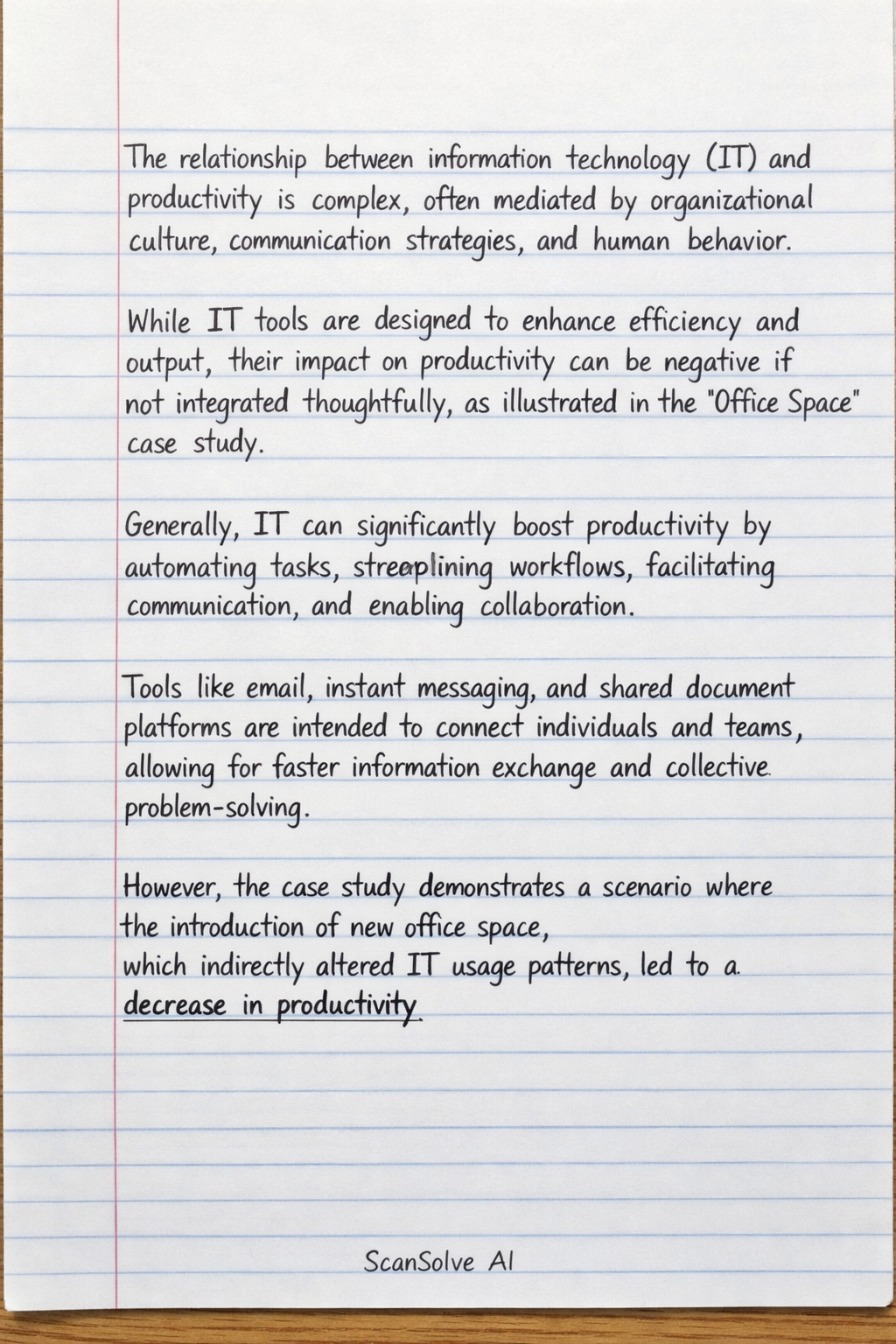
The relationship between information technology (IT) and productivity is complex, often mediated by organizational culture, communication strategies, and human behavior. While IT tools are designed to enhance efficiency and output, their impact on productivity can be negative if not integrated thoughtfully, as illustrated in the "Office Space" case study.
Generally, IT can significantly boost productivity by automating tasks, streamlining workflows, facilitating communication, and enabling collaboration. Tools like email, instant messaging, and shared document platforms are intended to connect individuals and teams, allowing for faster information exchange and collective problem-solving. However, the case study demonstrates a scenario where the introduction of new office space, which indirectly altered IT usage patterns, led to a decrease in productivity.
In the old office, the open-plan design fostered informal communication and collaboration, which are crucial for knowledge work. Programmers could easily talk and collaborate, leading to efficient problem-solving and a cohesive team. The new cubicle setup, with its high walls and isolated corners, physically hindered this natural interaction. This physical barrier then influenced how IT was used. For instance, Bradley, despite being only yards away, resorted to communicating with Martin primarily via email. This shift from immediate, rich face-to-face interaction to a more formal, asynchronous IT channel for close-proximity communication created delays and misunderstandings.
The breakdown in communication and collaboration, exacerbated by the new environment and the misapplication of IT, directly impacted productivity. Bradley's resentment and isolation led him to avoid seeking help from Martin, even when necessary, causing problems to escalate into crises. This lack of effective teamwork and the inability to leverage collective intelligence, despite the availability of IT tools, resulted in significant project delays and reduced overall team output. The unproductive weekly meetings further highlight how even structured interactions failed due to underlying communication issues.
Ultimately, the case study shows that IT is a tool whose effectiveness is contingent on how it supports human interaction and organizational goals. When IT is used in a way that creates barriers, fosters isolation, or replaces more effective communication methods without careful consideration of social dynamics, it can severely detract from productivity rather than enhance it. The physical environment, communication culture, and individual behaviors are critical factors that determine whether IT truly drives productivity or becomes a source of inefficiency.
Still stuck on this one?
Ask a follow-up, and the answer starts from this question.
More Business/Management Questions
Handwritten Step-by-Step Solution
Get this as a handwritten image on WhatsApp — like a tutor wrote it for you.
Try on WhatsApp