ScanSolve logoScanSolve
Toggle sidebar
  • Homework
  • Tutor
  • Humanizer
  • AI Detector
  • Questions
  • Blog
  • History
  • Mobile App

  • Homework
  • Tutor
  • Humanizer
  • AI Detector

  • Questions
  • Math homework helpMath
    Physics homework helpPhysics
    Chemistry homework helpChemistry
    Biology homework helpBiology
    Computer Science homework helpComputer Science
    History homework helpHistory
    More homework helpMore
  • Blog
  • History

  • Mobile App
ScanSolvePLUS
  • Unlimited answers
  • ScanSolve AI Pro
Start Free Trial →
Try on WhatsApp
Home > Chemistry Homework Help > Solution

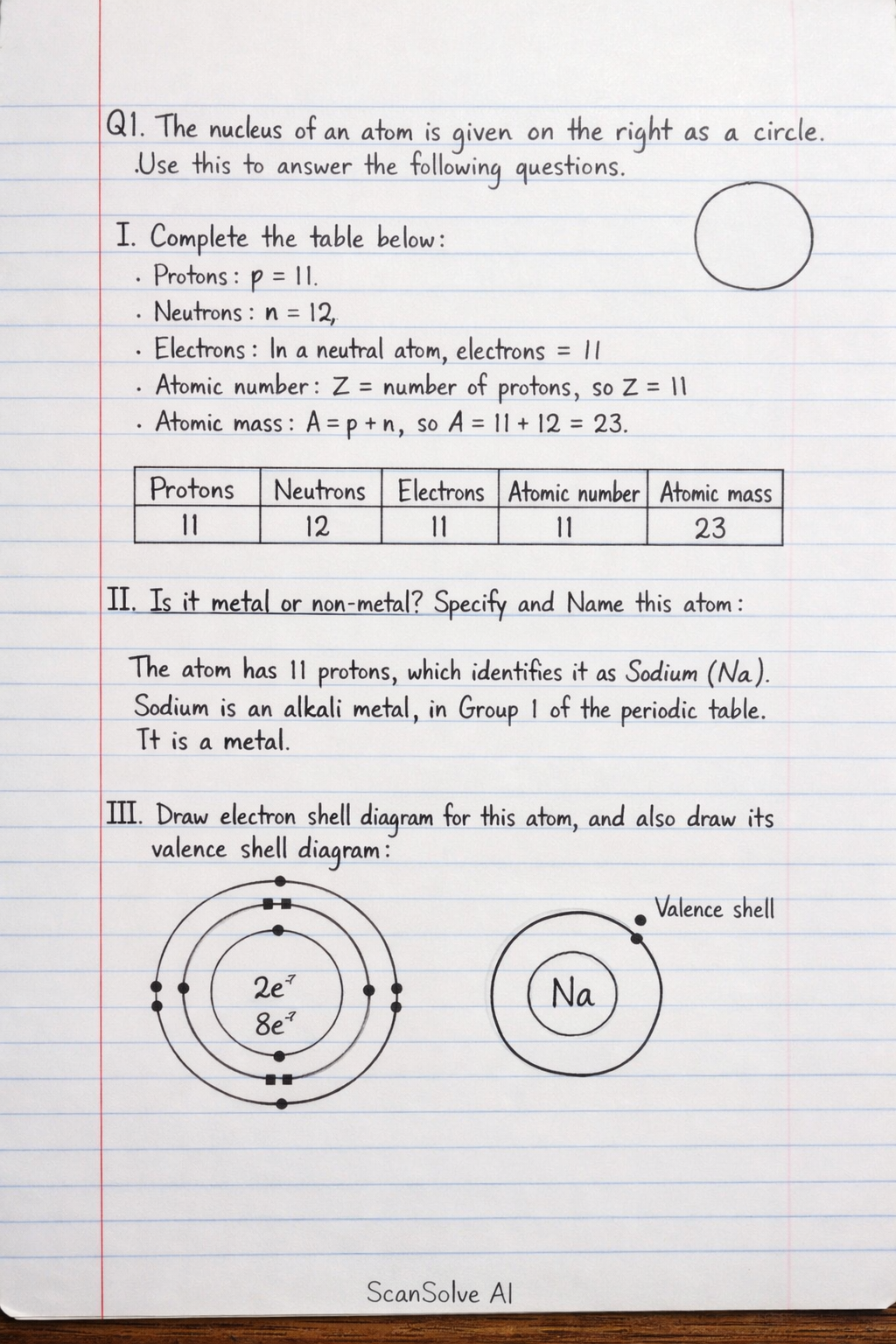
Q1. The nucleus of an atom is given on the right as a circle. Use this to answer the following questions: I. Complete the table below.

Asked on March 26, 2026|Chemistry

This chemistry question involves key chemical concepts and calculations. The detailed solution below walks through each step, from identifying the reaction type to computing the final answer.

ScanSolve AI AnswerAnswered on March 26, 2026
Q1. The nucleus of an atom is given on the right as a circle. Use this to answer the following questions. I. Complete the table below. Protons: The number of protons (p) is given as 11. Neutrons: The number of neutrons (n) is given as 12. Electrons: In a neutral atom, the number of electrons is equal to the number of protons. So, electrons = 11. Atomic number: The atomic number (Z) is equal to the number of protons. So, atomic number = 11. Atomic mass: The atomic mass (A) is the sum of protons and neutrons. So, atomic mass = 11 + 12 = 23. $$ \begin{array}{|c|c|c|c|c|} \hline \text{Protons} & \text{Neutrons} & \text{Electrons} & \text{Atomic number} & \text{Atomic mass} \\ \hline 11 & 12 & 11 & 11 & 23 \\ \hline \end{array} $$ II. Is it metal or non-metal? Specify and Name this atom. The atom has 11 protons, which identifies it as Sodium (Na). Sodium is an alkali metal, located in Group 1 of the periodic table. It is a metal. III. Draw electron shell diagram for this atom, and also draw its valence shell diagram. Electron Shell Diagram (Bohr Model): Sodium has 11 electrons. The electron configuration by shells is 2, 8, 1. The diagram shows the nucleus with 11 protons and 12 neutrons, surrounded by electron shells. • First shell (K-shell): 2 electrons • Second shell (L-shell): 8 electrons • Third shell (M-shell): 1 electron (Diagram representation - imagine concentric circles) $$ \text{Nucleus (11p, 12n)} \\ \text{1st shell (2 electrons)} \\ \text{2nd shell (8 electrons)} \\ \text{3rd shell (1 electron)} $$ Valence Shell Diagram (Lewis Dot Structure): The valence shell is the outermost shell, which contains 1 electron for Sodium. $$ \text{Na} \cdot $$ IV. Write the main shell electron configuration for this atom. The main shell electron configuration (Bohr model) for Sodium (11 electrons) is: $$ \boxed{\text{2, 8, 1}} $$ V. Write the subshell electron configuration for this atom. The subshell electron configuration for Sodium (11 electrons) follows the Aufbau principle: $$ \boxed{1s^2 2s^2 2p^6 3s^1} $$ VI. Write the condensed subshell electron configuration for this atom. The noble gas preceding Sodium is Neon (Ne), which has the configuration $1s^2 2s^2 2p^6$. The condensed subshell electron configuration for Sodium is: $$ \boxed{[Ne] 3s^1} $$ VII. Write and represent the ground state and excited state for this atom. Ground State: The ground state is the lowest energy electron configuration. $$ \text{Configuration: } 1s^2 2s^2 2p^6 3s^1 $$ Representation (Orbital Diagram): $$ \begin{array}{c c c c c c} \uparrow \downarrow & \uparrow \downarrow & \uparrow \downarrow & \uparrow \downarrow & \uparrow \downarrow & \uparrow \\ \text{1s} & \text{2s} & \text{2p}_x & \text{2p}_y & \text{2p}_z & \text{3s} \end{array} $$ Excited State: An excited state occurs when an electron absorbs energy and moves to a higher energy orbital. One possible excited state for Sodium is when the 3s electron moves to the 3p orbital. $$ \text{Configuration: } 1s^2 2s^2 2p^6 3p^1 $$ Representation (Orbital Diagram): $$ \begin{array}{c c c c c c c c} \uparrow \downarrow & \uparrow \downarrow & \uparrow \downarrow & \uparrow \downarrow & \uparrow \downarrow & & \uparrow & \\ \text{1s} & \text{2s} & \text{2p}_x & \text{2p}_y & \text{2p}_z & \text{3s} & \text{3p}_x & \text{3p}_y & \text{3p}_z \end{array} $$

Related Chemistry Questions

  • Identify the base and exponents.
  • Identify the atomic number.
  • Acid, bases and salt
  • SECTION A: PHYSICAL CHEMISTRY
  • The image provided is the cover page of a chemistry examination paper. It contains general instructions and information...
  • I) Compound Words
See all Chemistry questions

This step-by-step solution was generated by ScanSolve AI. Need help with more chemistry problems? Browse Chemistry solutions or ask your own question.

Home›Chemistry Homework Help›Q1. The nucleus of an atom is given on the right as a circle…
Q

Q1. The nucleus of an atom is given on the right as a circle. Use this to answer the following questions: I. Complete the table below.

March 26, 2026|Chemistry
Q1. The nucleus of an atom is given on the right as a circle. Use this to answer the following questions: I. Complete the table below.

Q1. The nucleus of an atom is given on the right as a circle. Use this to answer the following questions: I. Complete the table below.

ScanSolve AI

ScanSolve AI Answer

Answered on March 26, 2026

Q1. The nucleus of an atom is given on the right as a circle. Use this to answer the following questions.

I. Complete the table below.

  • Protons: The number of protons (p) is given as 11.
  • Neutrons: The number of neutrons (n) is given as 12.
  • Electrons: In a neutral atom, the number of electrons is equal to the number of protons. So, electrons = 11.
  • Atomic number: The atomic number (Z) is equal to the number of protons. So, atomic number = 11.
  • Atomic mass: The atomic mass (A) is the sum of protons and neutrons. So, atomic mass = 11 + 12 = 23.
ProtonsNeutronsElectronsAtomicnumberAtomicmass1112111123\begin{array}{|c|c|c|c|c|} \hline Protons & Neutrons & Electrons & Atomic number & Atomic mass \\ \hline 11 & 12 & 11 & 11 & 23 \\ \hline \end{array}Protons11​Neutrons12​Electrons11​Atomicnumber11​Atomicmass23​​

II. Is it metal or non-metal? Specify and Name this atom.

The atom has 11 protons, which identifies it as Sodium (Na). Sodium is an alkali metal, located in Group 1 of the periodic table. It is a metal.

III. Draw electron shell diagram for this atom, and also draw its valence shell diagram.

  • Electron Shell Diagram (Bohr Model): Sodium has 11 electrons. The electron configuration by shells is 2, 8, 1. The diagram shows the nucleus with 11 protons and 12 neutrons, surrounded by electron shells. • First shell (K-shell): 2 electrons • Second shell (L-shell): 8 electrons • Third shell (M-shell): 1 electron

    (Diagram representation - imagine concentric circles)

    Nucleus(11p,12n)1stshell(2electrons)2ndshell(8electrons)3rdshell(1electron)Nucleus (11p, 12n) \\ 1st shell (2 electrons) \\ 2nd shell (8 electrons) \\ 3rd shell (1 electron)Nucleus(11p,12n)1stshell(2electrons)2ndshell(8electrons)3rdshell(1electron)
  • Valence Shell Diagram (Lewis Dot Structure): The valence shell is the outermost shell, which contains 1 electron for Sodium.

    Na⋅Na \cdotNa⋅

IV. Write the main shell electron configuration for this atom.

The main shell electron configuration (Bohr model) for Sodium (11 electrons) is:

2, 8, 1\text{2, 8, 1}2, 8, 1

V. Write the subshell electron configuration for this atom.

The subshell electron configuration for Sodium (11 electrons) follows the Aufbau principle:

1s22s22p63s11s^2 2s^2 2p^6 3s^11s22s22p63s1

VI. Write the condensed subshell electron configuration for this atom.

The noble gas preceding Sodium is Neon (Ne), which has the configuration 1s22s22p61s^2 2s^2 2p^61s22s22p6. The condensed subshell electron configuration for Sodium is:

[Ne]3s1[Ne] 3s^1[Ne]3s1

VII. Write and represent the ground state and excited state for this atom.

  • Ground State: The ground state is the lowest energy electron configuration.

    Configuration:1s22s22p63s1Configuration: 1s^2 2s^2 2p^6 3s^1Configuration:1s22s22p63s1

    Representation (Orbital Diagram):

    ↑↓↑↓↑↓↑↓↑↓↑1s2s2px2py2pz3s\begin{array}{c c c c c c} \uparrow \downarrow & \uparrow \downarrow & \uparrow \downarrow & \uparrow \downarrow & \uparrow \downarrow & \uparrow \\ 1s & 2s & 2p_x & 2p_y & 2p_z & 3s \end{array}↑↓1s​↑↓2s​↑↓2px​​↑↓2py​​↑↓2pz​​↑3s​
  • Excited State: An excited state occurs when an electron absorbs energy and moves to a higher energy orbital. One possible excited state for Sodium is when the 3s electron moves to the 3p orbital.

    Configuration:1s22s22p63p1Configuration: 1s^2 2s^2 2p^6 3p^1Configuration:1s22s22p63p1

    Representation (Orbital Diagram):

    ↑↓↑↓↑↓↑↓↑↓↑1s2s2px2py2pz3s3px3py3pz\begin{array}{c c c c c c c c} \uparrow \downarrow & \uparrow \downarrow & \uparrow \downarrow & \uparrow \downarrow & \uparrow \downarrow & & \uparrow & \\ 1s & 2s & 2p_x & 2p_y & 2p_z & 3s & 3p_x & 3p_y & 3p_z \end{array}↑↓1s​↑↓2s​↑↓2px​​↑↓2py​​↑↓2pz​​3s​↑3px​​3py​​3pz​​

Need help with your own homework?

Get instant step-by-step solutions to any question. Free to start.

Ask Your Question
Handwritten step-by-step solution

Handwritten Step-by-Step Solution

Get this solution as a handwritten image on WhatsApp — just like a tutor wrote it for you.

Try on WhatsApp

More Chemistry Questions

Identify the base and exponents.Identify the atomic number.Acid, bases and saltSECTION A: PHYSICAL CHEMISTRYThe image provided is the cover page of a chemistry examination paper. It contains general instructi…I) Compound Words
See all Chemistryquestions →