
We read your photo as:
Represent the expression ((x+2) extasciitilde 3) * (y - (3+x)) - 5 using a binary tree, and write it in prefix, postfix, and infix notations.
ScanSolve AI Answer
a) Represent the expression using a binary tree.
The binary tree for the expression is constructed with operators as internal nodes and operands as leaf nodes. The root is the last operation performed, which is subtraction.
b) Write this expression in prefix notation.
Prefix notation (also known as Polish notation) lists the operator before its operands. It is obtained by a pre-order traversal (Root, Left, Right) of the expression tree.
c) Write this expression in postfix notation.
Postfix notation (also known as Reverse Polish notation) lists the operator after its operands. It is obtained by a post-order traversal (Left, Right, Root) of the expression tree.
d) Write this expression in infix notation.
Infix notation is the standard way of writing expressions, with operators between their operands, using parentheses to define the order of operations. The given expression is already in infix notation.
Still stuck on this one?
Ask a follow-up, and the answer starts from this question.
More Computer Science Questions
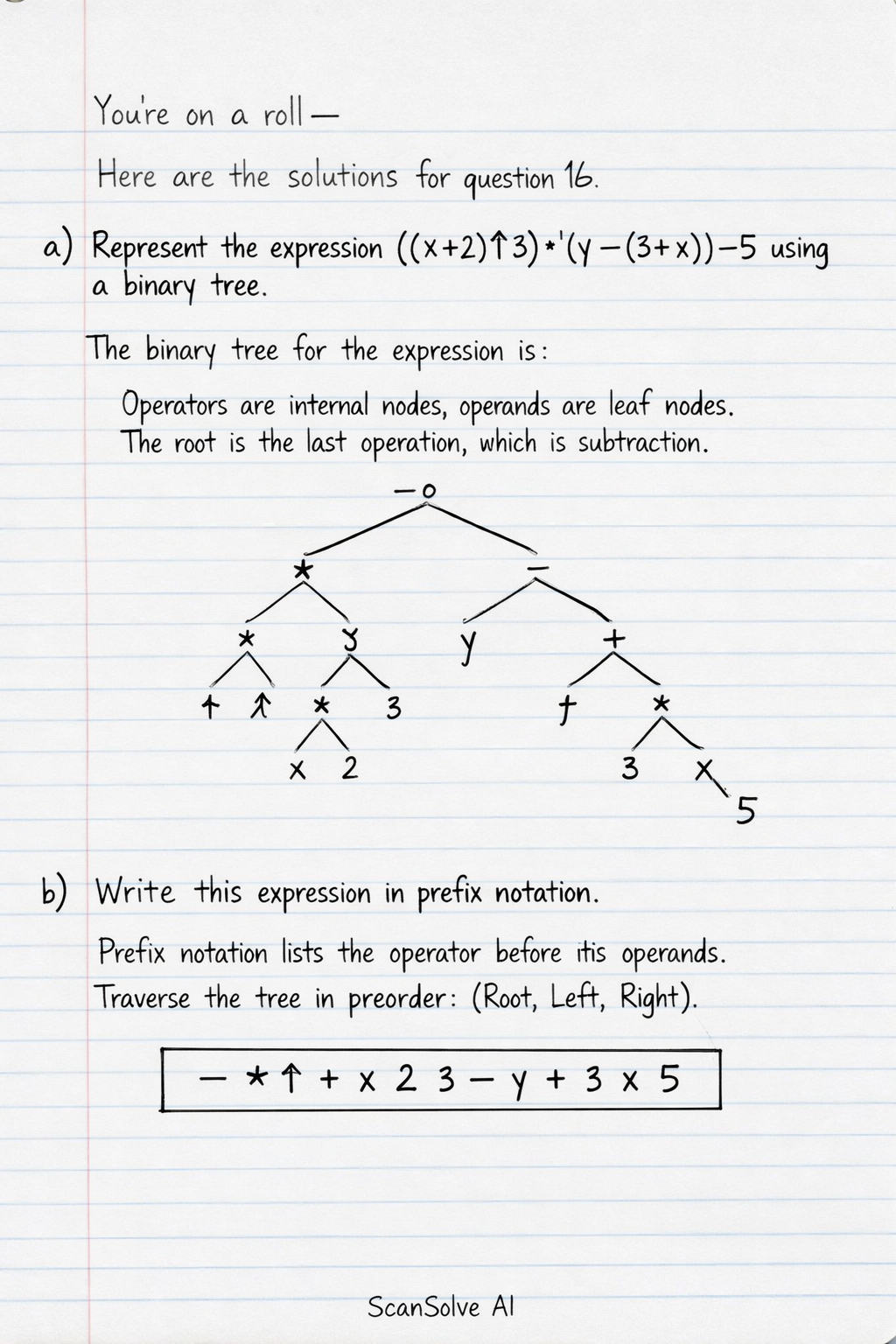
Handwritten Step-by-Step Solution
Get this as a handwritten image on WhatsApp — like a tutor wrote it for you.
Try on WhatsApp