
We read your photo as:
Show how selection sort sorts the array [7, 4, 10, 8, 3, 1] by writing out its content after each pass. Briefly explain syntax, semantics, and runtime errors in programming languages.
ScanSolve AI Answer
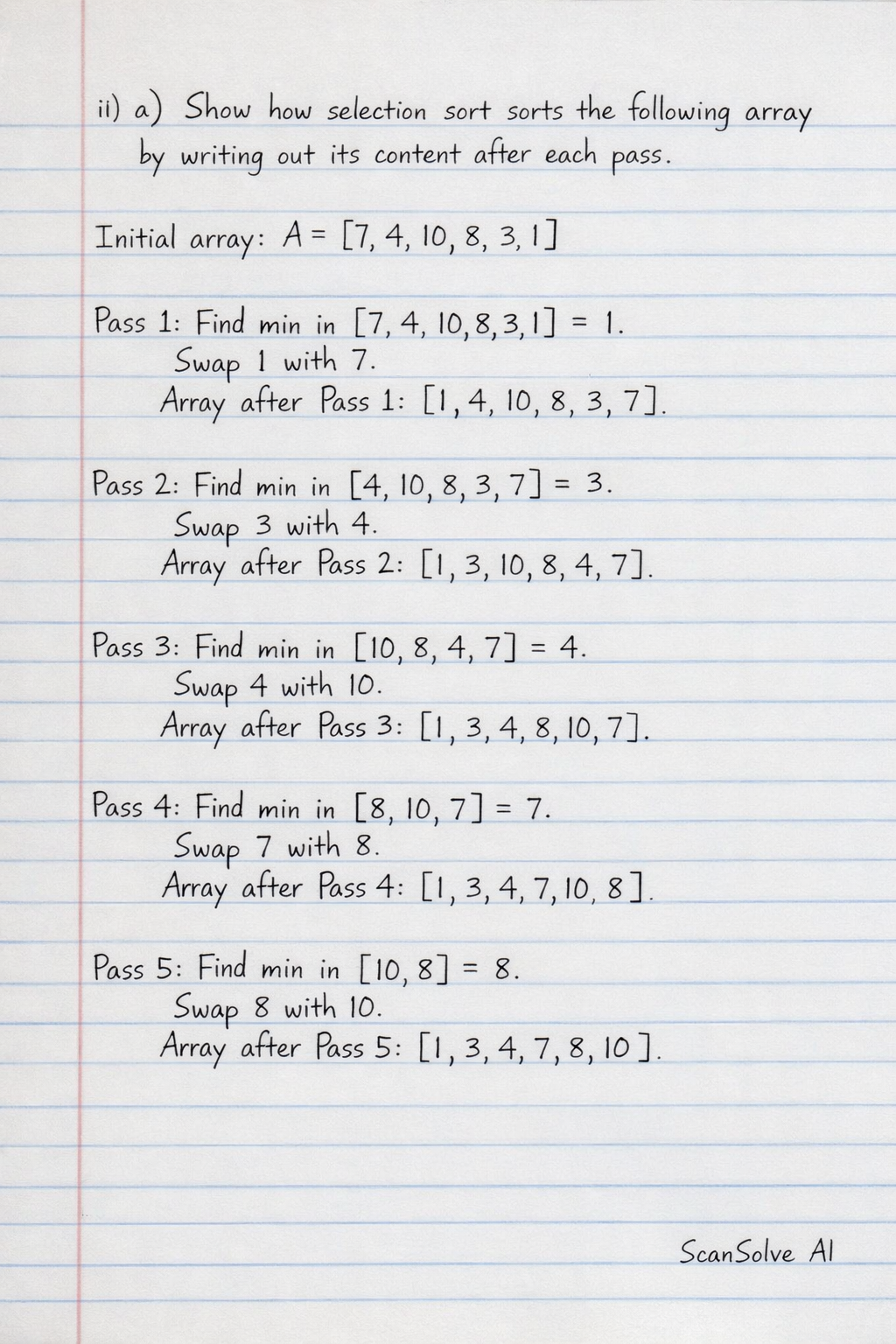
ii) a) Show how selection sort sorts the following arrays by writing out its content after each pass
Initial array:
-
Pass 1: Find the minimum element in (which is 1) and swap it with the first element (7). Array after Pass 1:
-
Pass 2: Find the minimum element in the unsorted sub-array (which is 3) and swap it with the second element (4). Array after Pass 2:
-
Pass 3: Find the minimum element in the unsorted sub-array (which is 4) and swap it with the third element (10). Array after Pass 3:
-
Pass 4: Find the minimum element in the unsorted sub-array (which is 7) and swap it with the fourth element (8). Array after Pass 4:
-
Pass 5: Find the minimum element in the unsorted sub-array (which is 8) and swap it with the fifth element (10). Array after Pass 5:
c) iii) Briefly explain the following in relation to programming languages: syntax and semantics and run time errors
- Syntax refers to the set of rules that define the correct structure of statements and expressions in a programming language, similar to grammar in human languages.
- Semantics defines the meaning of correctly structured statements and expressions, determining what a program will do when executed.
- Run-time errors are errors that occur during the execution of a program, typically due to operations that are impossible or invalid at that moment, such as division by zero or accessing memory out of bounds.
c) iv) C programming language supports imperative, procedural and structured programming paradigms. Briefly explain these paradigms with respect to C language.
- Imperative programming focuses on how a program achieves a result by explicitly stating a sequence of commands that change the program's state. C is imperative as it uses statements to modify data.
- Procedural programming, a subset of imperative, organizes code into procedures (functions). C heavily uses functions for modularity and code reuse.
- Structured programming emphasizes clear control flow using constructs like
if-else,for, andwhileloops, avoidinggotostatements. C supports these constructs for readable and maintainable code.
c) v) Explain the object oriented programming (OOP) concepts of encapsulation and abstraction giving ONE real life example of each.
-
Encapsulation is the bundling of data and the methods that operate on that data into a single unit (an object), while restricting direct access to some of the object's components.
- Example: A car engine. Its internal workings (pistons, valves) are hidden, and you interact with it through defined interfaces like the ignition and accelerator.
-
Abstraction is the process of hiding complex implementation details and showing only the essential features of an object. It focuses on what an object does rather than how it does it.
- Example: A TV remote control. You use buttons like "Power" or "Volume Up" without needing to know the complex electronic signals or internal circuitry that execute these commands.
Still stuck on this one?
Ask a follow-up, and the answer starts from this question.
More Computer Science Questions
Handwritten Step-by-Step Solution
Get this as a handwritten image on WhatsApp — like a tutor wrote it for you.
Try on WhatsApp