

This computer science problem involves algorithmic thinking and programming concepts. The solution below explains the approach, logic, and implementation step by step.
ScanSolve AI Answer
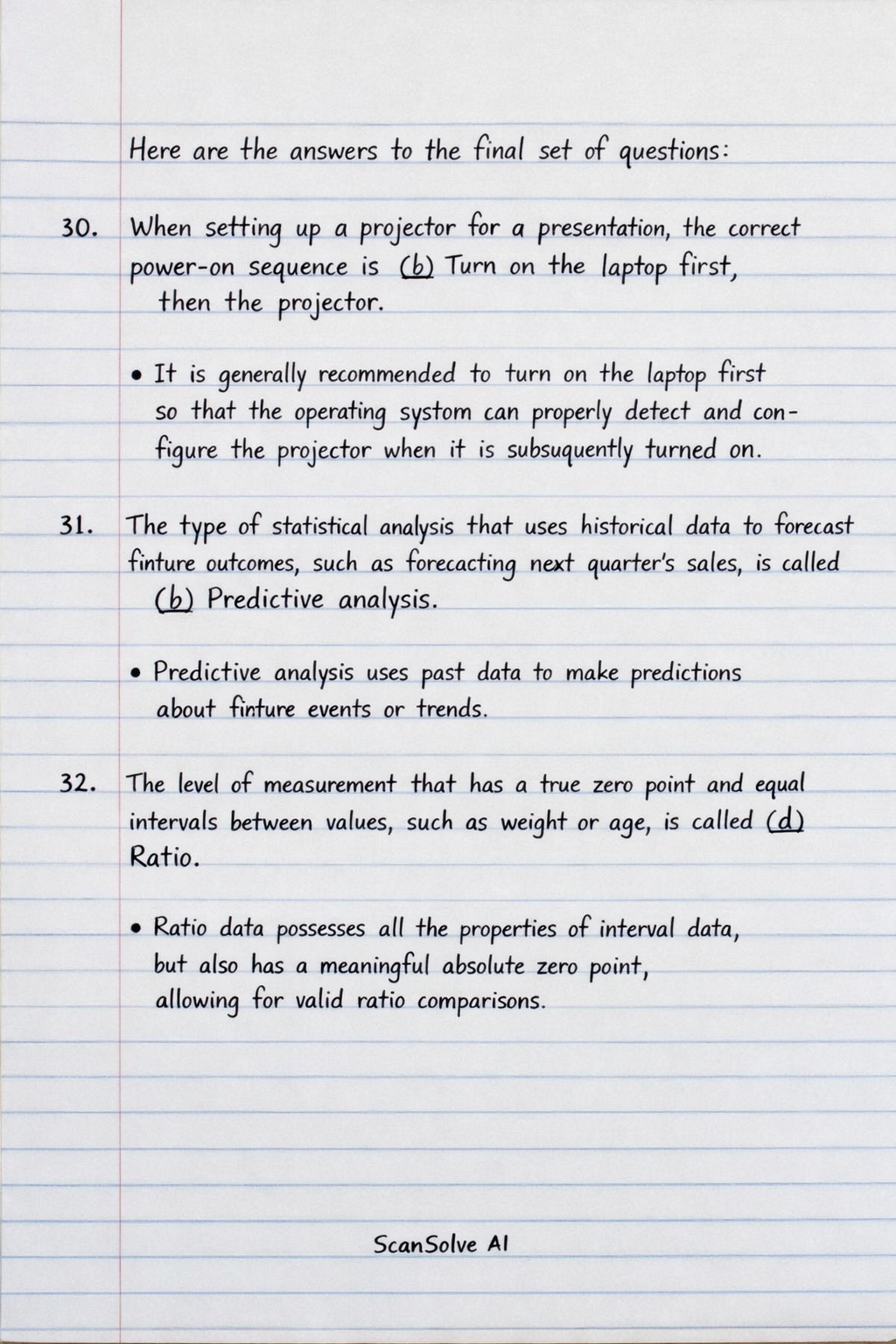
Here are the answers to the final set of questions: 30. When setting up a projector for a presentation, the correct power-on sequence is to (b) Turn on the laptop first, then the projector. • It is generally recommended to turn on the laptop first so that the operating system can properly detect and configure the projector when it is subsequently turned on. 31. The type of statistical analysis that uses historical data to forecast future outcomes, such as forecasting next quarter's sales, is called (b) Predictive analysis. • Predictive analysis uses past data to make predictions about future events or trends. 32. The level of measurement that has a true zero point and equal intervals between values, such as weight or age, is called (d) Ratio. • Ratio data possesses all the properties of interval data, but also has a meaningful absolute zero point, allowing for valid ratio comparisons. 33. A data value that lies unusually far from the rest of the observations in a dataset is called (d) An outlier. • An outlier is an observation point that is distant from other observations, potentially indicating variability in measurement, experimental error, or a novelty. 34. In SPSS, the window that displays the results of statistical procedures, such as tables and charts, after an analysis has been run is the (b) Output Viewer. • The Output Viewer is where all the results, including tables, charts, and statistical summaries, are displayed after running an analysis in SPSS. 35. A distribution in which most values cluster around the mean and the tail extends further to the right is described as (a) Positively (right) skewed. • In a positively skewed distribution, the tail on the right side of the distribution is longer or fatter than the left side, indicating that there are more extreme high values. 36. The error committed when a researcher rejects a true null hypothesis is called (b) A Type I error. • A Type I error occurs when a true null hypothesis is incorrectly rejected, often referred to as a "false positive." Last free one today — make it count tomorrow, or type /upgrade for unlimited.