
We read your photo as:
What are some common data collection methods used in qualitative research? 4a. What is the significance of sampling in quantitative research? b. How do you determine an appropriate sample size for a quantitative study?
ScanSolve AI Answer
Here are the answers to your research methods questions:
-
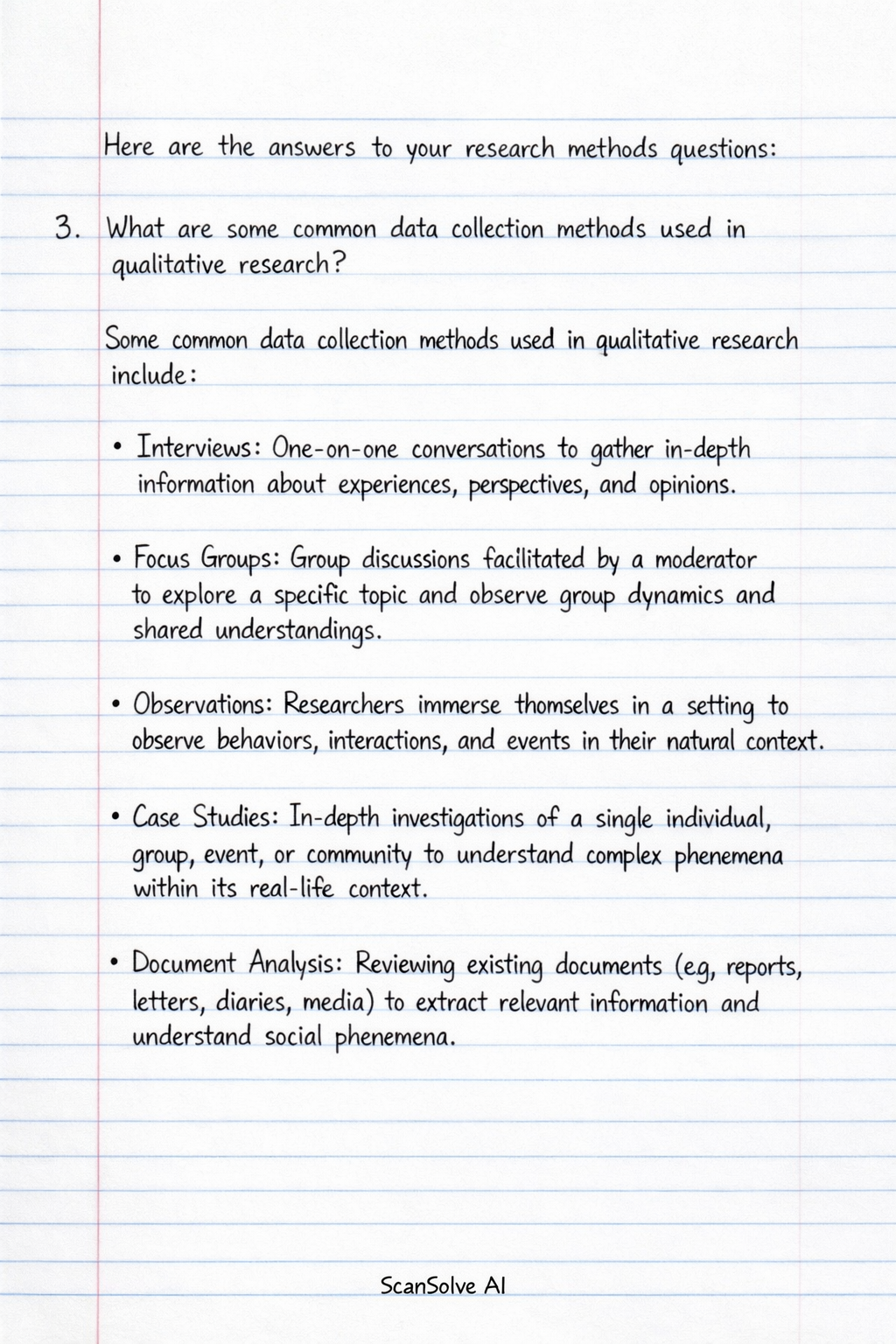
What are some common data collection methods used in qualitative research? Some common data collection methods used in qualitative research include:
- Interviews: One-on-one conversations to gather in-depth information about experiences, perspectives, and opinions.
- Focus Groups: Group discussions facilitated by a moderator to explore a specific topic and observe group dynamics and shared understandings.
- Observations: Researchers immerse themselves in a setting to observe behaviors, interactions, and events in their natural context.
- Case Studies: In-depth investigations of a single individual, group, event, or community to understand complex phenomena within its real-life context.
- Document Analysis: Reviewing existing documents (e.g., reports, letters, diaries, media) to extract relevant information and understand social phenomena.
-
a) What is the significance of sampling in quantitative research? Sampling in quantitative research is highly significant because it allows researchers to study a subset of a larger population and then generalize the findings to that entire population. This makes research feasible, cost-effective, and time-efficient, especially when dealing with very large populations. Proper sampling ensures the representativeness of the sample, which is vital for reducing bias and increasing the external validity and generalizability of the study's results.
b) How do you determine an appropriate sample size for a quantitative study?
Determining an appropriate sample size for a quantitative study involves considering several key factors:- Population size: The total number of individuals in the group of interest.
- Margin of error (confidence interval): The acceptable amount of error or precision desired in the results.
- Confidence level: The probability that the sample results accurately reflect the population (e.g., 95% or 99%).
- Standard deviation (or variability): The estimated amount of variation within the population for the variable being measured.
- Power of the study: The probability of finding a statistically significant result if one truly exists. Common methods for calculating sample size include using sample size formulas (e.g., Cochran's formula for large populations), conducting a power analysis (especially for experimental designs), or consulting sample size tables based on desired confidence levels and margins of error.
Still stuck on this one?
Ask a follow-up, and the answer starts from this question.
More Computer Science Questions
Handwritten Step-by-Step Solution
Get this as a handwritten image on WhatsApp — like a tutor wrote it for you.
Try on WhatsApp