
We read your photo as:
Which statement best distinguishes between structured and unstructured data?
Computer Science
ScanSolve AI Answer
Answer
The correct statement is A.
- A. Structured data fits neatly in databases; unstructured data includes images, videos, and text. This option accurately describes the fundamental difference. Structured data is highly organized and formatted, making it easy to store in relational databases (like SQL tables) with predefined schemas. Examples include customer names, addresses, and transaction amounts. Unstructured data, on the other hand, lacks a predefined format or organization and does not fit into traditional databases. Common examples include emails, social media posts, images, audio files, and video files.
Options B, C, and D are incorrect because:
- B is incorrect; the security of data depends on the security measures implemented, not inherently on whether it is structured or unstructured.
- C is incorrect; both structured and unstructured data can contain qualitative (descriptive) and quantitative (numerical) information. The distinction is about organization, not data type.
- D is incorrect; encryption is a security practice that can be applied to both structured and unstructured data, and neither is always encrypted while the other is not.
The final answer is .
Was this helpful?
Try one yourself
A new problem that tests the same skill.
Still stuck on this one?
Ask a follow-up, and the answer starts from this question.
Got a different question?Ask your own question
More Computer Science Questions
QWhat percentage of enterprise data is estimated to be structured data?QI. Say “True” if the Statement is correct and” False” if the statement is incorrect. ------1. Data…QState types of data use in databaseQData structures in computer scienceQExplain the difference between structured and unstructured interviews. What are the disadvantages of…
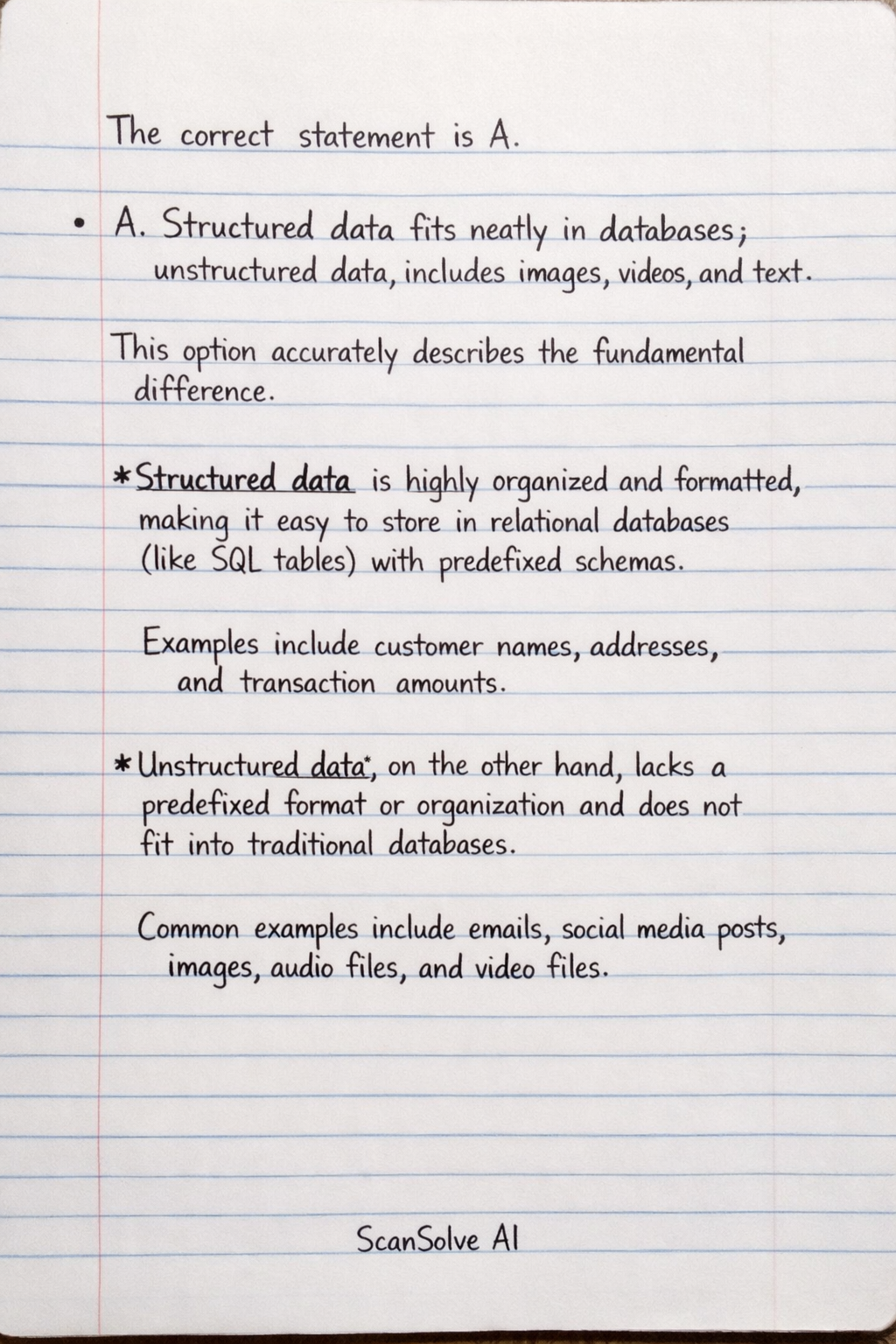
Handwritten Step-by-Step Solution
Get this as a handwritten image on WhatsApp — like a tutor wrote it for you.
Try on WhatsApp