
We read your photo as:
Substitute x=3 into the function f(x).
ScanSolve AI Answer
Answer
Step-by-step solution
13 stepshere are the solutions to the problems:
50. If , then
Substitute into the function .
Calculate the square.
Perform the multiplication.
Perform the subtraction.
The correct option is (C).
51. What is the gradient of the straight line ?
To find the gradient, rearrange the equation into the slope-intercept form , where is the gradient.
Divide both sides of the equation by 2.
The gradient is the coefficient of .
The correct option is (B).
52. What is the measure of ?
Analyze the construction description.
"With centre A, an arc BC is drawn." This means that the distance from A to B is equal to the distance from A to C. So, .
"With centre B, and the same radius, the arc PCQ is drawn." This means the distance from B to A is equal to the distance from B to C. So, .Conclude the type of triangle.
Since and , it follows that . Therefore, triangle ABC is an equilateral triangle.
Determine the angle measure.
In an equilateral triangle, all interior angles are equal to .
Thus, .
The correct option is (C).53. In the triangle, the value of is
Identify the properties of the triangle.
The markings on two sides of the triangle indicate that it is an isosceles triangle, meaning those two sides are equal in length.
Apply the property of isosceles triangles.
In an isosceles triangle, the angles opposite the equal sides are also equal. One of the base angles is given as , so the other base angle must also be .
Use the sum of angles in a triangle.
The sum of the interior angles in any triangle is .
Solve for .
The correct option is (C).
Try one yourself
A new problem that tests the same skill.
Still stuck on this one?
Ask a follow-up, and the answer starts from this question.
More Computer Science Questions
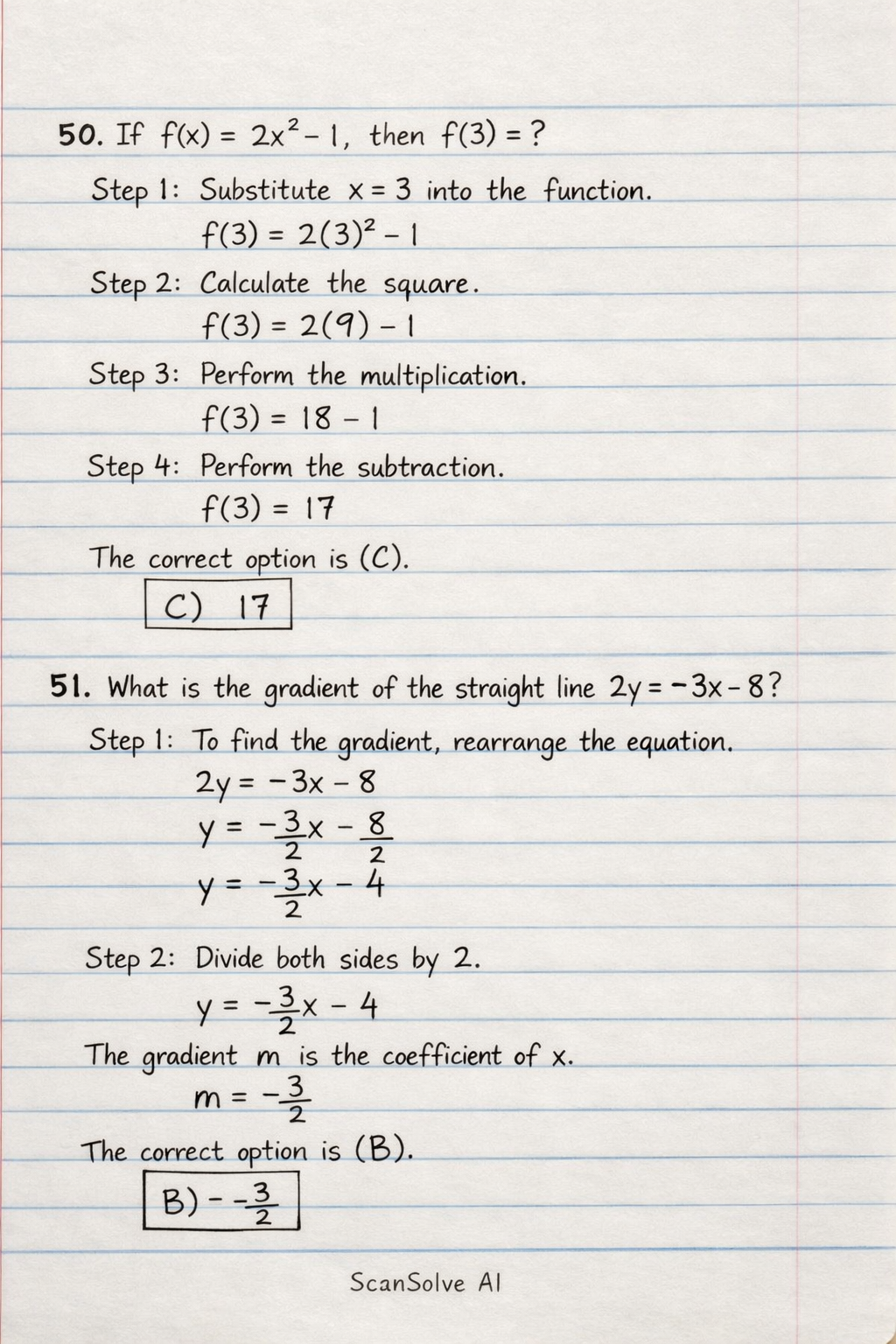
Handwritten Step-by-Step Solution
Get this as a handwritten image on WhatsApp — like a tutor wrote it for you.
Try on WhatsApp