
Explain me this well please because this is my first time trying to interpret this. Binomial expansion are sometimes aided by a tool known as pascal triangle. Pascals triangle is an array of numbers hich is triangular in nature. An example is shown below, 1 1 1 1 2 1 1 3 3 1 1 4 6 4 1 Here we realize that it is an N×N matrix where N is a natural number. The leading diagonal of the matrix and the first column are made up of 1s only. That is if the matrix A, then all A[i, 1] are 1s and all A[i, i] are 1s for each line(row) i of the pascal triangle. Elements of each line run from A[i, 1] to A[i, i] but A[i, 1] and A[i,i] are 1s and can be filled in advance. To fill each cell A[i,j] within the rest of the triangle, we go from A[i,2] to A[i,i-1] with j ranging from 2 to i-1. So every A[i,j] = A[i-1,j]+A[i-1,j-1].
ScanSolve AI Answer
Answer
You've got a great start on understanding Pascal's Triangle! Let's clarify a few points and connect it to binomial expansion.
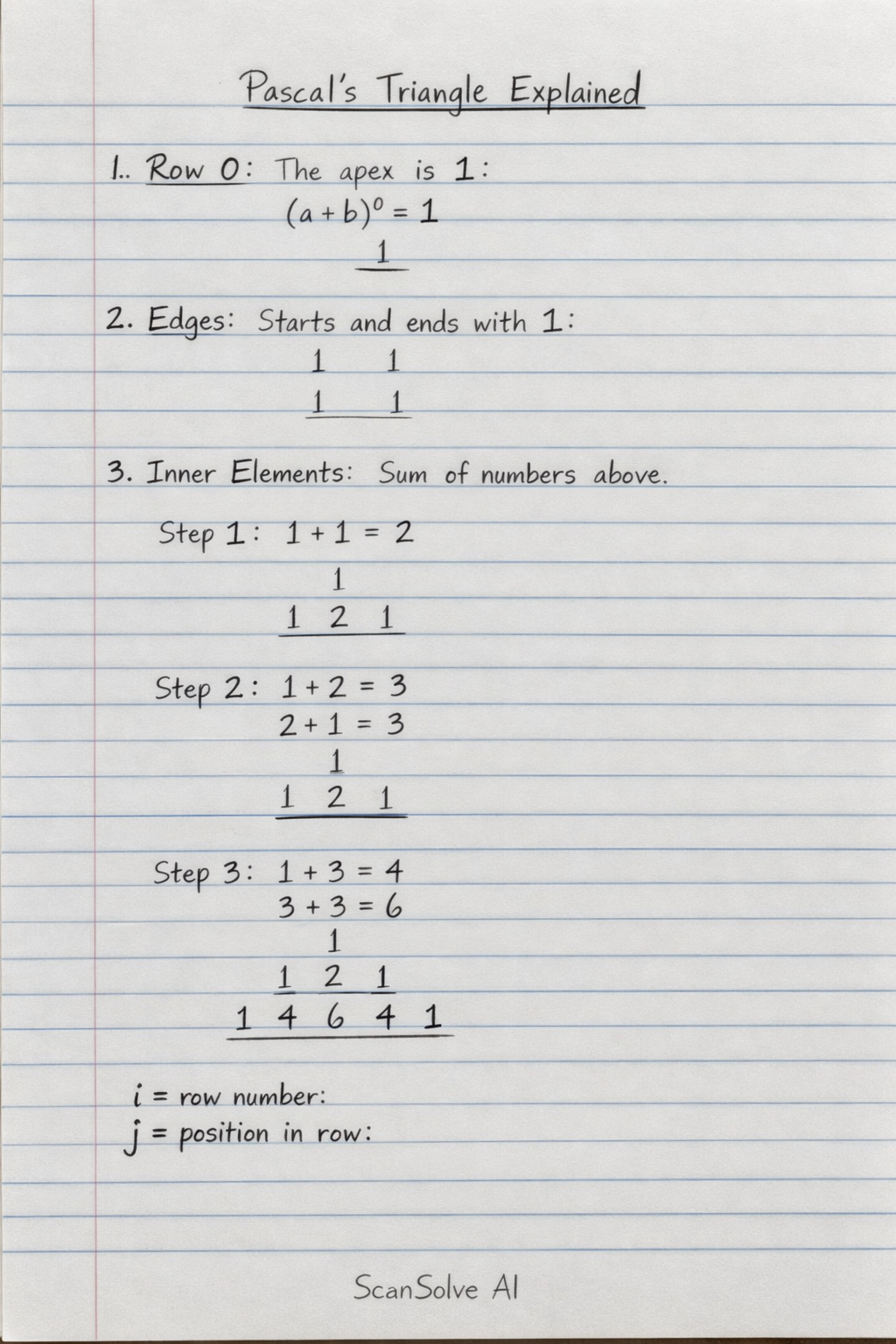
Pascal's Triangle Explained
Pascal's Triangle is indeed a triangular array of numbers, not strictly an matrix, as its rows vary in length. Each row represents the coefficients of a binomial expansion , where is the row number (starting from for the top row).
Structure and Rules:
- Row 0: The very top row (the "apex") is just the number 1. This corresponds to .
- Edges: Every row starts and ends with 1. These are your and elements.
- Inner Elements: Each number inside the triangle is the sum of the two numbers directly above it. This is the core rule you mentioned:
Where:
- is the current row number (starting from 0).
- is the position within the current row (starting from 0).
Let's re-examine your example with this rule:
- Row 0:
- Row 1: (Corresponds to )
- Starts with 1.
- Ends with 1.
- Row 2: (Corresponds to )
- Starts with 1.
- Middle element: .
- Ends with 1.
- Row 3: (Corresponds to )
- Starts with 1.
- Second element: .
- Third element: .
- Ends with 1.
- Row 4: (Corresponds to )
- Starts with 1.
- Second element: .
- Third element: .
- Fourth element: .
- Ends with 1.
Connection to Binomial Expansion
The numbers in each row of Pascal's Triangle are the coefficients for the terms when you expand a binomial expression of the form .
For , the coefficients are found in row of Pascal's Triangle.
Example: Expand .
- Look at Row 3 of Pascal's Triangle: . These are your coefficients.
- The powers of start from and decrease to 0.
- The powers of start from 0 and increase to .
So, for :
- The first term has coefficient 1, , :
- The second term has coefficient 3, , :
- The third term has coefficient 3, , :
- The fourth term has coefficient 1, , :
Combining these, the expansion is:
This tool simplifies finding coefficients for binomial expansions without needing to multiply out the terms manually.
Hope this detailed explanation helps you interpret it well!
Still stuck on this one?
Ask a follow-up, and the answer starts from this question.
More Computer Science Questions
Handwritten Step-by-Step Solution
Get this as a handwritten image on WhatsApp — like a tutor wrote it for you.
Try on WhatsApp