

This computer science problem involves algorithmic thinking and programming concepts. The solution below explains the approach, logic, and implementation step by step.
ScanSolve AI Answer
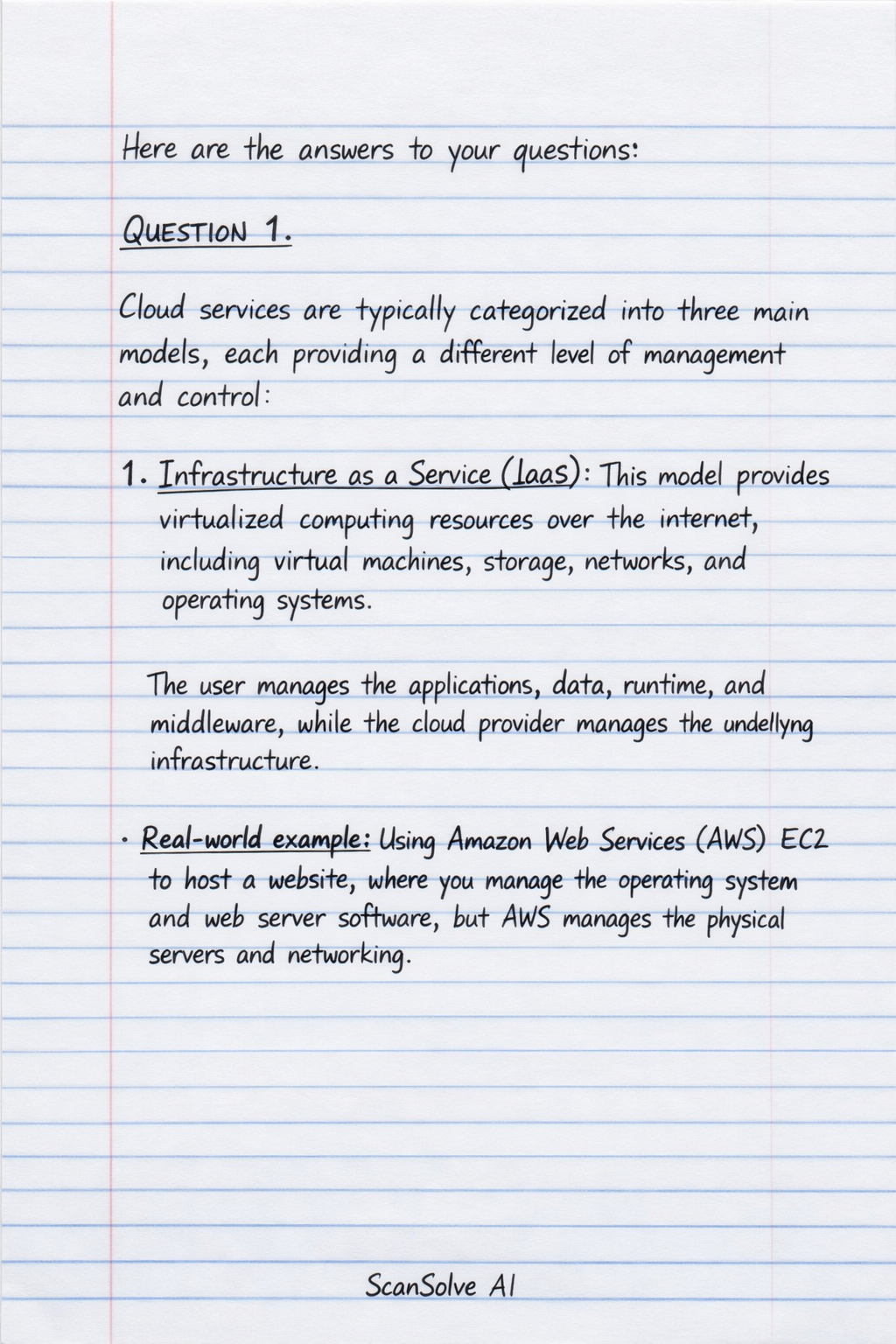
Here are the answers to your questions: QUESTION 1. Cloud services are typically categorized into three main models, each providing a different level of management and control: Infrastructure as a Service (IaaS): This model provides virtualized computing resources over the internet, including virtual machines, storage, networks, and operating systems. The user manages the applications, data, runtime, and middleware, while the cloud provider manages the underlying infrastructure. Real-world example:* Using Amazon Web Services (AWS) EC2 to host a website, where you manage the operating system and web server software, but AWS manages the physical servers and networking. Platform as a Service (PaaS): This model provides a complete development and deployment environment in the cloud, with resources that enable you to deliver everything from simple cloud-based apps to sophisticated, cloud-enabled enterprise applications. The user manages their applications and data, while the provider manages the operating systems, runtime, middleware, and underlying infrastructure. Real-world example:* Developing and deploying a web application using Google App Engine, where you write your code, but Google handles the servers, operating systems, and application runtime environment. Software as a Service (SaaS): This model delivers software applications over the internet, on-demand, typically on a subscription basis. The cloud provider manages all aspects of the application, including the software, runtime, middleware, operating systems, and underlying infrastructure. Users simply access the software via a web browser or mobile app. Real-world example:* Using Gmail for email services or Salesforce for customer relationship management (CRM), where you only interact with the application interface, and the provider manages all the backend infrastructure and software updates. QUESTION 2. a) Cloud computing is the on-demand delivery of computing services—including servers, storage, databases, networking, software, analytics, and intelligence—over the Internet ("the cloud") to offer faster innovation, flexible resources, and economies of scale. It works by pooling physical computing resources (servers, storage, network devices) in data centers and then virtualizing them. Users access these virtualized resources via a network connection, typically the internet, and pay only for what they use. The cloud provider manages the underlying infrastructure, allowing users to provision and scale resources dynamically without needing to own or maintain physical hardware. b) Cloud computing is being used for emerging technologies such as artificial intelligence (AI) and the Internet of Things (IoT) in the following ways: Artificial Intelligence (AI): Cloud computing provides the massive computational power (e.g., GPUs, TPUs), scalable storage for large datasets, and specialized services (e.g., machine learning platforms, pre-trained models, APIs) required for training complex AI models and deploying them at scale. It democratizes AI by making these expensive resources accessible to a wider range of users and organizations without significant upfront investment. Internet of Things (IoT): Cloud computing serves as the backend infrastructure for IoT solutions. It provides the scalable storage and processing capabilities to collect, store, and analyze the vast amounts of data generated by billions of connected IoT devices. Cloud platforms offer services for device management, real-time data ingestion, stream processing, and integration with other applications, enabling insights and automation from IoT data. QUESTION 3. a) Using the scenario of a researcher behind schedule for data collection, the most suitable cloud delivery model would be Infrastructure as a Service (IaaS). This model provides the fundamental computing resources (virtual machines, storage, networking) that allow the researcher to have maximum control over their environment. They can install specific operating systems, databases, and custom data collection or analysis software tailored to their research needs, while benefiting from the scalability and flexibility of the cloud to quickly provision resources and catch up on their schedule. b) To ensure the IaaS model effectively supports the research, the researcher would look for the following specific features or services from the service provider: Scalable Compute Instances (Virtual Machines): The ability to quickly provision and scale up or down virtual machines with varying CPU, RAM, and GPU configurations. This is crucial for handling fluctuating data collection workloads and computationally intensive data processing or simulations. Object Storage: Highly durable, scalable, and cost-effective storage for large volumes of raw and processed research data (e.g., sensor readings, experimental results, images). Services like AWS S3 or Azure Blob Storage offer high availability and data redundancy. Managed Database Services: For structured research data, managed relational (e.g., MySQL, PostgreSQL) or NoSQL databases (e.g., MongoDB, Cassandra) that handle backups, patching, and scaling automatically. This reduces administrative overhead and ensures data integrity. Networking and Security Features: Virtual Private Clouds (VPCs) to create isolated network environments, robust access controls (IAM), and encryption for data in transit and at rest to ensure the security and privacy of sensitive research data. Data Analytics and Machine Learning Integration: While IaaS provides the base, integration with or easy access to higher-level data analytics services (e.g., data warehousing, big data processing frameworks like Hadoop/Spark) and machine learning platforms (e.g., for model training and inference) can significantly accelerate research insights. QUESTION 4. a) Cloud delivery models, also known as cloud service models, define the different levels of services that cloud providers offer to their customers. They specify the scope of responsibility between the cloud provider and the consumer, determining which components of the IT stack (e.g., infrastructure, platform, application) are managed by whom. b) The different cloud delivery models used in cloud computing lately are: Infrastructure as a Service (IaaS): Provides virtualized computing resources like virtual machines, storage, and networks. Users manage operating systems, applications, and data, while the provider manages the underlying infrastructure. Platform as a Service (PaaS): Offers a complete development and deployment environment in the cloud, including infrastructure, operating systems, middleware, and runtime. Users focus on application development and deployment. Software as a Service (SaaS): Delivers fully functional applications over the internet. Users access the software via a web browser or mobile app, and the provider manages all underlying infrastructure, platforms, and software. c) The different versions of the cloud (referring to deployment models) are: Public Cloud: Cloud services delivered over the public internet and available to anyone. Private Cloud: Cloud infrastructure operated exclusively for a single organization, either on-premises or off-premises. Hybrid Cloud: A combination of two or more distinct cloud infrastructures (public and private) that remain unique entities but are bound together, enabling data and application portability. Community Cloud: Shared cloud infrastructure for a specific community of consumers from organizations that have shared concerns (e.g., security requirements, compliance). Send me the next one 📸