
We read your photo as:
To find the sum of coefficients, substitute 1 for each variable in the expression.
ScanSolve AI Answer
Answer
Step-by-step solution
15 stepsAlright Princess, let's tackle these.
Part 33· 1 step
The sum of the coefficients in the expansion of is
To find the sum of coefficients, substitute 1 for each variable in the expression.
For , substitute and .
Sum of coefficients .The sum of the coefficients is .
This matches option c) .
Part 34· 3 steps
In the expansion of , the coefficient of is
Use the general term formula for binomial expansion
.
Here, , , and .
We want the coefficient of , so we set .Substitute into the formula.
Calculate the binomial coefficient and simplify.
The coefficient of is 60.
The coefficient of is .
This matches option b) 60.
Part 35· 3 steps
The coefficient of in the expansion of is
Use the general term formula
.
Here, , , and .
We want the coefficient of , so we set .Substitute into the formula.
Calculate the binomial coefficient and simplify.
The coefficient of is 15.
The coefficient of is .
This matches option c) 15.
Part 36· 3 steps
In the expansion of , what is the coefficient of ?
Use the general term formula
.
Here, , , and .
We want the coefficient of , so we set .Substitute into the formula.
Calculate the binomial coefficient and simplify.
The coefficient of is 216.
The coefficient of is .
Since 216 is not among options a) -72, b) -72, c) 36, d) -36, the correct option is e) None of the above.
Part 37· 2 steps
The coefficient of the term containing in the expansion of is
Use the generalized binomial theorem for
Here, and .
We need the term containing , which corresponds to the term with .Substitute and into the term.
The term is .
The coefficient of is 24.
The coefficient of the term containing is .
Since 24 is not among options a) -3, b) -6, c) 6, d) 3, the correct option is e) None of the above.
Part 38· 3 steps
The term independent of in the expansion of is
Use the general term formula
.
Here, , , and .
The term independent of is the term where the power of is 0. This occurs when .Substitute into the formula.
Calculate the value.
The term independent of is 1.
The term independent of is .
Since 1 is not among options a) -40, b) 40, c) -10, d) 10, the correct option is e) None of the above.
Try one yourself
A new problem that tests the same skill.
Still stuck on this one?
Ask a follow-up, and the answer starts from this question.
More Computer Science Questions
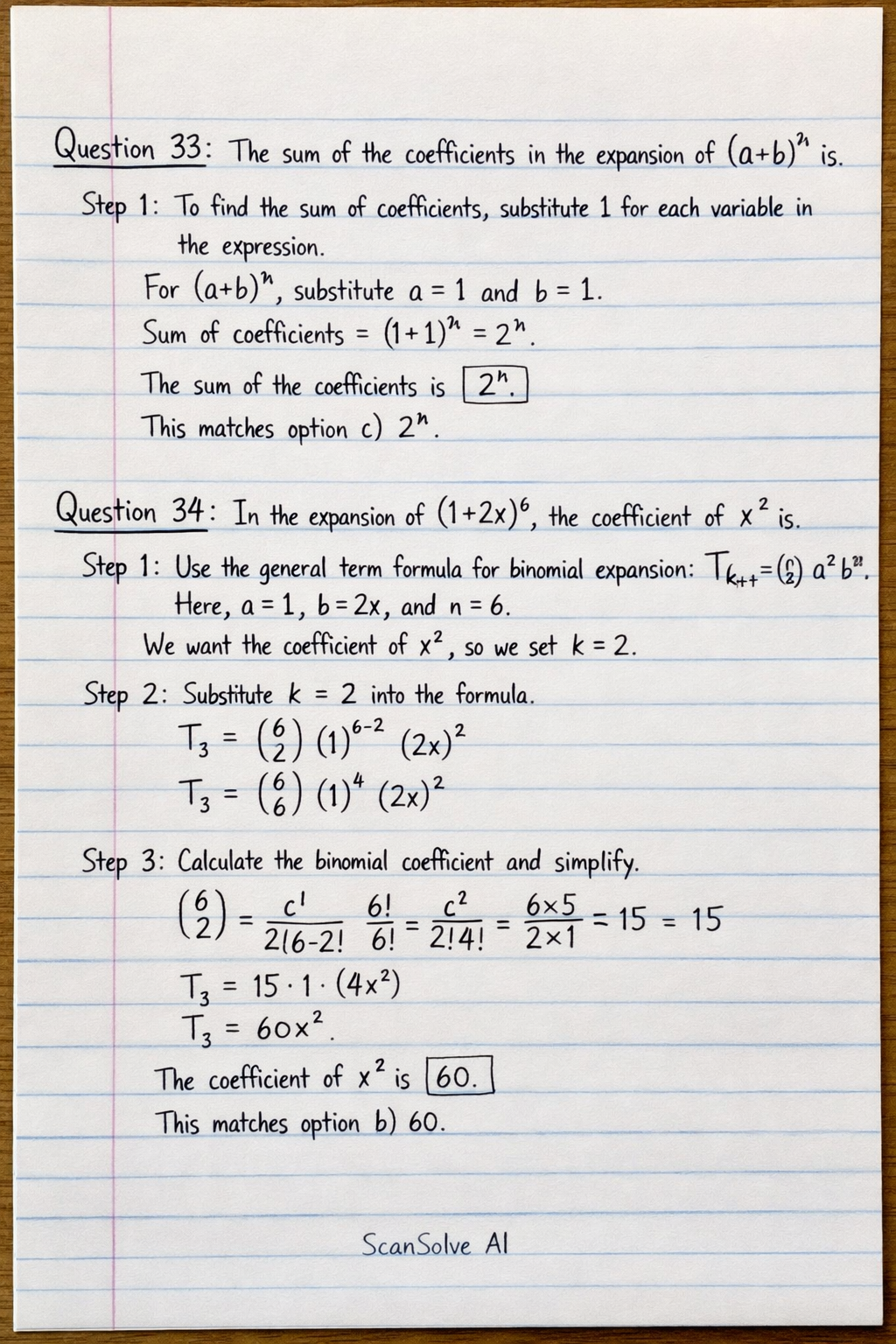
Handwritten Step-by-Step Solution
Get this as a handwritten image on WhatsApp — like a tutor wrote it for you.
Try on WhatsApp