
We read your photo as:
Explain how to wire a three-phase supply to three single-phase sockets using an educational board.
ScanSolve AI Answer
Step-by-step solution
6 stepsthis educational board demonstrates how to distribute a three-phase supply to multiple single-phase switch sockets. Here are the steps for wiring such a setup:
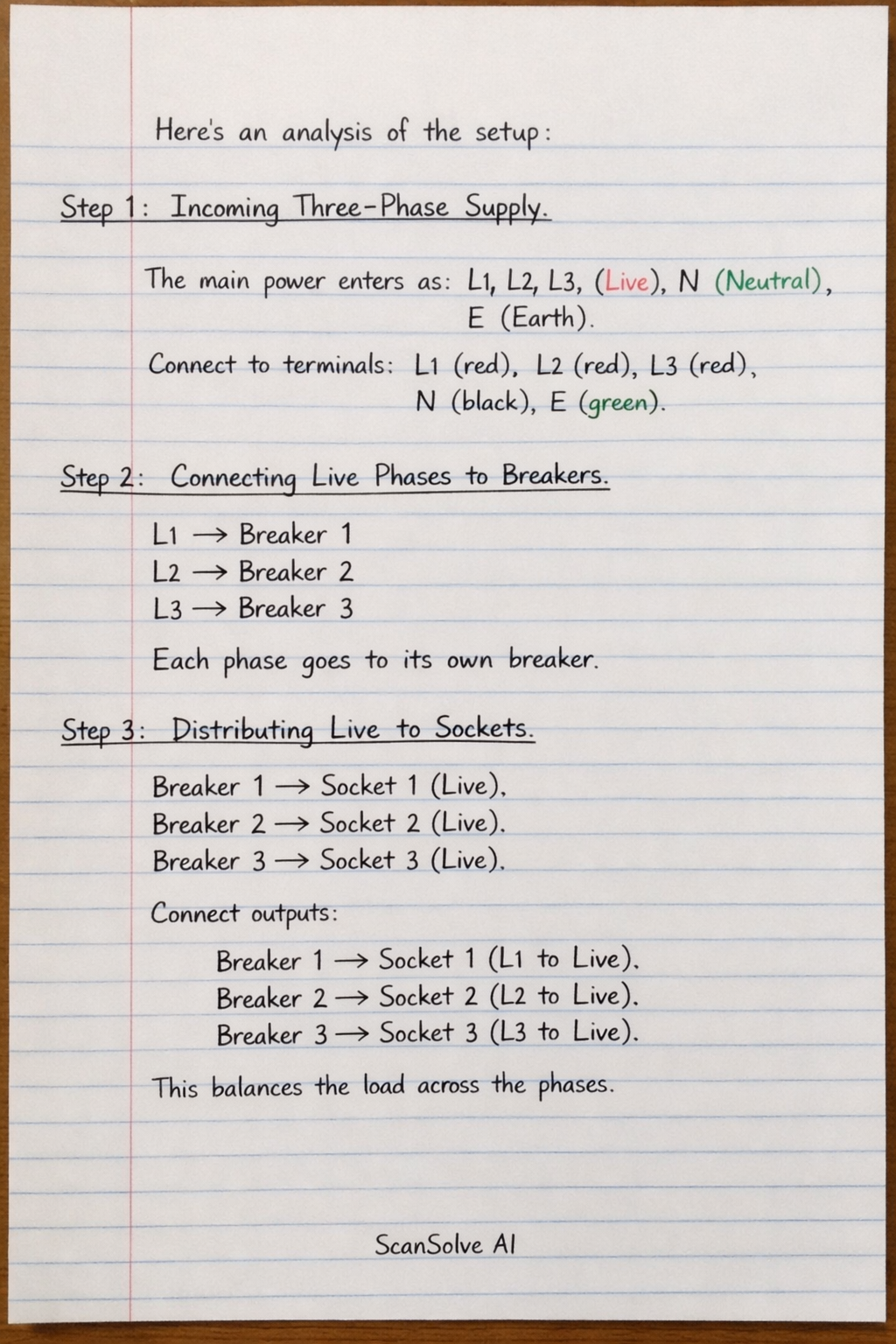
Incoming Three-Phase Supply
The main power enters the board with three Live phases (L1, L2, L3), one Neutral (N), and one Earth (E). On the board, these would connect to designated input terminals, often color-coded (red for Live, black for Neutral, green for Earth).
Connecting Live Phases to Breakers
Each of the three incoming Live phases (L1, L2, L3) is connected to the input terminal of a separate circuit breaker. This ensures that each individual socket circuit has its own overcurrent protection.
Distributing Live to Sockets
The output terminal of each circuit breaker is then connected to the Live terminal of one of the three switch sockets. For example, the output of the breaker connected to L1 goes to Socket 1's Live, L2 to Socket 2's Live, and L3 to Socket 3's Live. This balances the load across the three phases.
Connecting Neutral to Sockets
All the Neutral terminals of the three switch sockets are connected together to a common Neutral Bar. This Neutral Bar is then connected to the main incoming Neutral supply.
Connecting Earth to Sockets
All the Earth terminals of the three switch sockets are connected together to a common Earth Bar. This Earth Bar is then connected to the main incoming Earth supply, providing a safety path for fault currents.
Testing and Operation
Once wired, each socket can be used to power a single-phase appliance. The circuit breakers protect each socket individually, and the Earth connection ensures safety.
Still stuck on this one?
Ask a follow-up, and the answer starts from this question.
More Computer Science Questions
Handwritten Step-by-Step Solution
Get this as a handwritten image on WhatsApp — like a tutor wrote it for you.
Try on WhatsApp