
We read your photo as:
Trace the execution of the following C code and determine its output: int x = 10; int y = ++x; x = y--; printf("%d %d", x, y);
ScanSolve AI Answer
Answer
Use the left and right arrow keys to trace the curve, up and down to jump between key points, and plus and minus to zoom.
| Point | x | y |
|---|---|---|
| x-intercept | 0 | 0 |
Step-by-step solution
4 stepshere's the trace out put for the given C code:
Initialize variables.
An integer variable
xis initialized to 10.
An integer variableyis declared.- Initially: , is undefined.
Evaluate
y = ++x;.The
++xis a pre-increment operator. This meansxis incremented first, then its new value is assigned toy.xbecomes .yis assigned the new value ofx, so .- After this step: , .
Evaluate
x = y--;.The
y--is a post-decrement operator. This means the current value ofyis assigned toxfirst, thenyis decremented.- The current value of
y(11) is assigned tox, so . - Then,
yis decremented, so becomes . - After this step: , .
- The current value of
Print the final values.
The
printf("%d %d", x, y);statement prints the integer values ofxandyseparated by a space.- The value of
xis 11. - The value of
yis 10.
The output will be:
- The value of
Try one yourself
A new problem that tests the same skill.
Still stuck on this one?
Ask a follow-up, and the answer starts from this question.
More Computer Science Questions
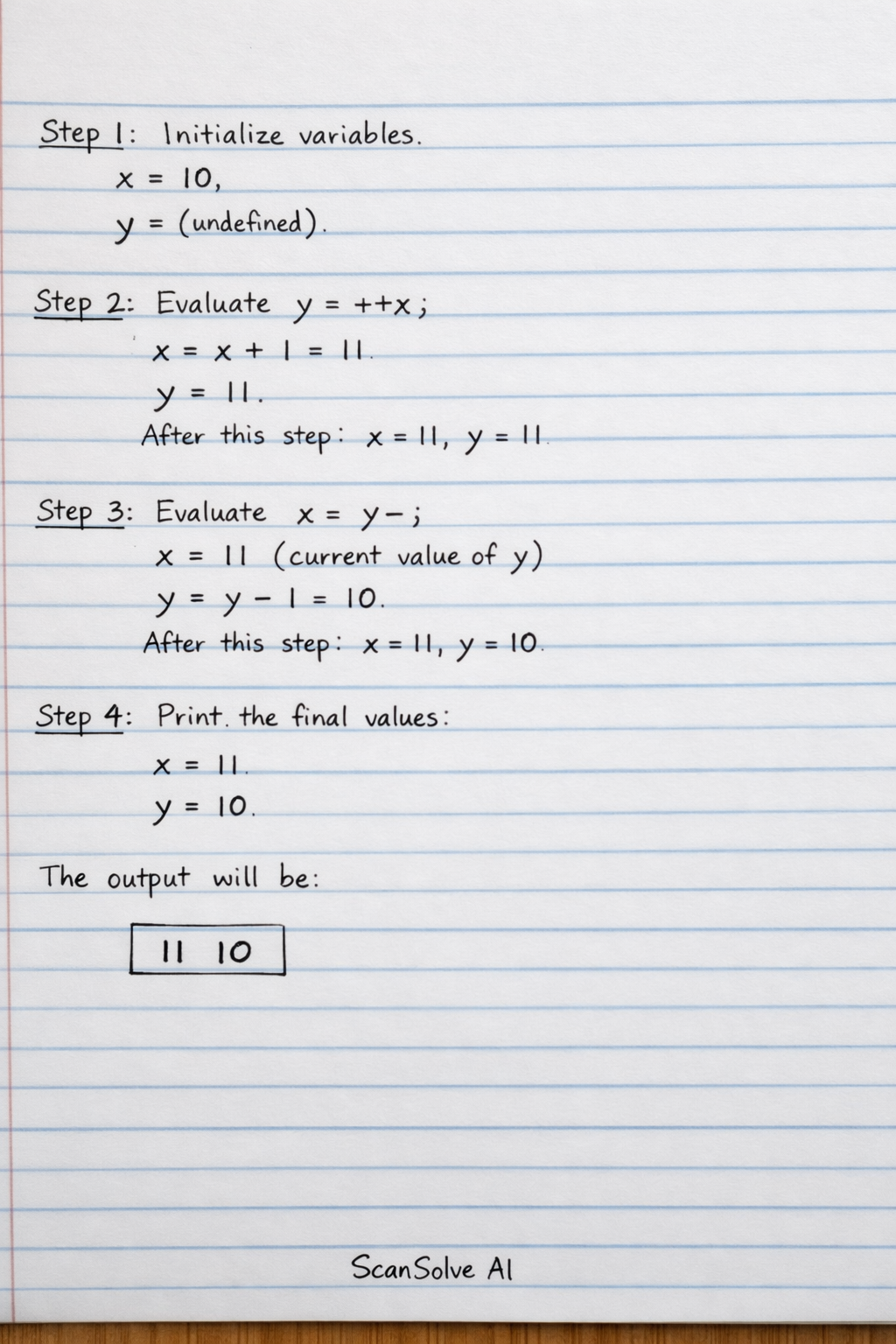
Handwritten Step-by-Step Solution
Get this as a handwritten image on WhatsApp — like a tutor wrote it for you.
Try on WhatsApp